

Global Entry, TSA PreCheck and CLEAR solve different airport queues at very different prices. We compare 2026 fees, application times, family rules and which programme actually earns its keep.
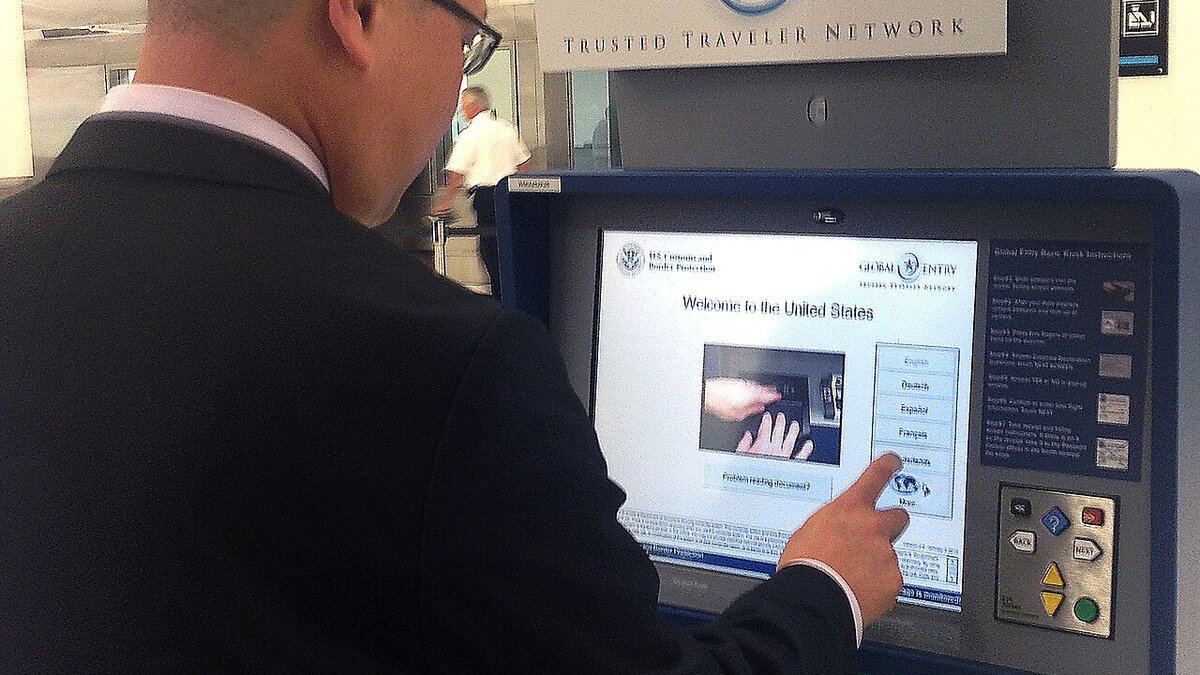
Cover image: Traveller using a CBP Global Entry kiosk under a Trusted Traveler Network sign — photo by U.S. Customs and Border Protection, Public domain, via Wikimedia Commons.
The short answer to the Global Entry vs TSA PreCheck vs CLEAR question has not changed for 2026, but the prices have. If you leave the United States even once a year, Global Entry is the best value of the three: it costs $120 for five years, speeds up immigration and customs on the way home, and includes full TSA PreCheck membership at no extra charge, per US Customs and Border Protection (CBP). If you only fly domestically, standalone TSA PreCheck now starts at $76.75 for five years, depending on which enrolment provider you use.
CLEAR is the outlier. It is a private subscription, not a government vetting programme, and its list price jumped to $219 a year on 1 July 2026 — more than nine times the annualised cost of Global Entry. For most travellers it only makes sense as an add-on to PreCheck, and ideally one somebody else pays for. Here is how the three compare on fees, benefits and approval times, all verified against official TSA, CBP and CLEAR pricing in August 2026.
What does TSA PreCheck actually get you?
TSA PreCheck is the Transportation Security Administration's expedited screening programme for low-risk travellers at US airport security checkpoints. Members use a dedicated lane and keep shoes, belts and light jackets on, and laptops and compliant liquids in the bag. TSA says most PreCheck passengers wait under 10 minutes; the programme works at more than 200 US airports across roughly 90 airlines.
Pricing now varies by enrolment provider. A new five-year membership costs $76.75 through IDEMIA, $79.95 through CLEAR or $85 through Telos, according to TSA's own PreCheck pages. Renewals are cheaper still — $58.75 online with IDEMIA ($66.75 in person) or $70 with Telos. Enrolment is quick: apply online, then complete a roughly 10-minute in-person visit for fingerprints and identity verification, with hundreds of enrolment locations nationwide.
The family rules are generous. Per TSA, children aged 12 and under can use the PreCheck lane free with an enrolled parent or guardian, with no sign-up needed. Teenagers aged 13–17 can also join you when they are on the same airline reservation and the PreCheck indicator shows on their boarding pass.
What is Global Entry, and why does it include PreCheck?
Global Entry is CBP's Trusted Traveler Program for expedited entry into the United States. Instead of the standard immigration queue, members use Global Entry portals or the touchless lanes at major airports — at most large hubs the process is now a quick facial-recognition capture with no passport scan or paper receipt. It also smooths re-entry for travellers who visit the US under the Visa Waiver Program alongside an approved ESTA, since several partner countries' citizens can apply.
The fee is $120 for five years, and — this is the number that settles most comparisons — every Global Entry member gets TSA PreCheck included. Your Known Traveler Number works for domestic security exactly as a standalone PreCheck membership would. Annualised, that is $24 a year for both border and security benefits, versus roughly $15–17 a year for PreCheck alone.
Families got a meaningful break here too. Since CBP harmonised its Trusted Traveler fees in October 2024, minors under 18 pay no application fee when they apply with a parent or legal guardian, or when a parent or guardian is already a member. Note that unlike PreCheck, children do still need their own Global Entry membership to use the arrival lanes — the fee is simply waived.
What does CLEAR do differently?
CLEAR Plus does not change the physical screening at all. It replaces the ID-check stage at the front of the security queue: a CLEAR ambassador verifies your identity by iris or fingerprint at a pod, then escorts you past the document-checking line straight to screening. If you also hold PreCheck, you are walked to the front of the PreCheck lane — the combination is genuinely fast at big, congested hubs.
The economics are harder to defend in 2026. CLEAR raised its list price to $219 a year from 1 July 2026, its second increase in two years, according to reporting by The Points Guy. Added family members cost around $125 each per year, and discounted rates exist for military members and government employees. Coverage is also narrower than the government programmes: CLEAR operates at around 60 US airports, concentrated at major hubs, so its value collapses if your home airport is not on the list.
CLEAR is also pushing biometrics beyond the checkpoint, part of the broader shift covered in our guide to biometric boarding and face recognition at airports.
Global Entry vs TSA PreCheck vs CLEAR: fees and what you get
| Programme | What it speeds up | Fee and term | Includes | Best for |
|---|---|---|---|---|
| TSA PreCheck | US security screening (dedicated lane; shoes, belts, laptops stay put) | $76.75–$85 for 5 years; renewals from $58.75 | Nothing else | Domestic-only US flyers |
| Global Entry | US immigration and customs on arrival, plus security via PreCheck | $120 for 5 years; minors free with a member parent | Full TSA PreCheck | Anyone flying internationally at least once a year |
| CLEAR Plus | The identity check at the front of the security queue | $219 per year (from 1 July 2026) | No government programme; pairs with PreCheck | Frequent flyers at big hubs, ideally with a card credit |
| NEXUS | US–Canada land, air and marine borders | $120 for 5 years | Global Entry benefits and PreCheck for eligible members | Regular US–Canada border crossers |
| SENTRI | US land-border entry from Mexico | $120 for 5 years | Global Entry benefits and PreCheck for US citizens and permanent residents | Regular US–Mexico land crossers |
How do you apply, and how long does approval take?
PreCheck is the fast one. Apply online with any of the three providers, book (or walk into) a brief in-person appointment, and TSA says most applicants receive their Known Traveler Number within days of enrolment.
Global Entry is a genuine background vetting process and takes longer. The sequence: create a Trusted Traveler Programs account, submit the application and $120 fee, wait for conditional approval, then complete an in-person interview. Conditional approval commonly arrives within weeks, but applications flagged for manual review can sit for months, and in 2026 interview appointments at major hubs such as JFK, LAX and SFO are frequently backlogged by several months. Realistic end-to-end planning: anywhere from a few weeks to close to a year.
Two proven shortcuts:
- Enrollment on Arrival — conditionally approved applicants can complete the interview with a CBP officer when landing from any international trip at a participating US airport, no appointment needed. This is the single best way to dodge the backlog.
- Hunt smaller enrolment centres — regional airports and land-border offices often have appointments within four to eight weeks, and cancellations appear daily.
CLEAR, being private, enrols you in minutes at any airport pod: scan your documents, register your biometrics, done.
What about NEXUS and SENTRI?
Two CBP siblings are worth a look before you pay for Global Entry. NEXUS ($120 for five years, up from $50 in October 2024) is the joint US–Canada programme: dedicated lanes at the land border, expedited processing into both countries, and — for US and Canadian citizens and permanent residents — Global Entry benefits and TSA PreCheck included. Its historic price advantage is gone, but for anyone who drives to Canada it remains the most complete package sold at that price.
SENTRI ($120 for five years) covers expedited land entry from Mexico and likewise carries Global Entry and PreCheck benefits for US citizens and lawful permanent residents. Since the 2024 fee harmonisation, the honest advice is simple: all three CBP programmes cost the same, so pick the one matching your dominant border, and let the included benefits cover the rest.
Which one is worth it for you — and can credit cards make them free?
For most travellers the flowchart is short. Fly abroad at all? Buy Global Entry — the $120 covers everything PreCheck does plus arrival queues, and kids are free. Strictly domestic? Buy PreCheck through IDEMIA at $76.75. Add CLEAR only if it costs you little or nothing and you fly weekly through a CLEAR hub where document-check queues are long.
Then make someone else pay. Premium travel cards routinely reimburse these fees, one of the practical perks covered in our beginner's guide to travel credit cards and points:
- Global Entry / PreCheck ($120, typically once every four years): Chase Sapphire Reserve (also covers NEXUS), Capital One Venture X, Capital One Venture, and many airline co-brands.
- CLEAR Plus: The Platinum Card from American Express carries a statement credit of up to $219 per calendar year — raised in July 2026 to match the new price — on top of a Global Entry or PreCheck fee credit.
- Airline routes: Delta and United frequent flyers get discounted CLEAR rates, and top-tier elites often pay nothing.
One forward-looking note: identity is going digital on both sides of the checkpoint. TSA PreCheck Touchless ID — an opt-in facial-recognition check that replaces showing physical ID in the PreCheck lane — reached roughly 65 US airports by spring 2026, with TSA stating images are deleted within about 24 hours of departure. Paired with CBP's portal-free Global Entry arrivals, the queue-skipping premium these programmes sell is steadily becoming the default airport experience, a trend we track in our report on digital travel credentials and passport-free travel. Until it is, $120 every five years remains one of the cheapest hours-saved purchases in travel.
Frequently asked questions
Does Global Entry include TSA PreCheck?
Yes. Every approved Global Entry member receives full TSA PreCheck benefits at no extra cost, per CBP. Enter your PASSID (from the back of your Global Entry card or your Trusted Traveler account) as the Known Traveler Number on airline bookings and the PreCheck indicator prints on your boarding pass. There is no reason to buy both.
Is CLEAR worth it if you already have TSA PreCheck?
Usually only if you are not paying the full $219. CLEAR speeds up the identity check before screening, while PreCheck speeds up screening itself, so they stack — but at busy hubs the marginal saving is minutes. It becomes an easy yes with the Amex Platinum's up-to-$219 annual credit, airline elite discounts, or a home airport with chronically long document-check queues.
How long does Global Entry approval take in 2026?
Plan for weeks to many months. Conditional approval often arrives within a few weeks, but manually reviewed applications can take considerably longer, and interview slots at major-hub enrolment centres are backlogged well into the future. The fastest path is Enrollment on Arrival: once conditionally approved, complete the interview with CBP when landing from any international trip, no appointment required.
Do children need their own Global Entry?
Yes — every traveller using the Global Entry lanes needs a membership, including infants. The cost barrier is gone, though: since October 2024, minors under 18 pay no application fee when applying with a parent or legal guardian, or when a parent or guardian is already a member. For PreCheck, children 12 and under simply accompany an enrolled adult free.
Which credit cards cover these fees?
Chase Sapphire Reserve, Capital One Venture X and Capital One Venture all reimburse a Global Entry or TSA PreCheck application fee (up to $120, typically once every four years); Sapphire Reserve also covers NEXUS. For CLEAR Plus, the American Express Platinum Card offers up to $219 in statement credits per calendar year, effectively making the membership free.
Sources
- TSA — TSA PreCheck
- TSA — TSA PreCheck for Families
- US Customs and Border Protection — Global Entry
- Federal Register — Harmonization of the Fees and Application Procedures for the Global Entry and SENTRI Programs
- The Points Guy — Clear hikes membership fee for 2nd year in a row
- American Express — CLEAR Plus Membership Travel Benefit






Post a comment