

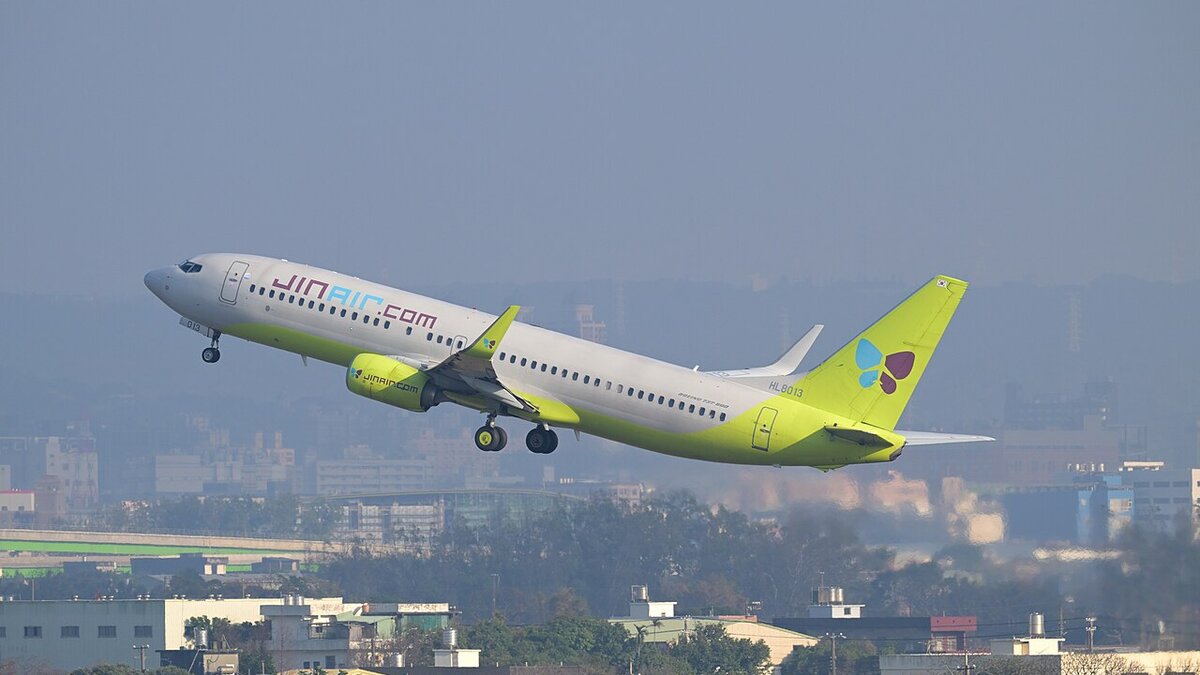
Korean Air's three budget carriers signed a merger agreement on 21 August, creating a unified Jin Air with about 59 aircraft from 17 March 2027 — overtaking Trinity Airways as South Korea's largest low-cost airline.
Cover image: Jin Air Boeing 737-800 with lime-green tail taking off — photo by 4300streetcar, CC BY 4.0, via Wikimedia Commons.
The Jin Air, Air Busan and Air Seoul merger moved from plan to contract on Friday 21 August, when the boards of all three South Korean budget carriers approved the deal and signed a formal merger agreement, according to UPI and the Korea Herald. The combined airline — to operate under the Jin Air name — is scheduled to launch on 17 March 2027, pending shareholder votes in December and regulatory sign-off under South Korea's Aviation Business Act.
The unified carrier will field roughly 59 aircraft — 32 from Jin Air, 21 from Air Busan and six from Air Seoul, per UPI (the Korea Herald counts 58 as of end-2025) — vaulting past Trinity Airways, the former T'way Air, whose 48 jets currently make it the country's largest low-cost carrier by fleet size.
What was announced?
Under the agreement, Jin Air is the surviving entity: it absorbs the assets, liabilities, rights, obligations, employees and legal status of Air Busan and Air Seoul. The Seoul Economic Daily reports the merger ratio was fixed at 1 : 0.2862684 : 0.7501939 for Jin Air, Air Busan and Air Seoul respectively, in line with Korean valuation rules.
The remaining steps are:
- December 2026 — extraordinary shareholder meetings at all three airlines to ratify the merger.
- Winter 2026–27 — merger approval under the Aviation Business Act, plus a Ministry of Land, Infrastructure and Transport safety inspection so the enlarged carrier can operate on a single air operator certificate.
- 17 March 2027 — the unified Jin Air begins flying.
Jin Air says the combination is designed to pool the three carriers' routes, fleets and people to achieve economies of scale — the classic lever in how low-cost airlines make money, where unit costs fall as aircraft, crews and maintenance are standardised across a bigger operation.
Why are Korean Air's budget airlines merging?
The deal is the final consolidation step in the biggest restructuring in South Korean aviation history. Parent Korean Air completes its merger with Asiana Airlines on 17 December 2026, the Korea Herald reports — and Asiana brought its two budget subsidiaries, Air Busan and Air Seoul, into the Hanjin Group alongside Korean Air's own Jin Air. Three overlapping low-cost brands under one owner made little commercial sense; the LCC merger lands exactly three months after the full-service tie-up closes.
Integration work is already under way, including joint pilot and cabin-crew training, standardised operating manuals and, per the Seoul Economic Daily, a 22 billion won investment in an A321neo flight simulator and pilot-training infrastructure — a strong signal that Air Busan's and Air Seoul's Airbus jets will keep flying under the new certificate rather than being retired for fleet purity.
What happens to Air Busan and Air Seoul?
Both brands are absorbed into Jin Air, ending Air Busan's 18-year run as the hometown carrier of South Korea's second city and Air Seoul's decade as Asiana's boutique budget arm.
| Carrier | Fleet | Main base | Heritage |
|---|---|---|---|
| Jin Air | 32 | Seoul Incheon / Gimpo | Korean Air subsidiary, Boeing 737 family |
| Air Busan | 21 | Busan Gimhae | Former Asiana affiliate, Airbus A320 family |
| Air Seoul | 6 | Seoul Incheon | Former Asiana subsidiary, Airbus A321 |
The sensitive question is Busan. Air Busan is the anchor tenant at Gimhae International Airport, and losing a locally branded carrier has long worried the city's business community. Jin Air has addressed this directly, telling Korean media it will strengthen networks in both the Seoul metropolitan area and the Yeongnam region by linking its Incheon and Busan operations, building up regional-airport competitiveness and adding new international routes. It also inherits a mixed Boeing 737 / Airbus A320-family fleet — operationally more complex than a single-type LCC, but one that lets it right-size aircraft to thinner regional routes from Gimhae as well as trunk routes from Incheon.
What does the merger mean for travellers and the market?
South Korea's LCC sector is crowded — CAPA counts eight domestic budget carriers plus 16 foreign LCCs serving the market, with low-cost airlines holding 51.7% of domestic seats in 2025. Consolidation into a 59-jet unified Jin Air versus Trinity Airways' 48 and Jeju Air creates a clear big-three structure, concentrated on the high-frequency Korea–Japan and Korea–Southeast Asia corridors where all three merging carriers overlap today. Demand on those routes remains strong: Japan set another monthly visitor record in July 2026, with South Koreans its largest inbound market.
For fares, the near-term picture is neutral — the three carriers already share an owner, so the merger formalises rather than removes competition — but fewer independent brands on overlapping city pairs typically hands surviving rivals pricing cover, something regulators will weigh during approval. The wider lesson is that LCC consolidation is now a global pattern, from Korea's big-three shake-out to Icelandair's deal with PLAY in Europe, as sub-scale budget carriers seek shelter in bigger balance sheets.
Frequently asked questions
When will Jin Air, Air Busan and Air Seoul merge?
The merger agreement was signed on 21 August 2026 after board approval at all three airlines. Shareholders vote at extraordinary meetings in December 2026, regulatory approval follows under South Korea's Aviation Business Act, and the unified Jin Air is scheduled to begin operating on 17 March 2027.
Will my Air Busan or Air Seoul booking still be valid?
The airlines have not published detailed passenger-transition policies yet. Legally, Jin Air succeeds to all rights and obligations of Air Busan and Air Seoul, which covers existing ticket contracts. Watch for official guidance on bookings, mileage and schedules closer to the March 2027 launch, and book directly where possible so change notifications reach you.
Will fares go up after the merger?
Not necessarily in the short term: all three carriers already belong to the Korean Air group, so head-to-head price competition between them was limited. The bigger fare question is market-wide — a three-way structure of unified Jin Air, Trinity Airways and Jeju Air concentrates capacity on Korea–Japan and Southeast Asia routes, which regulators will scrutinise during approval.
Who is South Korea's largest low-cost carrier now?
Trinity Airways — the rebranded T'way Air, whose largest shareholder since 2025 is hospitality group Sono Trinity — currently leads with about 48 aircraft. The unified Jin Air's roughly 59 jets would overtake it in March 2027, with Jeju Air the other major player in what becomes a big-three budget market.
Sources
- UPI — Jin Air, Air Busan and Air Seoul sign merger agreement
- The Korea Herald — Jin Air, Air Busan, Air Seoul to merge into single carrier by March 2027
- Seoul Economic Daily — Merged Jin Air to launch March 17
- The Asia Business Daily — Jin Air, Air Busan, and Air Seoul to merge; 'Unified Jin Air' launch set for next year
- The Korea Times — T'way Air rebrands as Trinity Airways following acquisition
- CAPA — Jin Air set to strengthen its position in South Korea's LCC market after merger



Post a comment