

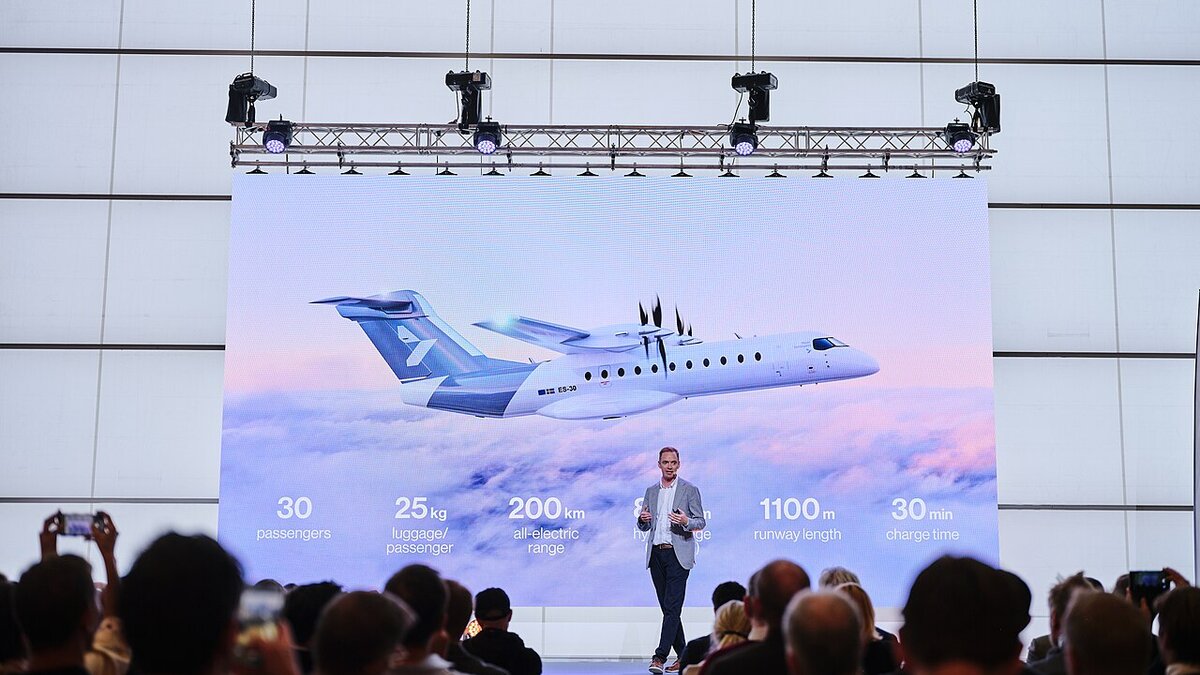
Heart Aerospace's 25,000 lb X1 demonstrator flew 27 minutes at Plattsburgh, New York on 12 August — the largest battery-electric aircraft ever flown, and a key de-risking step for the 30-seat ES-30.
Cover image: Heart Aerospace presenter on stage unveiling the ES-30 electric aircraft and its specifications — photo by Patrik Tommy Olsson, CC BY-SA 4.0, via Wikimedia Commons.
Heart Aerospace flew its X1 technology demonstrator for the first time on 12 August 2026 at Plattsburgh International Airport in upstate New York — a 27-minute piloted flight that made the aircraft, at more than 25,000 pounds take-off weight with a 106-foot wingspan, the largest battery-electric aircraft ever flown. The all-electric propulsion system delivered more than one megawatt of power as the X1 climbed to roughly 1,100 feet, and the whole sortie consumed about $5 worth of electricity, according to the company.
The flight matters because the X1 is a full-scale stand-in for the ES-30, Heart's 30-seat hybrid-electric regional airliner targeted at entry into service around 2031, with commitments and interest from United Airlines, Air Canada and semi-private operator JSX. It is the first time anything approaching airliner scale has flown on batteries alone — and a useful moment to separate what has been proven from what has not.
What is the Heart Aerospace X1?
The X1 is a composite-airframe, all-electric demonstrator built by Heart Aerospace, the Swedish-founded manufacturer that relocated its headquarters from Gothenburg to Los Angeles in 2025. It measures 76 feet nose to tail, spans 106 feet, and received an FAA experimental-category airworthiness certificate in July 2026 ahead of the Plattsburgh campaign.
Crucially, the X1 is not a converted light aircraft. Previous electric first flights — trainers, air taxis, retrofitted Caravans — sat far below this weight class. Flying a clean-sheet machine of this size on battery power alone moves the argument from PowerPoint to flight data.
What did the 27-minute flight actually prove?
Three things, chiefly. First, that a megawatt-class electric powertrain — motors, inverters, thermal management and batteries — can work together reliably at airliner scale in real flight conditions. Second, that the energy economics at the small end of aviation are startling: about $5 of electricity for a 27-minute flight, against the jet fuel costs that remain airlines' largest single expense. Third, that the FAA is prepared to let this class of aircraft fly, an early signal for the certification road ahead.
The initial test envelope is deliberately modest — up to 140 knots and 2,000 feet above ground, per reporting on the campaign — and will expand through further flights at Plattsburgh as Heart gathers data on handling, batteries and systems.
How does the X1 compare with the ES-30?
The production aircraft will differ in one fundamental way: it is a hybrid. The ES-30 pairs two inboard electric motors with two turboprop engines that can burn conventional fuel or sustainable aviation fuel, extending range well beyond what batteries alone allow.
| Spec | X1 demonstrator | ES-30 (planned) |
|---|---|---|
| Propulsion | All battery-electric, 1 MW+ | Hybrid: 2 electric motors + 2 turboprops |
| Seats | Demonstrator (no passengers) | 30 |
| Wingspan / length | 106 ft / 76 ft | Similar full-scale geometry |
| Range | Test flights only | ~124 mi electric / ~497 mi hybrid |
| Key dates | First flight 12 Aug 2026 | Flight tests 2028, service ~2031 |
What are the honest limits of battery-electric flight?
Batteries remain the binding constraint. Jet fuel holds roughly 50 times more energy per kilogram than today's best aviation-grade lithium-ion cells, and unlike fuel, batteries do not get lighter as they discharge. That is why the ES-30's all-electric range is around 124 miles, stretching towards 497 miles only with the turboprops running — and why Heart abandoned its earlier all-electric 19-seater in favour of a hybrid.
Certification is the other hard yard. The ES-30 must clear FAA Part 25 — the same transport-category standard as a Boeing 737 — with novel propulsion for which detailed rules are still being written. As the protracted 737 MAX 7 certification shows, even conventional designs can slip by years; a 2031 target should be read as ambitious.
What could electric regional aircraft mean for routes and fares?
The commercial case rests on operating cost. Heart claims the ES-30 could cut operating costs by around 40 per cent versus legacy regional aircraft, driven by cheap electricity and simpler electric motors. If that survives contact with reality, thin short-haul routes abandoned by 50–70-seat regional jets could become viable again — the kind of city pairs United, Air Canada and JSX are eyeing, with customer commitments Heart values at $9.4 billion.
It would also arrive as the industry struggles with an ageing regional fleet and strained supply chain, leaving a genuine gap at the 30-seat end of the market. None of that lowers fares by 2027: the realistic scenario is a handful of sub-250-mile routes in the early 2030s, scaling only as batteries, charging infrastructure and certification mature.
Frequently asked questions
Was the Heart Aerospace X1 flight really a record?
Yes, by weight. At more than 25,000 pounds at take-off, the X1 is the largest aircraft ever flown on battery power alone, comfortably exceeding earlier electric demonstrators such as converted nine-seaters and air taxis. The 27-minute piloted flight took place on 12 August 2026 at Plattsburgh International Airport, New York, under an FAA experimental-category airworthiness certificate issued in July.
How far can electric planes fly today?
Not far. Battery energy density limits airliner-scale all-electric flight to short hops; Heart's production ES-30 targets roughly 124 miles on batteries alone. Its hybrid configuration, with two turboprops backing up two electric motors, extends that to nearly 500 miles. That is why every credible near-term electric airliner programme is regional, and most are hybrids rather than pure battery designs.
When will electric passenger planes enter service?
Heart Aerospace targets ES-30 flight testing from 2028 and entry into service around 2031, pending FAA Part 25 certification. That timeline is ambitious: transport-category certification of novel propulsion has no precedent, and even conventional aircraft programmes routinely slip. Other electric and hybrid developers target similar early-2030s dates, so the first paying passengers are realistically at least five years away.
Which airlines have committed to the ES-30?
United Airlines converted its earlier 100-aircraft intent for Heart's ES-19 to the ES-30, Air Canada is both an investor and prospective customer, and US semi-private carrier JSX has also signalled commitments. Heart values its total customer commitments at $9.4 billion, though these are largely orders of intent rather than firm, deposit-backed purchases at this stage.
Sources
- Heart Aerospace — Heart Aerospace Completes First Flight of World's Largest Electric Aircraft
- PRNewswire — Heart Aerospace Completes First Flight of World's Largest Electric Aircraft
- Aerospace Global News — World first: Heart Aerospace successfully flies the largest battery-electric aircraft
- Aerospace Manufacturing and Design — Heart Aerospace flies its X1 electric aircraft
- New Atlas — Heart Aerospace X1 Electric Demonstrator Makes Aviation History





Post a comment