

The FAA has awarded Air Space Intelligence a 12-year, $875 million contract to replace its legacy traffic-flow system with FMDS and a predictive AI layer called SMART, targeting first operations in fall 2026. Here is what it changes for delays — and what it cannot fix.
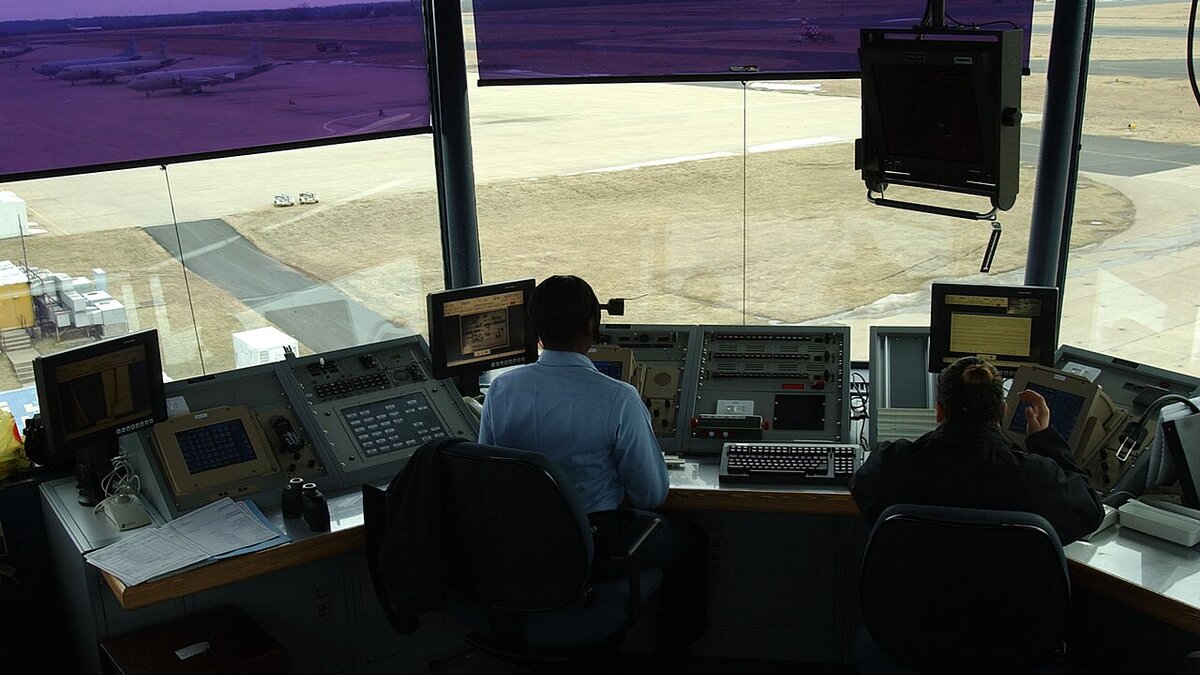
Cover image: Air traffic controllers monitoring flights inside a control tower cab — photo by U.S. Navy photo by Journalist 3rd Class David P. Coleman., Public domain, via Wikimedia Commons.
The Federal Aviation Administration is replacing the decades-old software that decides when America's flights wait on the ground. On 22 June 2026, the agency awarded Boston-based Air Space Intelligence (ASI) a 12-year, $875 million contract to build Flow Management Data and Services (FMDS), the new technological backbone of the FAA's Air Traffic Control System Command Center, the company announced. FMDS retires the legacy Traffic Flow Management System (TFMS) — and, more consequentially for passengers, adds a predictive layer called SMART (Strategic Management of Airspace, Routing, and Trajectories) designed to spot congestion before it turns into delay.
ASI, whose Flyways AI platform already runs in dispatch operations at Alaska Airlines, Delta and United, beat Palantir and Thales for the award, according to OAG. The FAA is targeting initial SMART operations in fall 2026, with full rollout over 12 to 24 months, per ASI. Administrator Bryan Bedford said FMDS and SMART will give controllers data-driven tools to "anticipate demand, balance capacity, and manage traffic before delays occur."
Why is your flight delayed when the sky is blue?
Most passengers assume delays happen where they can see them — a storm overhead, a missing crew. In reality, much delay is manufactured deliberately, hours earlier and hundreds of miles away, by traffic management initiatives (TMIs) issued from the FAA Command Center.
When forecast demand at an airport or airspace sector exceeds capacity — thunderstorms en route, low cloud at the destination, a closed runway, or simply too many scheduled arrivals in one hour — traffic managers delay aircraft at their departure airports to reconcile demand with arrival capacity, per NBAA guidance. That is why you can sit at a bone-dry gate in Phoenix because of weather over New Jersey. If the disruption cascades into a cancellation, it is worth knowing what airlines actually owe you when a flight is delayed or cancelled.
| Traffic management tool | What it does | What you experience |
|---|---|---|
| Ground stop | Halts departures to an affected airport until a set time | Boarding pauses; no departure estimate at first |
| Ground delay program (GDP) | Assigns each flight a controlled departure time to spread arrivals over hours | A specific new departure time, often in clear weather |
| Airspace flow program | Meters flights through a constrained chunk of en-route airspace | Delay or a longer routing around weather |
| Miles-in-trail / reroutes | Increases spacing between aircraft on a route | Slower taxi queues, airborne holding, extra flight time |
What do FMDS and SMART actually change?
Today's TFMS-era process is largely reactive: constraints are managed after they emerge, with critical data scattered across separate systems, screens and spreadsheets, as Forbes reported. FMDS pulls flight plans, airline schedules, real-time aircraft positions and capacity constraints into one cloud-based platform shared by the FAA and operators.
SMART then forecasts where demand will exceed capacity, so the system can act before aircraft leave the gate. In practice that should mean:
- Earlier, shorter interventions — a modest metering programme declared hours ahead instead of a blunt ground stop in the moment;
- Proactive reroutes agreed with airlines before departure, rather than airborne holding and diversions;
- Better airline decisions — carriers can swap aircraft, protect crew connections and rebook passengers before the delay exists, not after.
Transportation Secretary Sean Duffy said the tools will end up "slashing thousands of delays and cancellations in the process," per Forbes, which cites government studies putting the cost of US flight delays at $50–63 billion a year in today's money — more than half of it absorbed by passengers.
Can AI fix the air traffic controller shortage?
No — and the FAA does not claim it will. Prediction software can reduce self-inflicted congestion, but staffing remains a binding constraint: a facility short of certified controllers moves fewer aircraft, and that is a delay no algorithm can predict away. The Department of Transportation has hired a record 2,400 air traffic control staff since March 2025 — the highest staffing level in six years, Duffy said in April 2026, per Roll Call — but training a controller to full certification takes years, so staffing-driven flow restrictions will persist well into FMDS's deployment window.
OAG also flags unresolved governance questions: how SMART's recommendations will be tested, how transparent the FAA will be about why a flight is moved or rerouted, and who decides which flights absorb a constraint. Controllers, the FAA stresses, remain responsible for separating aircraft.
How does this fit the $12.5 billion ATC modernisation plan?
The FMDS award is one piece of a much larger rebuild. The budget reconciliation law signed in July 2025 (H.R. 1) gave the FAA a $12.5 billion down payment on a new air traffic control system — $4.75 billion for telecommunications, $3 billion for radar replacement, $1.9 billion for a new en-route control center and $1 billion for terminal-radar consolidation, per AOPA. Estimates cited by AOPA put the full modernisation at over $30 billion, and in April 2026 Duffy told reporters more money would be needed "for the software side of this build", with nearly half of the network's copper wiring already replaced by fibre, per Roll Call. The same wave of investment is reshaping airports themselves — see JFK's $19 billion New Terminal One, built around AI operations from day one.
Are airlines already using this kind of AI?
Yes — which is partly why the FAA picked a vendor from the airline world. ASI's Flyways has presented optimisation opportunities for 55% of Alaska Airlines' flights over a four-year partnership, delivering 3–5% fuel savings on flights longer than four hours and saving over 1.2 million gallons of fuel in 2023, according to Alaska Airlines. United's ConnectionSaver, launched in 2019, calculates when it is worth briefly holding a departure for late-running passengers — it saved roughly 40,000 connections within months of rollout, The Points Guy reported. On the commercial side, AI already sets many of the fares you pay — and airport check-in is following, with biometric boarding rolling out across major hubs.
Frequently asked questions
When will SMART start reducing delays?
The FAA is targeting initial SMART operations in fall 2026, with full deployment over the following 12–24 months, according to ASI. Benefits will build gradually as Command Center workflows move onto FMDS; travellers should not expect a visible difference this year.
What is the difference between TFMS and FMDS?
TFMS is the legacy system the FAA has used for decades to balance traffic demand against capacity, with data spread across multiple tools. FMDS consolidates that data into a single cloud platform and adds SMART, a predictive layer that forecasts congestion before departure.
Will AI replace air traffic controllers?
No. FMDS and SMART support strategic flow planning at the Command Center; human controllers remain responsible for separating aircraft. Controller staffing shortfalls are a separate constraint that software cannot solve.
Why was my flight delayed when the weather was fine?
Most likely a traffic management initiative: your destination or route had a forecast capacity problem, so the FAA assigned your flight a controlled departure time. The delay is taken on the ground, where it is cheaper and safer than airborne holding.
Sources
- PR Newswire — ASI Selected by FAA to Modernize the National Airspace System
- Forbes — FAA Bets $875 Million On AI To Reduce Flight Delays
- OAG — Airline AI's Real Battle Moves Below the Interface
- Roll Call — More air traffic control modernization funding needed, Duffy says
- AOPA — Where is the $12.5 billion for ATC modernization going?
- PR Newswire — Alaska Airlines renews partnership with Air Space Intelligence
- The Points Guy — United has saved 40,000 connections by holding flights
- NBAA — Ground Delay Programs explained


Post a comment