

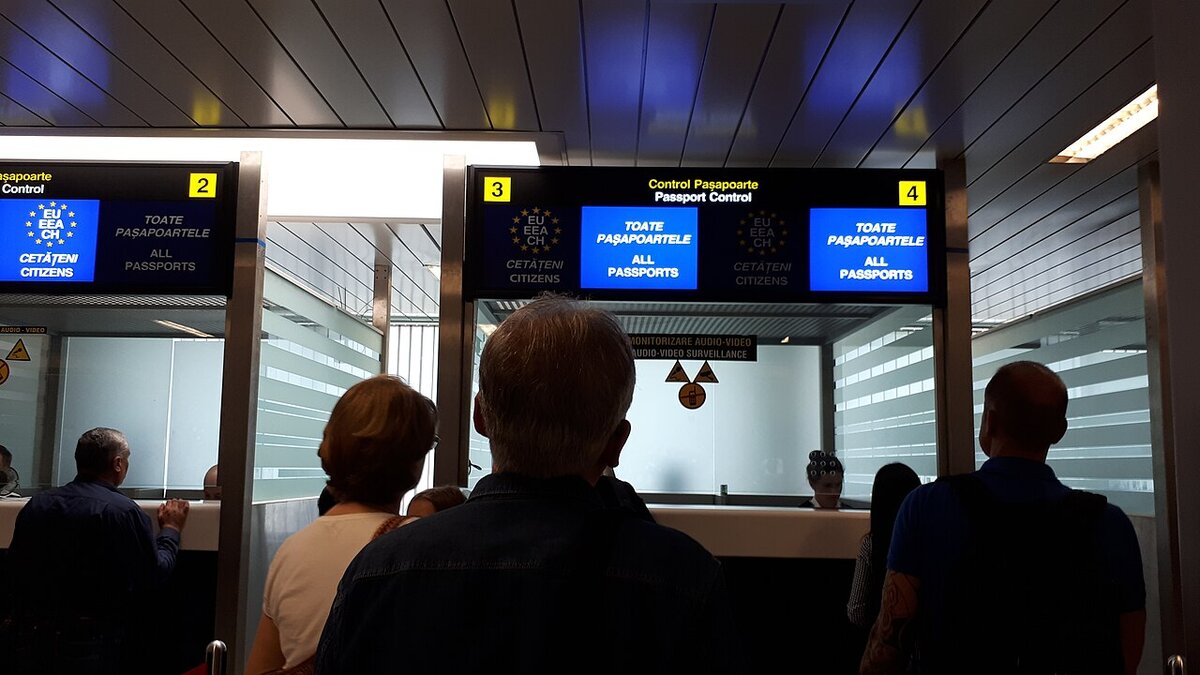
Peak EES border queues have reached five hours this summer, and hubs including Paris CDG, Schiphol, Frankfurt, Brussels and Milan are switching off biometric checks when crowds build. Why first-time registration jams borders, and how travellers can beat it.
Cover image: Travellers queuing at EU biometric passport control booths in airport — photo by Rakoon, CC0, via Wikimedia Commons.
Four months after the European Union's Entry/Exit System (EES) — the biometric border-registration scheme that replaced passport stamping across the Schengen area — became fully operational on 10 April 2026, EES border queues have become the defining story of the European summer. Peak waits of up to five hours have been reported at major hubs, with passengers missing connections and, in some cases, still queuing when gates closed. Euronews reports that Frankfurt's average July border wait doubled year-on-year to 120 minutes, Munich's rose from 31 to 60 minutes, and maximum waits at Amsterdam Schiphol climbed from 80 to 120 minutes.
The reason is arithmetic, not technology: the bottleneck is first-time biometric registration — fingerprints plus a facial image — and in year one of the system, most of the non-EU travellers arriving at any Schengen border still need one. The crush is now so severe that airports including Paris Charles de Gaulle, Amsterdam Schiphol, Frankfurt, Brussels and Milan have been temporarily switching off biometric collection when crowds build, according to reporting on 6 August. Air France-KLM has confirmed the practice at its Paris and Amsterdam hubs.
Why are EES queues so long?
EES logs every entry and exit by non-EU nationals across 29 European countries. Once a traveller is enrolled, the routine repeat check is quick — the European Commission puts the average at around 70 seconds, and insists the impact on non-EU travellers has been limited "in most cases". The problem is that a repeat check requires an existing record, and in the system's first summer almost every arriving American, Briton, Canadian or Australian is a first-timer.
First-time enrolment means capturing four fingerprints and a facial image alongside passport data — a process that can take several minutes per passenger even when kiosks behave. Multiply that across a wide-body arrival bank and the queue compounds fast. Industry bodies ACI Europe, Airlines for Europe and IATA have all demanded action from Brussels.
Which airports have the worst EES delays?
Euronews' July-on-July comparison shows how sharply waits have risen at German and Dutch hubs.
| Airport | July 2025 wait | July 2026 wait |
|---|---|---|
| Frankfurt (average) | 60 min | 120 min |
| Munich (average) | 31 min | 60 min |
| Amsterdam Schiphol (maximum) | 80 min | 120 min |
Paris CDG, Brussels and Milan round out the list of hubs pausing biometric capture when halls overflow. The worst delays hit large transfer hubs at peak arrival banks, when long-haul flights full of unregistered travellers land in waves.
What happens when airports switch off biometric checks?
The suspensions are legal. A derogation under Regulation (EU) 2025/1534 lets a member state suspend biometric collection at a specific crossing point for up to six hours at a time, renewable, when queues become unmanageable. Border guards revert to a shortened manual document check; the entry is still written to the central EES database and the 90-days-in-180 Schengen allowance still counts down.
The catch for travellers: if biometrics were switched off when you crossed, you may not have been enrolled — meaning on your next trip you are treated as a first-timer again and face the full registration queue once more. In year one, the derogation relieves today's queue partly by lengthening tomorrow's. It is one of several friction points in Europe's tightening web of tourist rules and fees this summer.
What about Dover and Eurotunnel?
The UK's juxtaposed borders are a special case. Coach passengers and freight drivers have gone through full biometric EES at Eurotunnel sites since October 2025, and coach traffic at Dover is fully enrolled too. But biometric capture for car passengers remains switched off at both crossings, with kiosks not expected to work before September 2026, The Local reports. Eurotunnel has reported typical delays of one to two hours during this manual-check phase, and Kent's Operation Brock contraflow is running on the M20 until 24 August. Inbound to Britain, a separate scheme applies — see our UK Electronic Travel Authorisation (ETA) explainer.
How can I get through EES faster?
- Arrive earlier than you think you need to. Treat two hours' margin on a Schengen connection as a minimum this summer.
- Use app or kiosk pre-enrolment where offered. Some airports and carriers let you pre-register biographic data before reaching the booth, cutting desk time.
- Fly off-peak. Late-evening arrivals and mid-week departures avoid the long-haul arrival banks where first-timer queues stack up.
- Keep documents ready and fingers dry — failed fingerprint reads are a common cause of kiosk time-outs.
- Expect it to improve. As the registered share of repeat travellers grows, more passengers drop to the ~70-second check — the same enrolment-once logic behind biometric boarding at airports.
One point of frequent confusion: EES is not ETIAS. ETIAS, the EU's €20 pre-travel authorisation for visa-exempt visitors, is a separate system that has not yet launched — see our ETIAS launch timeline update. Nothing about today's queues requires any advance application.
Frequently asked questions
How long does EES registration take?
First-time enrolment — fingerprints, facial image and passport data — can take several minutes per traveller, and it is this step that creates the queues. Once registered, the European Commission says the routine repeat check averages about 70 seconds.
What happens if biometric checks were suspended when I crossed?
Your entry is still recorded in the EES database and your 90-in-180-day allowance still runs, but you may not have been biometrically enrolled. If so, you will be treated as a first-time registrant on your next Schengen trip and should budget for the longer queue again.
Which airports have the worst EES queues?
Reporting in August 2026 named Paris Charles de Gaulle, Amsterdam Schiphol, Frankfurt, Brussels and Milan as hubs where biometric collection is temporarily deactivated when crowds build. Frankfurt's average July wait doubled year-on-year to 120 minutes, per Euronews; five-hour peaks have been reported at busy arrival banks.
Is ETIAS the same as EES?
No. EES is the biometric entry/exit register operating at the border now. ETIAS is a separate pre-travel authorisation for visa-exempt visitors, costing €20 and applied for online before departure; it launches later, in late 2026 or 2027. You do not need ETIAS to travel today.
Does EES apply at Dover and Eurotunnel?
Partially. Coach passengers and freight drivers have completed full biometric EES at Eurotunnel since October 2025, and coach traffic at Dover is enrolled. Biometric capture for car passengers is still switched off at both crossings and is not expected before September 2026, with manual checks causing one-to-two-hour delays meanwhile.
Sources
- Euronews — Europe's new border system is causing huge airport queues as EES wait times double
- heise online — Chaos at Schengen borders: Airports simply switch off EES biometrics
- TIME — What to know about the EU's new biometric entry system that's caused chaos at airports
- Biometric Update — EES rollout triggers delays, biometric suspensions at EU airports
- The Local — EES passport checks will not be fully implemented at Dover and Eurotunnel this summer





Post a comment