

Bangkok tops eDreams ODIGEO's most-booked city ranking for 2026, ahead of Paris and Rio de Janeiro — while Agoda data shows accommodation searches in Asia's secondary cities growing 15% faster than the region's established hubs.
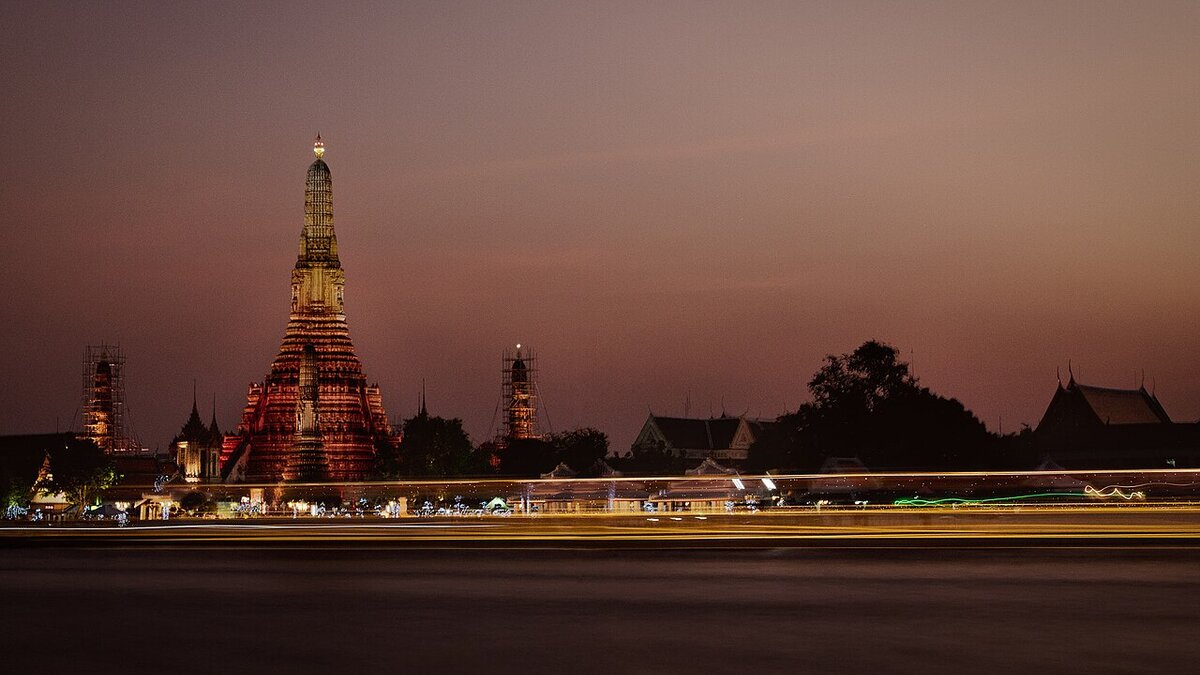
Cover image: Wat Arun temple rising over the Chao Phraya river at dusk in Bangkok — photo by Fernando Garcia, CC BY 3.0, via Wikimedia Commons.
Bangkok is the world's most booked city for 2026, according to booking data from eDreams ODIGEO, the European online travel group, which analysed reservations made for trips departing between 1 January and 31 December 2026. The Thai capital finished ahead of Paris and Rio de Janeiro — and, as Time Out noted in its coverage of the same dataset, Bangkok was both the most searched and most booked city on the platform.
Yet the region Bangkok anchors is quietly rebalancing. Agoda's 2026 Travel Outlook, published on 25 November 2025, found that accommodation searches in Asia's secondary cities grew 15% faster than in traditional tourism hubs over the past two years, and that second-tier destinations already accounted for 34% of all accommodation searches on the platform in the first half of 2025. "Secondary cities are no longer hidden gems. They're becoming the engine of travel growth across Asia," said Andrew Smith, Agoda's senior vice president of supply.
The two datasets are not contradictory — they describe the same traveller. Bangkok remains the region's default gateway, while the growth curve bends towards Chiang Rai, Da Nang, Takamatsu and their peers. For the trade, the itinerary of 2026 increasingly starts in a mega-hub and ends somewhere smaller.
Why is Bangkok the most booked city in the world for 2026?
The eDreams ODIGEO ranking reflects actual reservations rather than aspiration, and Bangkok's fundamentals explain its lead: deep long-haul and low-cost connectivity through Suvarnabhumi and Don Mueang, hotel rates that undercut comparable global capitals, a street-food-to-fine-dining scene with global pull, and retail anchors from ICONSIAM to the EmDistrict.
Policy has helped. Thailand's 30-day visa-free entry regime keeps friction low for more than 90 nationalities, and the aggressive events calendar — concerts, festivals and sporting fixtures under the "Amazing Thailand" banner — gives repeat visitors fresh reasons to return.
| Rank | City | Country |
|---|---|---|
| 1 | Bangkok | Thailand |
| 2 | Paris | France |
| 3 | Rio de Janeiro | Brazil |
| 4 | Barcelona | Spain |
| 5 | Rome | Italy |
| 6 | London | United Kingdom |
| 7 | Madrid | Spain |
| 8 | Florianópolis | Brazil |
| 9 | Amsterdam | Netherlands |
| 10 | Marrakech | Morocco |
Most-booked cities for 2026 travel. Source: eDreams ODIGEO booking data, via Nation Thailand and Time Out.
What is driving the second-city boom across Asia?
Agoda's outlook, which draws on an October 2025 survey of 3,353 customers across nine Asia-Pacific markets, puts value first: 43% of travellers cite lower costs as their top reason for choosing a secondary destination, followed by local culture, promotions and outdoor activities. Ease of access matters intensely in emerging source markets — 91% of Indian, 89% of Filipino and 80% of Indonesian respondents said it shapes their willingness to try somewhere new, according to Agoda.
The clearest country case is Japan. Agoda data reported by TTG Asia in May 2026 shows year-on-year booking growth of 63% for Takamatsu, 44% for Matsuyama and 32% for Sendai — far outpacing Tokyo and Osaka, even as Japan's inbound market smashes records overall. Similar dispersal is visible elsewhere:
- Thailand: the Tourism Authority of Thailand is steering demand towards provincial cities such as Chiang Rai and Khon Kaen as part of its diversification push;
- Vietnam: Da Nang holds a top-five Agoda spot nationally with accommodation searches up 25% year on year, while Sa Pa ranks as Asia's fastest-growing destination on the platform and Phu Quoc searches are up 49%, per Agoda data reported by Hospitality Net.
Anti-crowd sentiment and algorithmic discovery reinforce each other: a second city that trends on short-form video can see demand materialise within a single season, while non-hotel supply — villas, apartments and boutique guesthouses — has grown steadily on Agoda since 2022.
How is Thailand's tourism recovery actually performing in 2026?
Bangkok's ranking lands against a softer national backdrop. Thailand received 17.36 million foreign visitors between 1 January and 18 July 2026, down 3.05% year on year, generating THB838.73 billion, according to Ministry of Tourism and Sports figures reported by Nation Thailand.
China remains the top source market at 2.86 million arrivals, ahead of Malaysia (2.25 million), India (1.31 million), Russia (1.06 million) and South Korea (631,777). Chinese volumes nonetheless remain far below the roughly 11 million peak of 2019 — which is precisely why the kingdom is leaning on Indian, Russian and short-haul demand, as we detailed in our analysis of Thailand's 2026 tourism push.
What does the hub-versus-second-city split mean for the trade?
For itinerary designers, the data argues for a barbell model: sell the hub for arrival, connectivity and marquee experiences, then route clients onward to a lower-cost secondary base for the balance of the trip. Margins are often better outside the hubs, where boutique and non-hotel inventory is commissionable and less rate-compressed.
Airlines and tourism boards are already building the plumbing. The new AirAsia–TAT partnership explicitly targets secondary-city route development and joint marketing to spread demand beyond Bangkok and Phuket. Agoda's Smith likewise pitches the shift as "real opportunity" for "the partners who move early" — hotel supply that plants a flag in an emerging destination before rates and competition catch up.
The risk to watch is infrastructure lag: second cities can absorb a viral demand spike faster than they can add rooms, airport slots and ground transport. Operators who lock in allotments early — and pair them with realistic transfer times — will own the category.
Frequently asked questions
Which report named Bangkok the most booked city for 2026?
The ranking comes from eDreams ODIGEO, the European online travel group, based on reservations made for trips between 1 January and 31 December 2026. Bangkok topped both bookings and searches, ahead of Paris and Rio de Janeiro.
How fast are Asia's secondary cities growing compared with major hubs?
According to Agoda's 2026 Travel Outlook, accommodation searches in secondary cities grew 15% faster than in traditional hubs over the past two years, and made up 34% of all searches on the platform in the first half of 2025. In Japan, bookings for Takamatsu rose 63% year on year.
Is Thailand's tourism up or down in 2026?
Slightly down. Arrivals reached 17.36 million by 18 July 2026, a 3.05% decline year on year, per Ministry of Tourism and Sports data. China is still the largest source market, but volumes remain well below the 2019 peak.
Which secondary destinations should agents watch in 2026?
Agoda's data points to Takamatsu, Matsuyama and Sendai in Japan, plus Da Nang, Sa Pa and Phu Quoc in Vietnam, while Thailand is actively promoting Chiang Rai, Khon Kaen and other provincial cities. Value, ease of access and social-media discovery are the common drivers.
Sources
- Nation Thailand — Bangkok tops eDreams ODIGEO list of most-booked cities for 2026
- Time Out — The top trending travel destinations for 2026
- Agoda — Agoda Unveils 2026 Travel Outlook Report: Key Trends for Industry Partners
- TTG Asia — Agoda 2026 Travel Outlook highlights rise of secondary destinations across Asia
- TTG Asia — Agoda highlights shifting Asian travel trends driving demand
- Hospitality Net — How Vietnam is redrawing the Southeast Asian tourism map
- Nation Thailand — Thailand's foreign tourist arrivals reach 17.36 million in 2026



Post a comment