

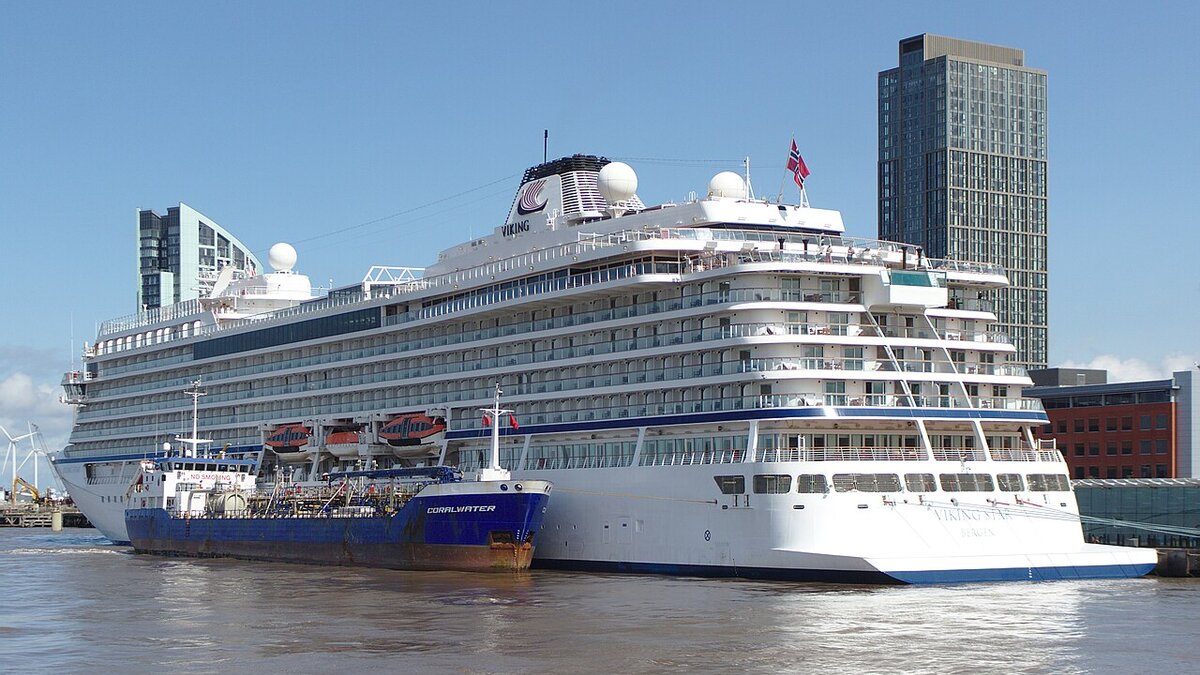
Viking has exercised options with Fincantieri for two more 54,300-ton, 998-guest ocean ships for delivery in 2032, taking its orderbook with the Italian shipbuilder to 28 vessels and doubling down on its small-ship strategy.
Cover image: Viking Star ocean cruise ship docked in port on a clear day — photo by Rodhullandemu, CC BY-SA 4.0, via Wikimedia Commons.
Viking's new cruise ships keep coming off the same blueprint. The cruise line has signed contracts with Fincantieri, Europe's largest shipbuilder, for two more ocean vessels for delivery in 2032, the companies announced on 20 August 2026. The order exercises options first announced in April 2025 and covers two 54,300-ton, 998-guest ships — the identical class Viking has been building for more than a decade — to be constructed at Fincantieri's Ancona yard on Italy's Adriatic coast. Fincantieri classes the deal as "large", its designation for agreements worth between €500 million and €1 billion, subject to financing and customary conditions. The contracts lift Viking's total orderbook and delivered-ship relationship with Fincantieri to 28 vessels, and follow two expedition-ship contracts signed earlier in 2026.
The announcement lands in a year when the industry's attention has been fixed on ever-larger hardware. As we examined in our look at the cruise ship size race and the economics of megaships, mainstream lines are competing on scale. Viking is running the opposite play — and its results suggest the play works.
How big are Viking's new ocean ships?
Deliberately not very. Each new ship measures roughly 54,300 gross tons with 499 staterooms for 998 guests — every one an outside cabin with a veranda. The design is adults-only (guests must be 18 or over), with no casinos or waterparks, and will incorporate the latest environmental, navigation and safety requirements.
Set against the industry's flagships, the contrast is stark:
| Metric | Viking ocean class | Royal Caribbean Icon class |
|---|---|---|
| Gross tonnage | 54,300 | ~248,700 |
| Guests (double occupancy) | 998 | ~5,610 |
| Cabin type | All outside, all veranda | Mixed, incl. interior |
| Onboard casino | No | Yes |
| Minimum age | 18+ | Family-focused |
Fincantieri's Ancona facility, which will build both vessels, has become the production home of the class. It delivered Viking Mira — the line's thirteenth ocean ship — for her maiden season in June 2026. "The agreement signed today marks another milestone in our long-standing partnership with Viking," said Fincantieri chief executive Pierroberto Folgiero, adding that Ancona "has proven to be an indispensable production hub."
Why does Viking keep ordering the same ship?
Fleet commonality is the quiet superpower of Viking's model. Because every ocean ship is a near-identical sister, crew can rotate between vessels without retraining, spare parts and provisioning are standardised, itinerary planners can swap ships freely, and shipyard series production compresses cost and delivery risk. Guests, meanwhile, know exactly what they are buying regardless of which hull they board.
The economics reward the discipline. Small, all-veranda, adults-only ships command premium per-diems from an affluent 55-plus demographic, and Viking reported $6.5 billion in revenue for 2025, up 22%, with 86% of its 2026 capacity already sold by early spring. Rather than chasing onboard spend from casinos and arcades — the revenue engine we unpacked in our guide to how cruise lines make money — Viking prices most of the experience into the fare and keeps the hardware simple.
Size also buys access. At 54,300 tons, Viking's ships can dock in central Venice-adjacent ports, tie up alongside in smaller Mediterranean and Baltic harbours, and transit waterways that are off-limits to 200,000-ton resorts — a destination-first logic carried over from the company's dominant European river cruise operation, which numbers more than 80 vessels.
What does the order mean for Fincantieri?
Series orders are precious to shipbuilders because they lock in yard utilisation years ahead with proven designs. The two 2032 ships extend Ancona's pipeline well into the next decade and stack on top of a Viking programme that already includes ocean ships on order through 2034 and two Polar Class 6 expedition vessels, contracted earlier in 2026, for delivery in 2030–2031.
Viking's relationship with the builder now spans 28 ships delivered or on order, including Viking Libra — under construction at Ancona and slated to become the world's first hydrogen-powered cruise ship. Across river, ocean and expedition segments, Viking said earlier this year it had 57 committed newbuild orders stretching to 2034.
What does this signal about cruise capacity through 2032?
The order confirms that the global orderbook is filling from both ends of the size spectrum. Yard slots at the big European builders are effectively spoken for into the early 2030s, which is why lines are contracting now for ships they will not sail for six years — a dynamic visible across this year's record slate of new cruise ship deliveries.
For the trade, the takeaway is capacity certainty: measured, premium small-ship growth of roughly 2,000 additional Viking berths in 2032, sold largely through advance bookings rather than discounting. In a market where megaship supply is expanding fast, Viking is betting that scarcity, consistency and destination access — not scale — will keep protecting its yields.
Frequently asked questions
How many new cruise ships has Viking ordered from Fincantieri?
The August 2026 contracts cover two ocean ships for delivery in 2032, exercising options announced in April 2025. They bring Viking's total relationship with Fincantieri — ships delivered plus ships on order — to 28 vessels, including two expedition ships contracted earlier in 2026.
How big are the new Viking ocean ships?
Each ship is about 54,300 gross tons with 499 staterooms carrying 998 guests, the same class Viking has built since 2015. Every cabin is an outside stateroom with a private veranda, and the ships are adults-only with no casinos.
Where will the new Viking ships be built?
Both vessels will be built at Fincantieri's shipyard in Ancona, on Italy's Adriatic coast, which delivered Viking Mira for her maiden season in June 2026 and is also building Viking Libra, planned as the world's first hydrogen-powered cruise ship.
Why does Viking build small ships instead of megaships?
Identical small ships give Viking fleet commonality — interchangeable crew, parts and itineraries — plus access to ports and waterways closed to megaships. Combined with premium all-inclusive-style fares aimed at travellers 55 and over, the model delivered $6.5 billion in 2025 revenue, up 22% year on year.


Post a comment