Royal Caribbean's Legend of the Seas has pushed the cruise industry into the 250,000-gross-ton era. Inside the unit economics driving ever-bigger ships, the ports fighting back, and the small-ship counter-trend reshaping itineraries.
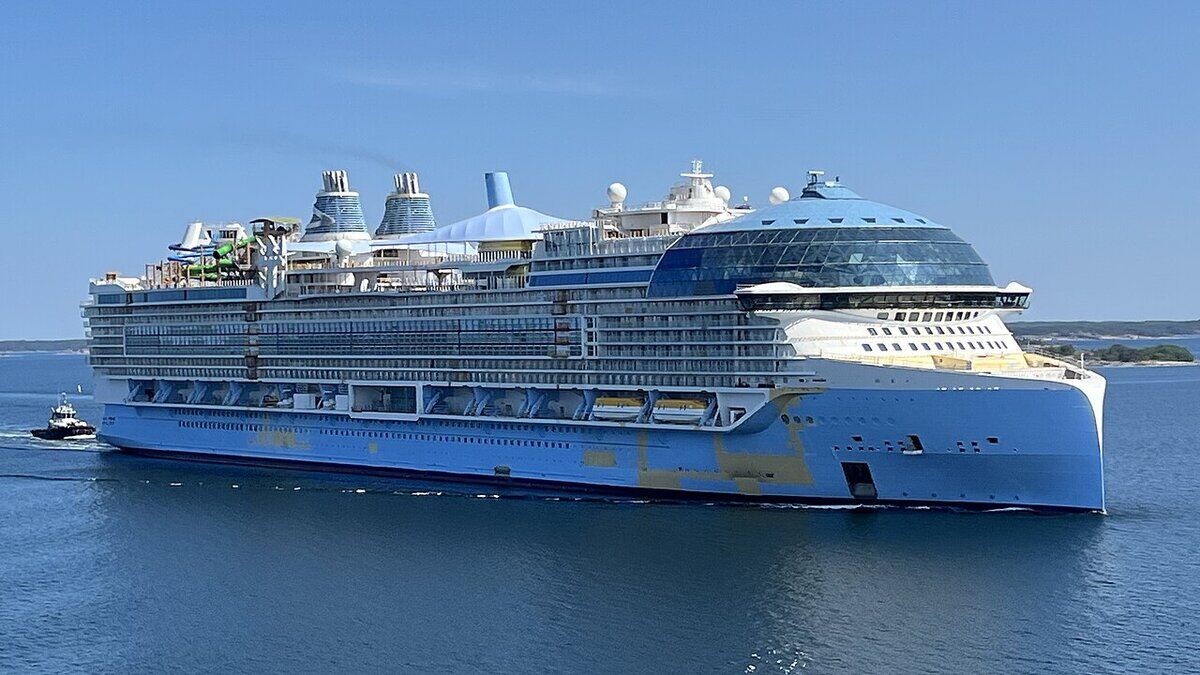
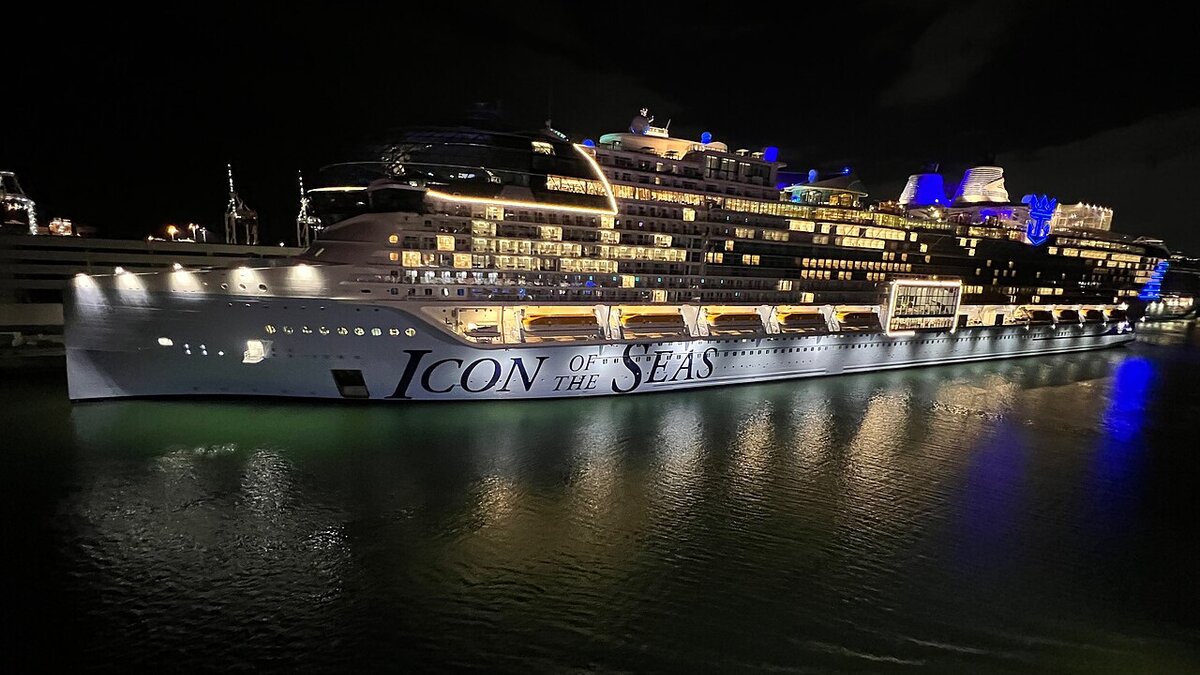
Cover image: one of the world's largest cruise ships at sea — photo by Kahunapule Michael Johnson, CC BY-SA 2.0, via Wikimedia Commons.
The world's biggest cruise ships have officially entered the 250,000-gross-ton era. On 4 July 2026, Royal Caribbean's Legend of the Seas carried its first paying guests on a seven-night Mediterranean maiden voyage from Civitavecchia, weeks after Finnish shipyard Meyer Turku handed over the third Icon-class vessel on 10 June. At roughly 250,800 gross tons and 1,197 feet long, Legend narrowly edges out sisters Icon of the Seas (debuted January 2024) and Star of the Seas (August 2025), each measured at 248,663 gross tons, to claim the title of largest cruise ship ever built. Every Icon-class ship carries 5,610 guests at double occupancy, up to about 7,600 at maximum, plus 2,350 crew. A fourth ship, Hero of the Seas, is due in 2027, with further orders stretching towards the end of the decade. The logic is brutal arithmetic: bigger hulls spread fixed costs over more berths and multiply onboard-spending venues. But the race is colliding with destination pushback, from Venice's outright ban on large ships to Santorini's 8,000-passenger daily cap, and it is feeding a fast-growing counter-market in small-ship and expedition cruising.
How big are the biggest cruise ships in 2026?
For scale, an Icon-class ship is nearly five times the gross tonnage of the Titanic and longer than three football pitches laid end to end. Each carries more than 40 restaurants, bars and lounges, seven pools and a 17-metre-tall waterfall, and runs on liquefied natural gas (LNG) with fuel cells supplementing onboard power, according to class specifications.
| Ship | Gross tonnage | Guests (double / max) | Debut | 2026 homeport |
|---|---|---|---|---|
| Legend of the Seas | ~250,800 GT | 5,610 / ~7,600 | July 2026 | Civitavecchia & Barcelona |
| Icon of the Seas | 248,663 GT | 5,610 / 7,600 | January 2024 | Miami |
| Star of the Seas | 248,663 GT | 5,610 / 7,600 | August 2025 | Port Canaveral |
Legend of the Seas is also the first Icon-class ship to homeport in Europe, spending summer 2026 on seven-night Western Mediterranean loops calling at Naples, Barcelona, Palma de Mallorca and Marseille before repositioning to Fort Lauderdale for the winter Caribbean season.
Why do cruise lines keep building bigger ships?
The answer is unit economics. Icon of the Seas cost an estimated $2 billion to build, per industry outlet Cruise Hive, which works out to roughly $355,000 per lower berth. But a hull, engines, bridge crew and port call cost broadly the same whether a ship carries 2,500 or 5,600 guests, so every additional cabin dilutes fixed cost per passenger.
Scale also transforms the revenue side. A megaship is a floating resort where the ship itself is the destination, and its 40-plus venues, waterparks, speciality restaurants and drink packages drive the onboard spending that underpins margins across the sector, a model we unpack in our guide to how cruise lines actually make money. Demand is there to fill the berths: CLIA reported a record 37.2 million passengers in 2025 in its 2026 State of the Cruise Industry report, part of a boom we track in the cruise industry's record-breaking 2026. The advantages compound:
- Lower cost per berth: fuel, crew, insurance and capital costs spread across more paying guests.
- More onboard revenue points: speciality dining, casinos, spas, shore-excursion desks and retail multiply with deck space.
- Pricing power for novelty: newest-and-biggest ships command premium fares in their debut seasons.
- Private-destination synergy: giant ships pair with line-owned islands and beach clubs, keeping spend in-house and avoiding congested ports.
Which destinations are pushing back against megaships?
The same scale that flatters a profit-and-loss statement overwhelms a historic port. Venice banned cruise ships over 25,000 gross tons from the Giudecca Canal and St Mark's basin in 2021, rerouting large vessels to the industrial port of Marghera and the Fusina terminal; no Icon-class ship will ever sail past the Doge's Palace. Santorini now caps cruise arrivals at 8,000 passengers per day under a berth-slotting system run by the local port fund, and for 2026 the calculation has tightened to assume ships arrive 100 per cent full, effectively squeezing out an additional large-ship call on busy days. Greece has also charged a €20 per-passenger "sustainable tourism fee" for peak-season disembarkation at Santorini and Mykonos since July 2025, reported by Euronews.
These measures are one front in a wider European reaction against visitor volumes, from Barcelona's doubled tourist tax to street protests in Spain, which we examine in our report on Europe's hardening overtourism backlash. For itinerary planners, megaships increasingly anchor their schedules on purpose-built or line-controlled destinations, while marquee old-world ports ration access by slot, fee or tonnage limit.
Is there a counter-trend towards smaller ships?
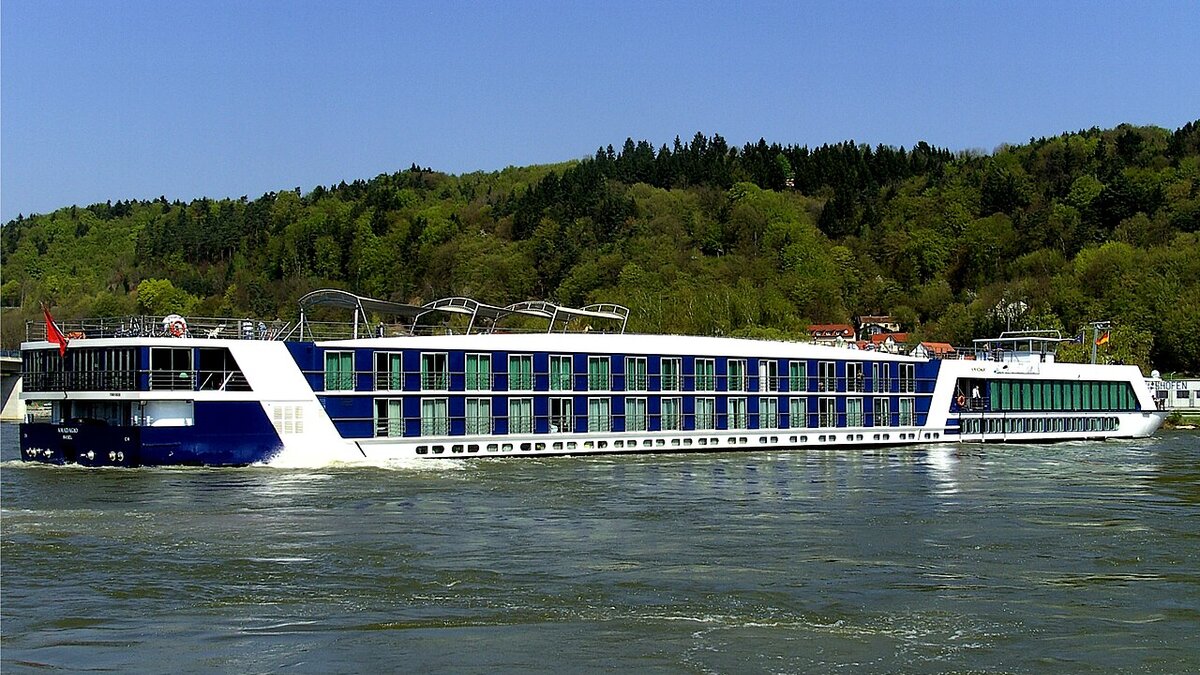
Yes, and it is growing precisely because of the megaship boom. CLIA's fleet data shows the global fleet split roughly into thirds between small, medium and large ships, and the small end is where much of the new-brand energy sits. Viking's expedition vessels Octantis and Polaris carry just 378 guests, MSC Group's luxury brand Explora Journeys adds Explora III in summer 2026, and Euronews reports that European cruise trends for 2026 favour smaller ships, longer port stays and secondary harbours as cities tighten access rules.
Small ships invert the megaship equation: the destination, not the vessel, is the product. They can reach ports and fjords that a 250,000-tonner physically cannot, and destination-led brands benefit directly from policies that penalise mass arrivals. The result is a barbell-shaped market: ever-larger resort ships at one end, premium-priced boutique and expedition vessels at the other, and the squeezed middle ageing out of major fleets.
Frequently asked questions
What is the biggest cruise ship in the world in 2026?
Royal Caribbean's Legend of the Seas, delivered in June 2026 and in service since 4 July 2026, is the largest cruise ship ever built at roughly 250,800 gross tons and about 1,197 feet long. It carries 5,610 guests at double occupancy and up to about 7,600 at maximum capacity.
Will cruise ships keep getting bigger?
Incrementally, yes: a fourth Icon-class ship, Hero of the Seas, is due in 2027, with further sisters ordered towards 2030. However, most observers expect size gains to plateau, because port infrastructure, destination caps and shipyard capacity all impose practical ceilings.
Do the biggest cruise ships still visit Venice and Santorini?
Not centrally. Venice bans ships over 25,000 gross tons from its historic waterfront, diverting large vessels to Marghera and Fusina, while Santorini limits cruise arrivals to 8,000 passengers a day and Greece charges up to €20 per passenger in peak season. Megaships instead favour large-capacity ports and line-owned private destinations.
Are megaships cheaper to cruise on than small ships?
Usually, per night. Economies of scale let lines price seven-night megaship sailings from a few hundred dollars per person while boutique and expedition ships often cost several times more. The trade-off is crowds: a full Icon-class ship moves nearly 10,000 people including crew.