Cruise lines earn roughly two-thirds of revenue from tickets and a third from high-margin onboard spending. Here is how casinos, drinks packages, excursions and private islands turn cheap-looking fares into record profits for the industry's big four.
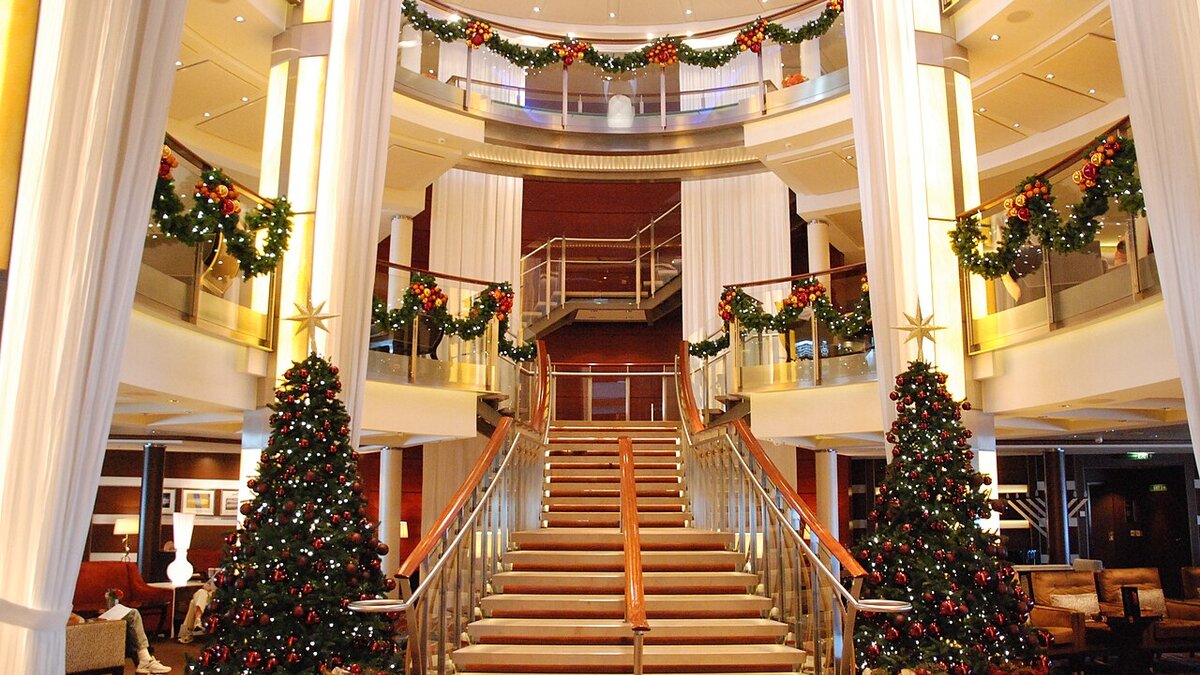
Cover image: grand atrium of a cruise ship — photo by Joe Ross from Lansing, Michigan, CC BY-SA 2.0, via Wikimedia Commons.
Cruise lines run a two-engine business: the ticket gets you on the ship, and the ship then becomes the shop. At Carnival Corporation & plc, the world's largest cruise group, passenger tickets generated about 65% of its record $26.6 billion revenue in fiscal 2025, while the remaining 35%, some $9.2 billion, came from onboard and other spending — casinos, bars, shore excursions, Wi-Fi, spas and shops — according to the company's 10-K filing. Royal Caribbean Group reported $17.9 billion in revenue and $4.3 billion of net income for 2025, with roughly 30% earned after passengers stepped aboard. The fare, in effect, is a customer-acquisition cost; the margin lives in what happens at sea. Layer on tax-light incorporation in Panama, Liberia and Bermuda, private islands that capture nearly every dollar spent ashore, and a market in which four groups — Carnival, Royal Caribbean Group, Norwegian Cruise Line Holdings and MSC Cruises — carry the overwhelming majority of the 37.2 million passengers who sailed in 2025 (per CLIA, the industry trade body), and the result is one of travel's most distinctive business models.
How much cruise revenue comes from tickets vs onboard spending?
The split is consistent across the industry: roughly two-thirds ticket, one-third onboard. Industry tracker Cruise Market Watch put the 2025 average at $193.46 per passenger per day in ticket revenue and $82.03 in onboard spending — about $286 a day in total per guest.
But the raw split understates how much profit depends on the second stream. Ticket revenue must cover fuel, food, port fees and crew payroll; onboard revenue arrives with far fatter margins, because the customer is already fed, housed and captive. Norwegian Cruise Line Holdings has reported gross onboard spend of $126.85 per passenger per day in mid-2024, up from $96.70 in 2019 — a rise of more than 30% that outpaced fare growth.
The scorecards below show how the model played out in 2025.
| Metric (FY2025) | Carnival Corporation & plc | Royal Caribbean Group |
|---|---|---|
| Total revenue | $26.6 billion (record) | $17.9 billion |
| Onboard & other share | ~35% ($9.2 billion) | ~30% |
| Net income | $2.8 billion ($3.1bn adjusted) | $4.3 billion |
| Flagship private destination | Celebration Key, Grand Bahama (opened July 2025) | Perfect Day at CocoCay, Bahamas (opened 2019) |
Why are cruise fares so cheap?
A seven-night Caribbean sailing can be advertised below the cost of a mid-range hotel week because the fare only needs to do one job: fill the ship. An empty cabin earns nothing onboard, so lines price aggressively to sail full and recover the margin later — the same ancillary logic that explains how low-cost airlines make money from bags and seat fees rather than the base fare.
Cruising has one structural advantage over both airlines and hotels: the guest cannot leave. Once aboard, every drink, bet, massage and dinner upgrade flows to the operator, whereas a hotel guest spends most of their budget in the surrounding city — one reason hotel room pricing has to work so much harder on the rate itself.
Increasingly, the sell starts before the ship does. Royal Caribbean executives said in 2025 that about half of all onboard spend is now booked before sailing, with three in four guests buying drinks packages, Wi-Fi or excursions pre-cruise — locking in revenue and smoothing demand.
What do cruise passengers spend money on once onboard?
The onboard till is spread across a dozen departments, but a few dominate:
- Casino gaming — typically the second-largest onboard revenue department. In international waters, ship casinos operate outside land-based gaming tax regimes, making a floating casino more profitable than one in Las Vegas or Macau.
- Bars and beverage packages — prepaid drinks deals convert uncertain bar takings into guaranteed revenue, and unused allowances are pure margin.
- Shore excursions — lines resell third-party tours at healthy mark-ups, and are shifting towards exclusive, higher-priced curated experiences booked via app.
- Specialty dining, spa, retail and Wi-Fi — steady per-diem earners that scale with ship size, which is a core reason megaships keep getting bigger.
Why are cruise lines building private islands?
Private destinations are the logical end-point of the capture-the-wallet model: a port day where the operator owns the beach, the bars, the cabanas and the waterpark. Royal Caribbean's Perfect Day at CocoCay in the Bahamas, opened in 2019, pioneered the format; Carnival answered with Celebration Key on Grand Bahama, opened in July 2025, and Royal Caribbean has a Mexican follow-up, Perfect Day Mexico, slated for 2027.
The economics stack up twice over. First, shore spending that would leak to local operators stays in-house. Second, Bahamas-centred itineraries are short and close to Florida homeports, cutting fuel burn — fuel runs at roughly 9% of a typical cruise line's costs, per Cruise Market Watch, so slow steaming between nearby stops directly widens margins. The concentration in the region does carry weather exposure, though forecasters expect a below-normal 2026 Caribbean hurricane season, a rare tailwind for itinerary planners.
Who owns the cruise industry, and why does the structure matter?
Four groups dominate global capacity: Carnival Corporation (brands including Carnival Cruise Line, Princess, Holland America, Costa and AIDA), Royal Caribbean Group (Royal Caribbean International, Celebrity, Silversea), Norwegian Cruise Line Holdings (Norwegian, Oceania, Regent Seven Seas) and privately held MSC Cruises. That concentration gives the majors pricing discipline, scale in shipbuilding orders and the balance sheets to fund $1 billion-plus private destinations.
The structure also includes a quieter advantage: the big operators are incorporated in Panama, Liberia and Bermuda and pay minimal corporate income tax on shipping profits under long-standing maritime rules. Combined with post-pandemic demand — CLIA logged a record 37.2 million passengers in 2025 and projects further growth in 2026 — that helped Carnival post record adjusted net income, regain investment-grade leverage metrics and reinstate its dividend in December 2025, its first since the pandemic.
Frequently asked questions
Do cruise lines make money on the ticket price alone?
Barely. Tickets cover most operating costs — fuel, food, crew, port fees — but the profit margin comes disproportionately from onboard spending. That is why lines would rather discount a fare heavily than sail with an empty cabin that earns nothing at the casino or bar.
Why is the casino such a big earner on cruise ships?
Ship casinos open in international waters, outside land-based gaming tax and licensing regimes, and serve a captive audience with time to spare. They are typically the second-largest onboard revenue department after beverages.
Are drinks packages actually profitable for cruise lines?
Yes. Prepaid packages convert unpredictable bar spending into guaranteed, upfront revenue, and most guests do not drink their full allowance. Around half of all onboard spend at Royal Caribbean is now committed before the ship leaves port.
Do cruise lines pay corporate tax like other travel companies?
Mostly not. The major groups are incorporated in Panama, Liberia and Bermuda, and long-standing international shipping rules exempt most of their operating income from corporate income tax in the countries where they sell cruises.