Thailand's 300-baht tourist entry fee never started. The plan has been revised to a proposed flat 450-baht fee, air arrivals first, which officials aim to collect from early 2027 if the Cabinet approves it. Nothing is payable yet.
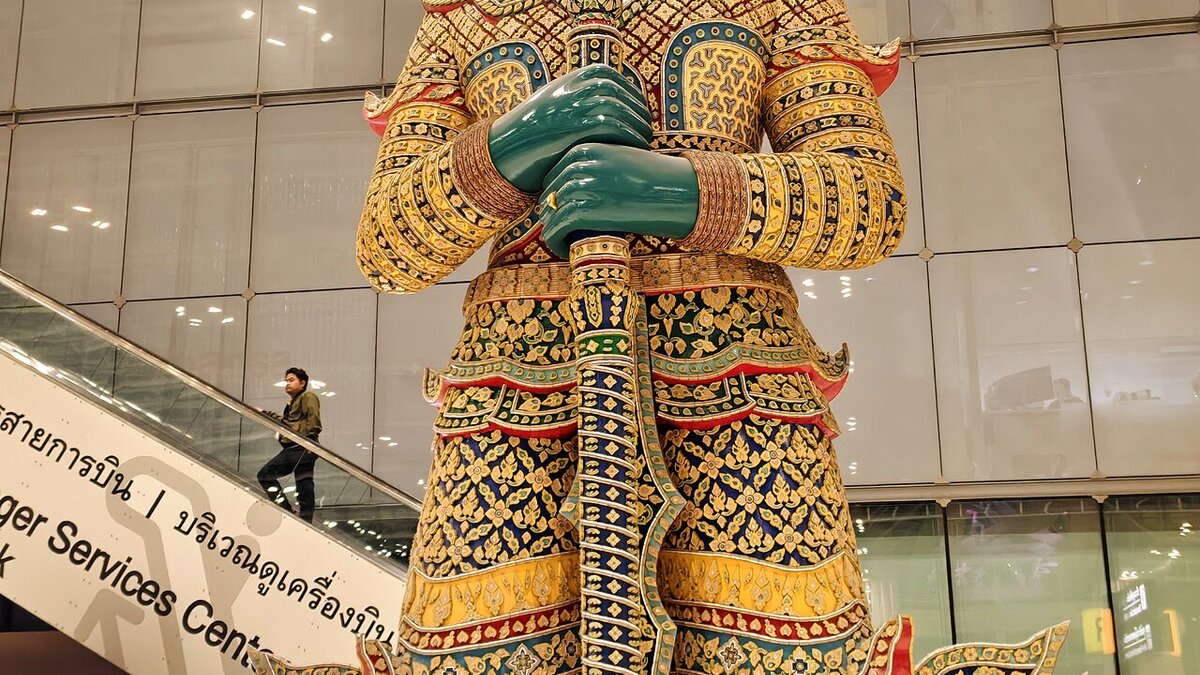
Cover image: green-faced Yaksha statue at Bangkok Suvarnabhumi Airport — photo by Suyash.dwivedi, CC BY-SA 3.0, via Wikimedia Commons.
Correction, 16 October 2026: an earlier version of this article, based on a January 2026 Chiang Rai Times report, said the fee would start in February 2026. No fee was introduced. The 300-baht plan has since been revised to a proposed 450-baht fee that has not been approved or collected, and this article has been updated throughout.
Thailand has not introduced the 300-baht tourist entry fee that some reports said would start in February 2026, and nothing is being collected from visitors. The Ministry of Tourism and Sports has instead proposed a flat 450-baht fee (about US$13.50) for foreign visitors, to be collected from air arrivals first. Officials are aiming for the first quarter of 2027, but the plan still needs Cabinet approval and publication in the Royal Gazette.
The levy, often called Kha Yeap Pan Din (a charge for stepping onto Thai soil), was approved in principle by the Cabinet in 2023 but repeatedly delayed. It never took effect: in August 2026 the plan was revised to a flat 450 baht, which has since been through an online public hearing and is now heading back to the National Tourism Policy Committee and the Cabinet. The fee is separate from the cut in visa-free stays to 30 days, which did take effect on 15 September 2026; the visa change is in force, the fee is not.
How much is the Thailand tourist entry fee and who must pay?
Under the current draft, every foreign visitor would pay a flat 450 baht per person, whether they arrive by air, land or sea, up from an earlier framework of 300 baht for air arrivals and 150 baht for land and sea entries. The ministry's study put an underlying cost-based rate above 490 baht, but the proposal was set at 450 baht to avoid overburdening visitors. The draft exempts royal guests and official guests of the government, holders of diplomatic and official passports, foreign nationals with work permits, border-pass holders, transit passengers, crew members and children under two. One payment would cover multiple entries and exits within 30 days while the linked insurance remains valid. These details can still change before the Cabinet decides.
The Government Public Relations Department puts 450 baht at about US$13.50. In an online public hearing that ran from 24 August to 28 September 2026, 80.50% of 5,954 respondents supported the draft and 78.30% supported the 450-baht rate, although charging the same rate for air, land and water arrivals remained a point of disagreement. Visitors who now pay nothing beyond their airfare to enter visa-free would face a new charge only if the plan is approved.
When does the Thailand entry fee start and how will it be collected?
No start date has been fixed. The National Tourism Policy Committee, chaired by Deputy Prime Minister and Commerce Minister Suphajee Suthumpun, endorsed the draft principles in August 2026. After the online hearing closed on 28 September, Tourism and Sports Minister Surasak Phancharoenworakul chaired a stakeholder meeting on 6 October, and the ministry's permanent secretary, Natthriya Thaweevong, said it still aims to start collecting in the first quarter of 2027, beginning with air travellers. In comments reported on 10 October, Ms Suphajee backed the 450-baht rate but told agencies to draw up detailed rules on collection, disbursement and use of the revenue before the proposal goes to the Cabinet. Under the draft, air collection would begin 180 days after the notification is published in the Royal Gazette, with land and sea collection about 360 days after that.
- Payment method not decided: the draft lists five channels: built into the airline ticket price, an official website, a mobile app, self-service kiosks at entry points, or another method approved by the fund's committee.
- By air: the government prefers adding the fee to airline tickets, and ticket-based collection was the most popular option in the public hearing (36.26% of respondents). Airlines have been reluctant, because their systems would have to tell liable foreign visitors apart from Thai passengers, including Thais who also hold a foreign passport.
- If airlines do not agree: options include scanning and paying electronically, or paying through an online channel before completing the Thailand Digital Arrival Card (TDAC).
- By land and sea: collection would follow about a year after air arrivals, to avoid congestion at busy crossings, particularly on the Malaysian border. A multiple-entry option is being considered for frequent border crossers.
The timetable has slipped repeatedly. The fee was approved in principle by the Cabinet in February 2023 at 300 baht for air arrivals and 150 baht for land or sea entries. In July 2025 the ministry postponed it and pointed to the second or third quarter of 2026, and in March 2026 the incoming government said it would table a 300-baht fee for air arrivals only. None of those timetables produced a fee.
What would the fee pay for? Insurance and tourism upgrades
Revenue would go to Thailand's Tourism Promotion Fund, with a share buying insurance for fee-paying tourists covering death and medical expenses, subject to policy terms. No per-baht split has been published for the 450-baht draft, so the 70-baht insurance share reported for the earlier 300-baht plan should not be assumed to carry over. Travellers who still need evacuation, trip cancellation or high-limit medical cover should keep a separate policy in place, as detailed in our guide to vaccinations and health preparation for Thailand.
The rest would fund the restoration and development of destinations, conservation of natural resources, promotion of Thai tourism, and research and training for the sector. Officials expect around 8 billion baht or more a year to remain for tourism projects after collection and insurance costs. The ministry has also cited about 7 billion baht a year in unpaid medical bills owed by foreign patients to state hospitals, though that estimate covers more than tourists and is being re-checked with public-health agencies.
| Item | Earlier 300-baht plan | Current 450-baht draft (October 2026) |
|---|---|---|
| Rate | 300 baht for air arrivals; a 150-baht land and sea charge was shelved in March 2026 | 450 baht flat for air, land and sea |
| Insurance | 70 baht, as reported in January 2026 | Share not published; cover for death and medical expenses |
| Collection | Airline ticket or TDAC options discussed | Ticket, website, app, kiosk or other approved method; not decided |
| Start | Repeatedly delayed; never collected | Air: 180 days after the Royal Gazette notice (target Q1 2027); land and sea about 360 days later |
| Status | Superseded | Awaiting the National Tourism Policy Committee, the Cabinet and the Royal Gazette |
How does the entry fee differ from Thailand's visa-free stay cut?
Travellers often conflate the two, but only one is in force. The visa-free stay cut from 60 to 30 days, which took effect on 15 September 2026, governs how long visitors from 60 countries and territories can remain without a visa. The entry fee, now proposed at 450 baht, would be a separate charge for stepping onto Thai soil and is still awaiting approval. One determines duration, the other would impose a fixed levy.
In practice an Australian, British or Indian traveller who previously enjoyed 60 days visa-free has received 30 days since 15 September 2026. If the fee is approved, the same traveller would also pay 450 baht from its start date, which has not been set. Those who need a visa or e-visa would pay the visa charge on top. For now, the visa-free cut affects itinerary length; the entry fee does not yet affect cost.
What should visitors do before travelling?
- Do not pay an entry fee yet. No fee is being collected and no official payment channel has been chosen, so treat any website or agent asking for a Thailand entry-fee payment with suspicion. Watch for a Royal Gazette notice: air collection would start 180 days after it.
- File the TDAC. Thailand requires the digital arrival card within 72 hours before travel for visa-exempt and visa holders alike.
- Keep separate insurance. The fee's bundled cover does not exist yet and its terms are still being worked out, so it is no substitute for your own policy, especially for evacuation and cancellation.
- Land and sea arrivals: nothing changes yet. Under the draft, land crossings, including those on the Malaysian border, and sea arrivals would not start collecting until about a year after airports do.
Thailand welcomed more than 35 million foreign arrivals in 2019 before the pandemic and has made tourism central to its recovery, so even a small per-visitor levy aggregates to significant funding for maintenance and safety. For wider trip-planning context, see whether Thailand is safe to visit and the country-specific visa checklists.
Frequently asked questions
Do I pay the 300 baht if I transit through Bangkok without clearing immigration?
Under the current draft, transit passengers are exempt, along with crew members, children under two, holders of diplomatic and official passports, work-permit holders, border-pass holders and official government guests. The list is not final until the Cabinet approves the rules and they are published in the Royal Gazette.
Is the 300-baht fee refundable if I cancel my trip?
There is nothing to refund yet, because no fee is being collected. Refund rules have not been published, and they will depend on the collection method, which is still undecided between the airline ticket, a website or app, and kiosks at entry points.
Does the 300 baht replace Thailand's visa fee?
No. The proposed fee, now 450 baht rather than 300, would be paid into Thailand's Tourism Promotion Fund and does not replace visa charges. Travellers who require a visa, e-visa or extension would still pay those separately, and the draft does not exempt visitors entering under the 30-day visa-free scheme.
Will the fee appear when I book my flight now?
No. As of 16 October 2026 the fee has not been approved by the Cabinet or published in the Royal Gazette, so airlines are not charging it and there is nothing to pay at the border. The ministry is aiming to start with air arrivals in the first quarter of 2027; check for an official Royal Gazette notice before you travel.
Sources
- Chiang Rai Times — Thailand to Implement 300 Baht Tourist Entry Fee in February 2026 (10 January 2026; superseded, no fee was introduced)
- Wego Blog — Thailand Tourist Entry Fee 2026 (4 May 2026)
- Tourism Authority of Thailand — General Information for Visitors
- Government Public Relations Department — Thailand Proposes New THB450 (~US$13.50) Tourism Fee for All Foreign Visitors (17 August 2026)
- Bangkok Post — Suphajee backs B450 tourism fee plan (10 October 2026)
- Bangkok Post — Tourist tax goes ahead despite floods (7 October 2026)
- The Nation — Thailand government and private sector back tourist fee (7 October 2026)
- The Star (Bernama) — Thailand weighs flat 450-baht entry fee for foreign visitors by 2027 (13 September 2026)
- The Nation — Thailand weighs 450-baht tourist fee to build major tourism fund (12 September 2026)
- The Nation — Thailand advances proposed 450-baht tourist fee towards early 2027 collection (15 August 2026)
- Bangkok Post — Visitors to Thailand could face higher ‘tourist tax’ (20 May 2026)
- The Nation — Thailand to Launch $9 Tourist Entry Fee Under New Government (27 March 2026)
- The Nation — Tourism Ministry delays ‘Travel Fee’ collection, eyes mid-2026 rollout (15 July 2025)
- Vialto Partners — Thailand: changes to visa exemption scheme effective 15 September 2026 (2 September 2026)