

Japan welcomed a record 3.44 million foreign visitors in July 2026, its first year-on-year rise in four months, as booming arrivals from South Korea, Taiwan, the US and Indonesia offset a 56.1% collapse in mainland-China traffic.
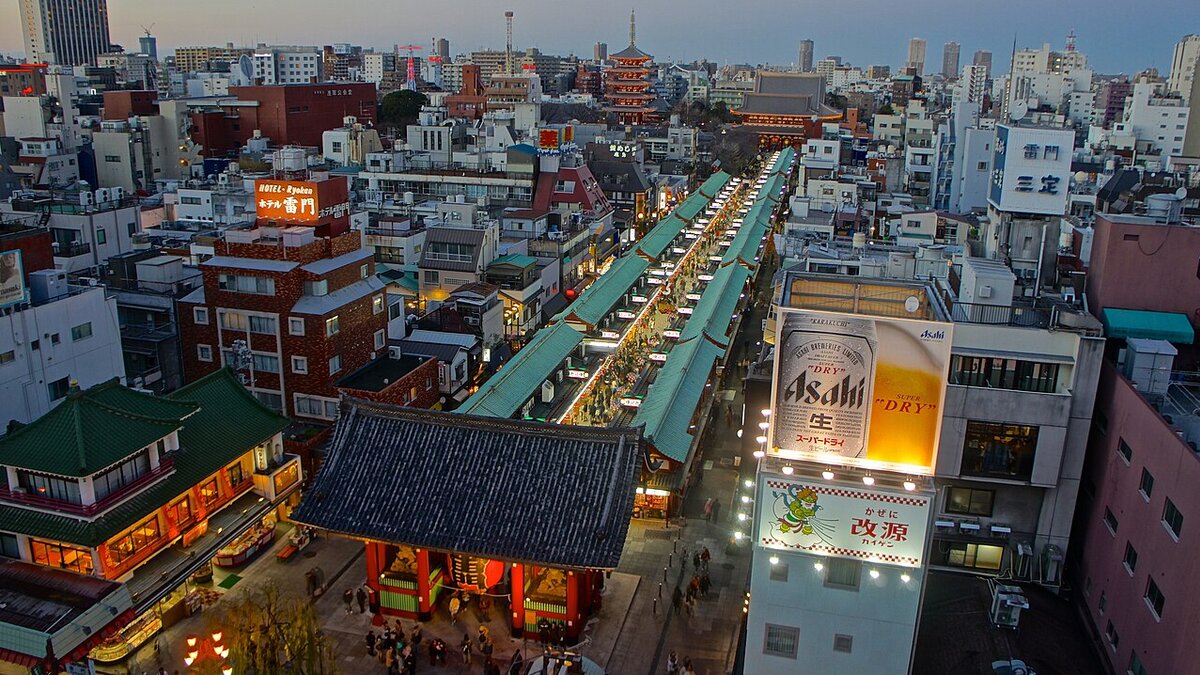
Cover image: Dusk aerial of Nakamise street and Senso-ji temple, Tokyo, amid Japan's tourism record — photo by Manish Prabhune, CC BY 2.0, via Wikimedia Commons.
Japan welcomed an estimated 3.44 million foreign visitors in July 2026 — an all-time high for the month of July and, at +0.1% year on year, the country's first annual increase in four months, according to Japan National Tourism Organization (JNTO) data released on 19 August. The headline is modest; the story underneath it is not. Arrivals from mainland China collapsed 56.1% year on year to 428,200, the eighth straight month of decline since Beijing issued an advisory against travel to Japan in November 2025. That Japan still set a July record while its former number-one market was cut in half shows how quickly the inbound boom is rebalancing: South Korea, the United States and Indonesia all posted their best July ever, and Taiwan topped 700,000 visitors in a single month for the first time. For the travel trade, the message from a summer that also saw Japan raise its visa fees for the first time in decades is clear: demand for Japan is deep enough to absorb a geopolitical shock — but the mix of who is coming, and what they spend, is changing fast.
Why are Chinese tourists avoiding Japan?
The China slump is political, not commercial. In November 2025, Prime Minister Sanae Takaichi told lawmakers that a "Taiwan contingency" could allow Japan to intervene militarily — remarks that triggered a furious response from Beijing, which advised its citizens against travelling to Japan. Chinese carriers trimmed capacity, group bookings evaporated, and mainland arrivals have now fallen year on year for eight consecutive months.
The July figure of 428,200 mainland visitors compares with nearly a million in the same month a year earlier. The symbolism was not lost in Taipei: for the second summer month running, more Taiwanese than mainland Chinese visited Japan — a reversal that would have been unthinkable during the 2015–2019 Chinese outbound boom, when the mainland was Japan's largest and highest-spending source market.
Which countries are driving Japan's July record?
JNTO counted 17 source markets setting new July records, including South Korea, Indonesia and Mexico. The heavy lifting came from short-haul Asia:
| Market | July 2026 arrivals | Trend |
|---|---|---|
| South Korea | 894,700 | +31.9% — best July on record |
| Taiwan | 763,800 | +26.4% — first month ever above 700,000 |
| Mainland China | 428,200 | −56.1% — eighth straight monthly decline |
| Hong Kong | 272,000+ | +54.8% — rebound from 2025's quake-rumour slump |
Some of those eye-catching growth rates flatter the comparison: July 2025 was depressed by a viral social-media rumour predicting a catastrophic earthquake in Japan that month, which knocked South Korean arrivals down 10.4% and sent Hong Kong numbers into a dive. But the absolute levels are what matter, and they are records. Beyond North Asia, the long-haul and Southeast Asian growth is structural:
- South Korea reclaimed its position as Japan's largest market by a wide margin, helped by dense low-cost airline capacity across the Korea Strait.
- Taiwan has been lifted by new routes and added frequencies into regional Japanese airports.
- The United States and Indonesia both set all-time July highs, extending a run of record months for US travellers.
- Mexico — a market barely on Japan's radar five years ago — also set a July record.
Is the weak yen still fuelling the boom?
Currency remains the quiet engine of Japan's inbound story. The weak yen was central to 2025's blowout, when a record 42.7 million international visitors spent a record ¥9.5 trillion — themes we unpacked in our earlier analysis of Japan's inbound record and new tourist taxes. For Koreans, Taiwanese and Americans, Japan still feels like a sale rack: hotels, rail passes and retail all price attractively against the won, the Taiwan dollar and the US dollar. That affordability is doing double duty in 2026 — it is not just growing the market, it is cushioning the loss of Chinese spending by pulling in more visitors from everywhere else. The government's longer-term target of 60 million visitors and ¥15 trillion in spending by 2030 assumes that cushion holds.
Can 2026 still beat Japan's full-year record?
It will be tight. The first six months of 2026 brought 21.08 million visitors, down about 2% year on year, and the January–July running total of just over 24.5 million is still 1.7% behind 2025's pace. To surpass last year's 42.7 million, Japan needs its final five months to run ahead of an extremely strong 2025 base — arithmetic that almost certainly requires either a thaw in Beijing's advisory or continued double-digit growth from Korea, Taiwan and long-haul markets.
July suggests the second path is at least possible: the year-on-year gap has now closed to zero in a single month. But a full-year record without China would be unprecedented, and most forecasters expect 2026 to end slightly below 2025 — Japan's first annual decline in years, even as global tourism overall pushes to new record arrivals in 2026. For destination marketers elsewhere in Asia, meanwhile, Japan's rebalancing is a live case study in how fast a source-market mix can be rebuilt when price, capacity and appetite line up.
Frequently asked questions
How many foreign visitors did Japan receive in July 2026?
Japan welcomed an estimated 3.44 million foreign visitors in July 2026, according to JNTO data released on 19 August. It was an all-time high for the month of July and, at +0.1% year on year, the first annual increase in four months.
Why have Chinese tourist numbers to Japan collapsed?
Mainland-China arrivals fell 56.1% year on year to 428,200 in July — the eighth consecutive monthly decline. Beijing has advised its citizens against travel to Japan since November 2025, after Prime Minister Sanae Takaichi suggested Japan could intervene militarily in a Taiwan contingency.
Which countries are replacing Chinese visitors to Japan?
South Korea led with 894,700 July arrivals, followed by Taiwan at 763,800 — the first time Taiwan has topped 700,000 in a month. The United States and Indonesia set all-time July highs, Hong Kong rebounded 54.8%, and 17 source markets in total set July records.
Will Japan beat its 2025 tourism record in 2026?
Probably not, though it is close. January–July arrivals of just over 24.5 million are running 1.7% behind 2025, when Japan set a full-year record of 42.7 million visitors. Beating that without a recovery in Chinese demand would require sustained record months through December.
Sources
- The Japan Times — Foreign visitors to Japan increased 0.1% in July
- Japan Today — Foreign visitors to Japan hit 3.44 mil in July; S Koreans top list
- Taipei Times — More Taiwanese visited Japan last month than Chinese
- VnExpress International — Tourist arrivals rebound to hit 3.44 million in July
- Nippon.com — Japan Welcomes Record 42.7 Million International Visitors in 2025




Post a comment