

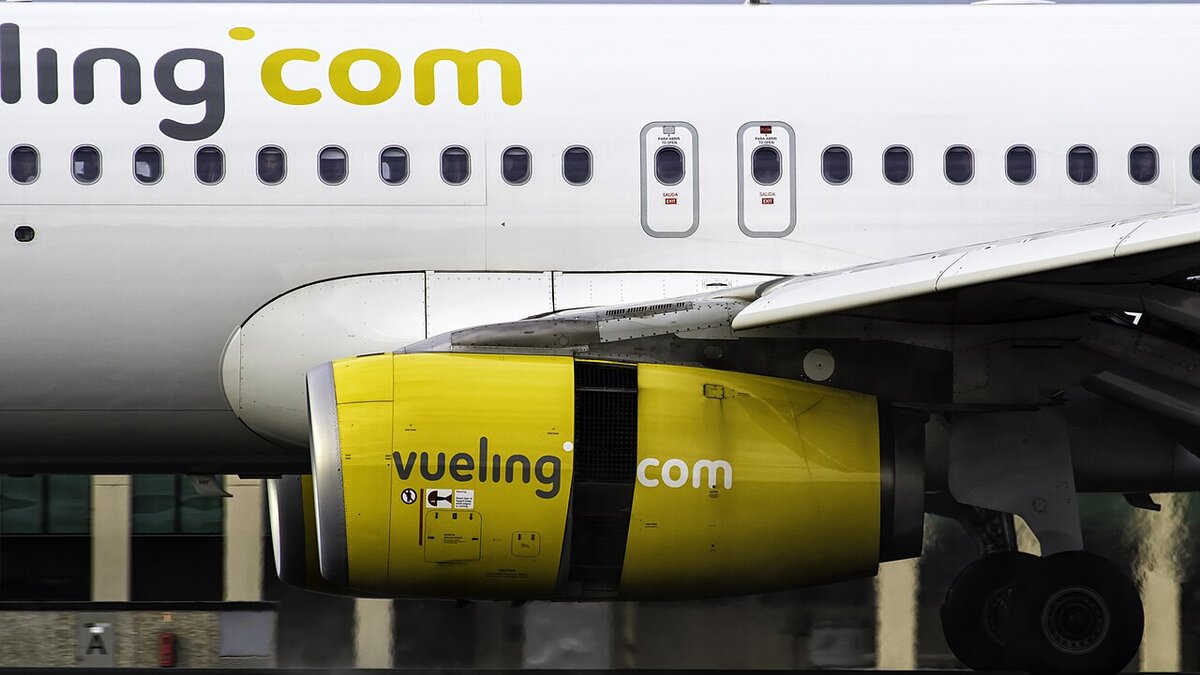
The FAA has finalised an airworthiness directive requiring 3rd-stage compressor blade replacements across the entire US-registered IAE V2500 fleet after fires and in-flight shutdowns.
Cover image: Close-up of an IAE V2500 turbofan engine mounted on a Vueling Airbus A320 — photo by Bene Riobó, CC BY-SA 4.0, via Wikimedia Commons.
The Federal Aviation Administration has finalised an airworthiness directive — the FAA V2500 engine directive aviation insiders have been tracking since late 2025 — requiring the replacement of 3rd-stage high-pressure compressor (HPC) rotor blades on 1,462 US-registered IAE V2500 engines, effectively the entire American fleet of V2500-powered aircraft. The rule, designated AD 2026-17-03, was published in the Federal Register on 20 August 2026 and takes effect on 24 September 2026.
The directive targets two blade part numbers — 6A8353 and 6A8688 — that a manufacturer investigation found susceptible to shroud wear and fracture. The FAA says failures of these blades have already caused engine fires, aborted takeoffs, unplanned engine removals and in-flight shutdowns. Operators must fit a complete new set of eligible blades at the next engine shop visit in which the 3rd-stage rotor is exposed, at an estimated fleet-wide cost of roughly $44 million.
The affected engines overwhelmingly power first-generation Airbus A320-family (ceo) jets, a population that is flying longer than airlines ever planned because new-aircraft deliveries remain scarce.
Why is the FAA ordering V2500 blade replacements?
The V2500 is built by International Aero Engines (IAE), a Pratt & Whitney-led consortium, and for three decades it has been one of two engine choices on the A320ceo family. The FAA first proposed the blade mandate in November 2025 after receiving multiple reports of failed 3rd-stage HPC rotor blades.
Those failures were not benign. The agency's final rule cites engine fires, rejected takeoffs and in-flight shutdowns — the categories of event regulators treat as precursors to a more serious accident. The root cause, per IAE's investigation, is that the two affected blade part numbers wear at the shroud, the interlocking tip feature that stabilises each blade, and can then fracture.
Seven organisations commented on the proposal, including the Air Line Pilots Association, American Airlines, United Airlines, IndiGo owner InterGlobe Aviation, Lufthansa Technik and SIA Engineering. The FAA rejected requests to withdraw the rule, though it did clarify that operators who have already carried out IAE service bulletin V2500-ENG-72-0716, issued in October 2024, get credit for compliance.
Which engines and aircraft are affected?
The directive covers ten V2500 variants: the V2522-A5, V2524-A5, V2525-D5, V2527-A5, V2527E-A5, V2527M-A5, V2528-D5, V2530-A5, V2531-E5 and V2533-A5, wherever the suspect blades are installed. In practice that means:
- Airbus A319, A320 and A321ceo — the vast majority of the affected fleet, flown by several major US carriers;
- Boeing MD-90 — the -D5 variants that powered the type;
- Embraer C-390 Millennium — the military transport's V2500-E5 derivative.
With Airbus and Boeing still struggling to hand over new jets fast enough, V2500-powered ceos remain workhorses of US domestic flying — which is precisely why a fleet-wide blade mandate matters commercially as well as technically.
When must airlines comply, and what will it cost?
There is no hard calendar or flight-cycle deadline. Instead, the AD is triggered by maintenance opportunity: at the first engine shop visit after 24 September 2026 in which the 3rd-stage HPC rotor is exposed to piece-part level, the full blade set must be replaced with eligible parts — new part numbers 6C8368 or 6C8403, modified -001 versions of the original blades, or later FAA-approved alternatives.
| Item | Detail |
|---|---|
| AD number | 2026-17-03 (docket FAA-2025-2555) |
| Effective date | 24 September 2026 |
| US engines affected | 1,462 |
| Compliance trigger | Next shop visit exposing the 3rd-stage HPC rotor |
| Cost per engine (reworked blades) | About $30,085 |
| Cost per engine (new blades) | About $225,000 |
| Estimated total US fleet cost | $43.98 million |
The FAA estimates roughly $30,085 per engine where reworked blades are used, or about $225,000 per engine for a full set of new blades — a meaningful add-on for engines that already command multi-million-dollar overhauls in an overheated MRO market.
Will travellers notice?
Probably not directly. Because the work piggybacks on scheduled shop visits rather than forcing immediate groundings, airlines can absorb it into existing overhaul plans. The bigger risk is indirect: MRO shops are already congested, and any extra scope lengthens turnaround times, which can thin spare-aircraft cover and make schedules more brittle.
If a blade-related removal or shop-visit backlog does cancel or delay a flight, that is a controllable event in most regimes — worth knowing what compensation rules apply when an airline's own maintenance disrupts your trip.
Frequently asked questions
What does the FAA V2500 engine directive require?
AD 2026-17-03 requires operators to replace the complete set of 3rd-stage high-pressure compressor rotor blades (part numbers 6A8353 or 6A8688) with eligible redesigned or reworked blades at the next engine shop visit, after the rule takes effect on 24 September 2026.
How many engines are affected?
The FAA estimates 1,462 engines on the US registry — essentially every V2500 in American service. The November 2025 proposal had put the figure at 1,496; the final rule revised it slightly downward.
Is it safe to fly on a V2500-powered A320?
Yes. The directive is a preventive measure: the affected blades remain legal to fly until an engine's next qualifying shop visit, and the phased replacement schedule reflects the FAA's assessment that the risk is managed, not immediate.
Do airlines that already replaced the blades need to act?
No. The FAA confirmed that operators who completed IAE service bulletin V2500-ENG-72-0716 (October 2024) before the effective date receive credit and need not repeat the work.
Sources
- Federal Register — Airworthiness Directives; International Aero Engines AG Engines (final rule)
- GovInfo — FAA AD 2026-17-03 full text, 20 August 2026
- FlightGlobal — FAA proposes mandatory V2500 compressor blade replacements after failures
- Aviation Week — FAA Plans V2500 Compressor Blade Swap Mandate
- GovInfo — FAA NPRM on V2500 3rd-stage HPC blades, 18 November 2025




Post a comment