

Canada-to-US business flight bookings rose 12.7% in Q2 2026, Corporate Traveler data shows, even as overall Canadian travel to the United States remains nearly 29% below 2024 levels after the boycott.
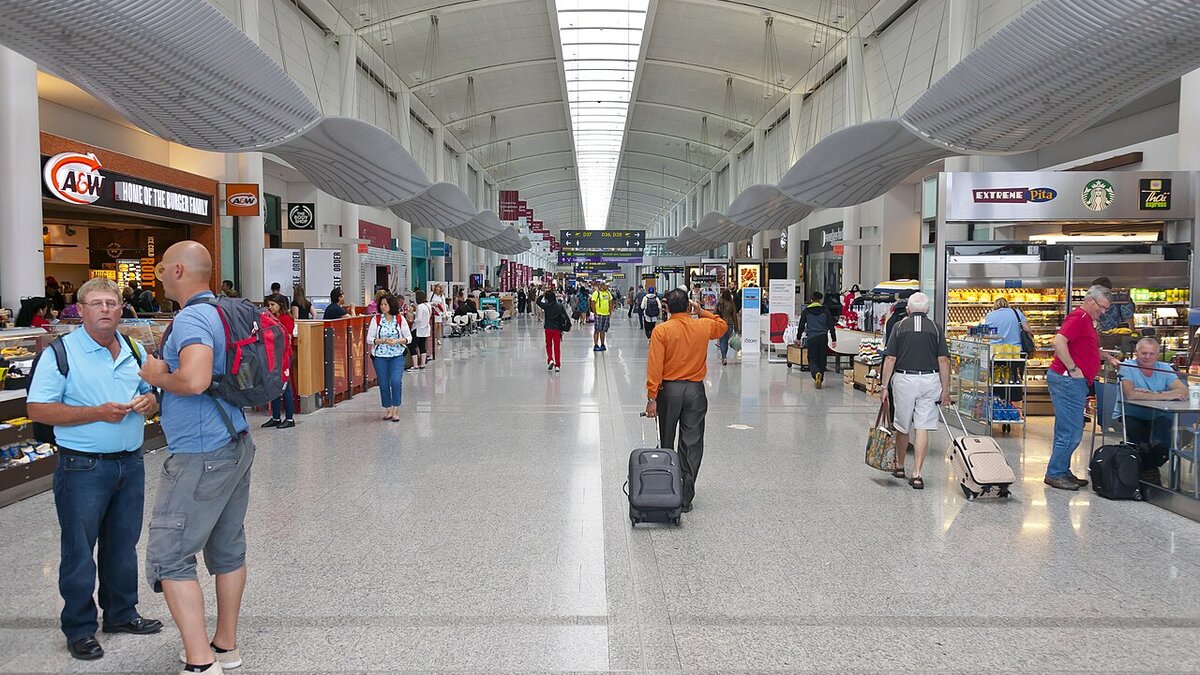
Cover image: Terminal concourse at Toronto Pearson International Airport — photo by Daniel Case, CC BY-SA 3.0, via Wikimedia Commons.
Canada US business travel is staging a recovery that the leisure market cannot yet match. Canada-to-US business flight bookings rose 12.7% year-over-year in the second quarter of 2026 (April through June), according to data from Corporate Traveler, the travel management company owned by Flight Centre Travel Group. Toronto, Montreal and Vancouver sent the highest volumes of business travellers south, with New York, Chicago and Las Vegas the leading US destinations, the firm reported.
The corporate rebound stands in sharp contrast to the wider picture. Canadian-resident return trips from the US were still down almost 29% from 2024 as of mid-summer, according to Skift's analysis of Statistics Canada data — evidence that the consumer boycott that began in early 2025 continues to weigh on transborder demand even as corporate desks book again.
Why is Canadian business travel to the US rising?
Corporate Traveler attributes the upturn to companies resuming trips they had deferred during a period of political and economic uncertainty between the two countries. "After a period of uncertainty, it's encouraging to see Canadian businesses once again prioritizing travel to the US, reflecting the importance of the business relationship between the two countries," said John Van den Heuvel, president of Corporate Traveler USA, in comments reported by trade publication Open Jaw.
The character of the recovery matters as much as its size. Travel managers describe a shift towards "value-based" travel — fewer speculative trips, more targeted journeys with a clear commercial return, such as client renewals, deal closings and essential conferences. That mirrors the discipline seen globally, where the Global Business Travel Association still expects record business travel spending in 2026 despite trade-policy headwinds.
The city pairs driving the rebound reflect that focus on high-yield commercial hubs:
| Top Canadian origin cities | Top US destinations |
|---|---|
| Toronto | New York |
| Montreal | Chicago |
| Vancouver | Las Vegas |
One caveat: the Corporate Traveler figures cover flight bookings only, excluding cross-border business trips by car or rail — and they measure growth against a depressed 2025 base.
Is Canadian leisure travel to the US still down?
Yes — substantially. Statistics Canada's July 2026 figures show Canadian-resident return trips from the US rose 10.2% year-over-year, the fourth consecutive month of growth, but the agency notes the increase is "largely due to a base-year effect" after trips collapsed in 2025. Return trips by car in July were still 28.9% below July 2024, and return trips by air actually fell 1.4% from a year earlier.
June told the same story: return trips rose 3.2% year-over-year but remained 28.7% below June 2024, per Skift. Canadians are cautiously driving across the border again — but largely not flying for holidays. That makes the corporate flight-booking surge a genuine decoupling from consumer sentiment rather than part of a broad recovery.
What does it mean for airlines and transborder capacity?
For Air Canada, WestJet and the US majors, the split is awkward but workable. Business traffic is the highest-yielding segment on transborder routes, so a 12.7% rebound in corporate bookings supports premium cabins and frequencies on trunk routes such as Toronto–New York and Vancouver–Chicago even while point-of-sale Canada leisure demand stays soft. Carriers that trimmed transborder capacity through 2025 now have a case for restoring business-heavy frequencies first rather than leisure-focused routes — a dynamic that echoes the premium-over-economy pattern that ran through the airlines' Q2 2026 earnings results.
What does it signal for US inbound tourism and border cities?
Less comfort than the headline suggests. Corporate volumes are concentrated in a handful of gateway hubs, so the spending uplift flows mainly to big-city hotels in New York, Chicago and Las Vegas — a helpful tailwind for the US hotel RevPAR growth streak in urban markets. Border destinations that depend on Canadian leisure drive traffic — upstate New York, Washington state, Michigan, Florida's snowbird belt — are still missing roughly three in ten of their 2024-level Canadian visitors. Until air-based leisure demand turns positive, the US inbound recovery from its largest source market remains partial and heavily dependent on favourable base-year comparisons.
Frequently asked questions
How much did Canada-to-US business travel grow in Q2 2026?
Canada-to-US business flight bookings rose 12.7% year-over-year between April and June 2026, according to Corporate Traveler, Flight Centre Travel Group's travel management company. Toronto, Montreal and Vancouver were the top origin cities, while New York, Chicago and Las Vegas led US destinations. The data covers flight bookings only, excluding cross-border business trips by car or rail.
Is Canadian travel to the US still down overall?
Yes. Despite four straight months of year-over-year growth, Canadian-resident return trips remain roughly 29% below 2024 levels, per Skift and Statistics Canada. July 2026 car trips were 28.9% below July 2024, and air return trips fell 1.4% year-over-year — the growth is mostly a base-year effect against a collapsed 2025.
Why are companies travelling to the US again while consumers stay away?
Corporate trips are driven by commercial necessity rather than sentiment. Travel managers describe a shift to value-based travel — targeted trips with a clear return, such as client meetings, deal work and key conferences — resuming after firms deferred travel amid political and economic uncertainty in 2025. Consumer decisions, by contrast, remain shaped by the boycott mood and the weak Canadian dollar.
Which routes benefit most from the corporate rebound?
High-yield transborder trunk routes linking Toronto, Montreal and Vancouver with New York, Chicago and Las Vegas benefit most, since business traffic supports premium cabins and higher frequencies. Leisure-focused transborder routes and border-city destinations reliant on Canadian drive traffic see far less uplift while air-based leisure demand stays negative.
Sources
- Business Travel News — Corporate Traveler Data Shows Rebound in Canada-to-U.S. Business Travel
- Open Jaw — Data Shows Canada-US Business Travel Rebounding
- Skift — Canadian Travel to the U.S. Ticks Up Again, But Still Far from a Full Recovery
- Skift — Canadian Travel to the U.S. Is Rising Again, Still Down Almost 29% From 2024
- Statistics Canada — Leading indicator of international arrivals to Canada, July 2026




Post a comment