

USF satellites tracked 27 million metric tons of sargassum in July as Quintana Roo cleanup crews broke annual records. Here is where beaches stay clear, when the season ends, and how to check before booking.
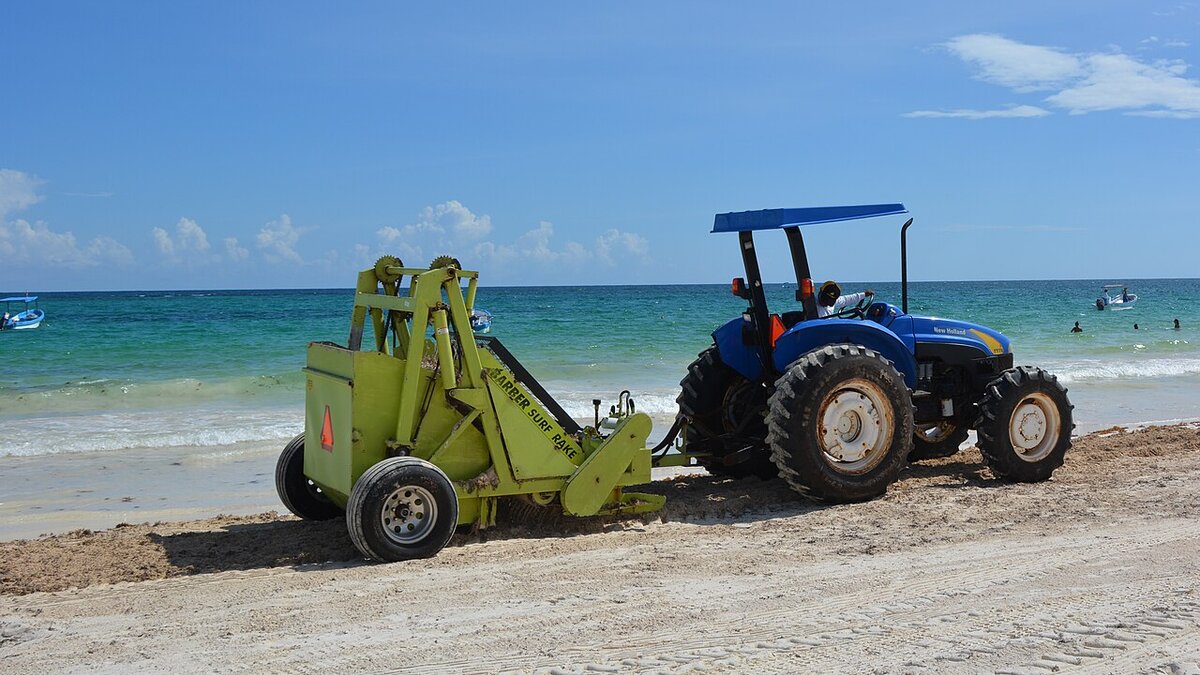
Cover image: A tractor clears thick mounds of brown sargassum seaweed from the white-sand beach at Tulum, Mexico, with the Caribbean Sea behind it. — photo by G.Mannaerts, CC BY-SA 4.0, via Wikimedia Commons.
The sargassum Caribbean 2026 season is the heaviest coastal inundation the region has ever had to manage. Satellite monitoring by the University of South Florida's Optical Oceanography Lab recorded roughly 27 million metric tons of the brown macroalgae across the Atlantic, Caribbean and Gulf of Mexico in July, after May and June readings hit record levels in nearly every monitored region. The Caribbean Sea itself set an all-time high in June, and the Gulf reached 5 million metric tons — almost double its previous record.
On the ground, the impact is concentrated on Atlantic-facing coasts. Mexico's Quintana Roo state — home to Cancún, Playa del Carmen and Tulum — had cleared more than 105,000 metric tons of sargassum from its beaches by 14 August, already surpassing the full-year record of about 92,783 tons set in 2025.
For travellers, the practical picture is mixed: the worst-hit stretches of the Riviera Maya are seeing hotel rate cuts of up to 40%, Skift reported in June, while leeward and west-facing beaches remain largely clear. Conditions typically ease from late October. Here is what to know before booking.
How bad is the 2026 sargassum season?
Scientists began tracking the Great Atlantic Sargassum Belt in 2011, and 2026 has rewritten several of its benchmarks. USF's May bulletin found record-high levels in every monitored region except the western Atlantic, and June brought a Caribbean-wide record. Across the whole Atlantic basin, researchers expect 2026 to finish just behind 2025's roughly 40-million-ton peak — but because more of this year's biomass has drifted ashore in the Caribbean and Gulf, coastal impacts are the worst on record.
Landings also started unusually early. Quintana Roo reported arrivals in January and March, months ahead of the traditional May–October window. On the worst days, up to 9,000 tons have washed onto Mexico's Caribbean coastline. When sargassum decomposes on shore it turns turquoise water brown and releases hydrogen sulfide and ammonia — the rotten-egg smell that, per the U.S. Environmental Protection Agency, can cause nausea, headaches and lung irritation near large decomposing mats.
"None of this is normal," USF marine scientist Brian Barnes told the Associated Press. "Every year is a little bit of a new story."
Which Caribbean beaches have sargassum right now?
Exposure depends almost entirely on which way a beach faces. Sargassum rides currents and the prevailing easterly winds, so east- and Atlantic-facing coasts take the brunt, while leeward (west-facing) shores are often clear on the same day.
In Quintana Roo, the state's Red de Monitoreo sargassum network flagged 56 of 140 monitored beaches at red alert in early August, with Tulum, Akumal, Puerto Aventuras, Playa del Carmen and Xcalak among the hardest hit. Puerto Rico, the U.S. Virgin Islands and Martinique have also reported heavy landings this season.
| Coast / area | Typical 2026 impact |
|---|---|
| Tulum, Akumal, Puerto Aventuras (open Atlantic-facing) | Heavy — worst-hit stretches, daily cleanup |
| Playa del Carmen, Xcalak | Heavy to moderate |
| North-facing Cancún, Playa Mujeres, Isla Blanca, Punta Sam | Light — safest mainland options |
| Playa Norte (Isla Mujeres), Cozumel west coast | Consistently protected leeward beaches |
| Pacific Mexico (Los Cabos, Puerto Vallarta, Oaxaca) | Unaffected — sargassum is an Atlantic phenomenon |
| Eastern Caribbean windward coasts (e.g. Martinique's east) | Heavy in season; leeward bays far lighter |
The same logic applies across the islands: west- and leeward-facing bays — Cozumel's western shore, Playa Norte on Isla Mujeres, Carlisle Bay in Barbados — routinely stay clear even when windward beaches a short drive away are buried. Cruise calls at Cozumel's western piers usually see normal beaches — see our guide to whether you need a passport for a cruise.
When does sargassum season end?
The season historically runs May to October, peaking mid-summer. USF's monitoring in previous years has shown quantities falling through October and reaching an annual low in November, and local forecasters in Quintana Roo expect a gradual decline from late August into September, with beaches largely clearing by late October or November. The cleanest, most reliable window for the Mexican Caribbean is January through April.
That winter window coincides with expanded airlift to the region: see our report on WestJet's winter 2026-27 sun routes.
How do I check sargassum conditions before booking?
Do not rely on brochure photos. Three checks take minutes:
1. USF's Sargassum Watch System (SaWS). The University of South Florida publishes satellite imagery and monthly outlook bulletins showing where the belt sits and where it is drifting.
2. Local monitoring maps. Quintana Roo's Red de Monitoreo del Sargazo posts a daily colour-coded map of 140 beaches — green to red — widely shared on its social channels. Several Caribbean islands run similar trackers, such as CariCOOS for Puerto Rico and the USVI.
3. Live webcams and recent guest photos. Beach webcams and photos uploaded to review sites in the past week beat any forecast. Conditions can change with a single wind shift, so check again in the days before departure and ask your hotel what its beach looked like that morning.
Should you book a discounted Caribbean trip now?
The silver lining is real. With occupancy in Quintana Roo down sharply year-on-year, hotels in affected zones have cut rates by up to 40% and loosened rebooking terms, and Mexico is spending $115 million (2 billion pesos) on barriers, vessels and offshore harvesting to intercept the algae before it lands. Travellers who choose leeward beaches, book flexible rates or aim for November onwards can get record-severity-year prices without record-severity-year beaches.
It stacks with a broader buyer's market: a quieter hurricane outlook has already pushed Caribbean deals wider this season, and destinations such as Jamaica have seen travel advisories eased in 2026. Verify the specific beach, not the destination — and the discount can work in your favour.
Frequently asked questions
Is all of Cancún affected by sargassum in 2026?
No. North-facing Cancún beaches, Playa Mujeres, Isla Blanca and Punta Sam are among the lightest-hit mainland areas, and resorts run daily cleanup crews. The heaviest accumulations are further south on open Atlantic-facing coasts such as Tulum, Akumal and Puerto Aventuras. Check Quintana Roo's daily beach-by-beach monitoring map before choosing a hotel zone.
Is sargassum dangerous to swim near?
Floating sargassum at sea is harmless, but large mats decomposing on shore release hydrogen sulfide and ammonia, which the EPA says can cause nausea, headaches and lung irritation. Avoid swimming through thick mats or lingering beside rotting piles, and rinse off after contact, as tiny organisms in the weed can irritate skin.
When is the best time to visit the Mexican Caribbean to avoid sargassum?
January through April is historically the cleanest window, with quantities falling from late October and bottoming out around November. The 2026 season arrived unusually early, with landings in January and March, so check the USF Sargassum Watch System and local webcams close to your travel dates whichever month you book.
Are Caribbean hotels really cheaper because of sargassum?
Yes, in affected zones. Skift reported in June 2026 that hotels along hard-hit stretches of Mexico's Riviera Maya were cutting rates by up to 40% as occupancy fell year-on-year, alongside more flexible rebooking policies. Leeward-facing destinations with clear beaches have less pressure to discount, so the deepest deals track the heaviest seaweed.
Sources
- PBS NewsHour (AP) — Huge blankets of seaweed are smothering coastlines from the Caribbean to Mexico
- Skift — Record Seaweed Levels Are Hitting Caribbean Beaches — Hotels Are Cutting Prices
- Skift — Mexico Will Spend $115 Million Fighting Rotting Seaweed as Hotels Slash Rates
- The Rio Times — Cancun's New Resorts Open Into a Record Sargassum Season
- University of South Florida — Sargassum Watch System (SaWS)


Post a comment