

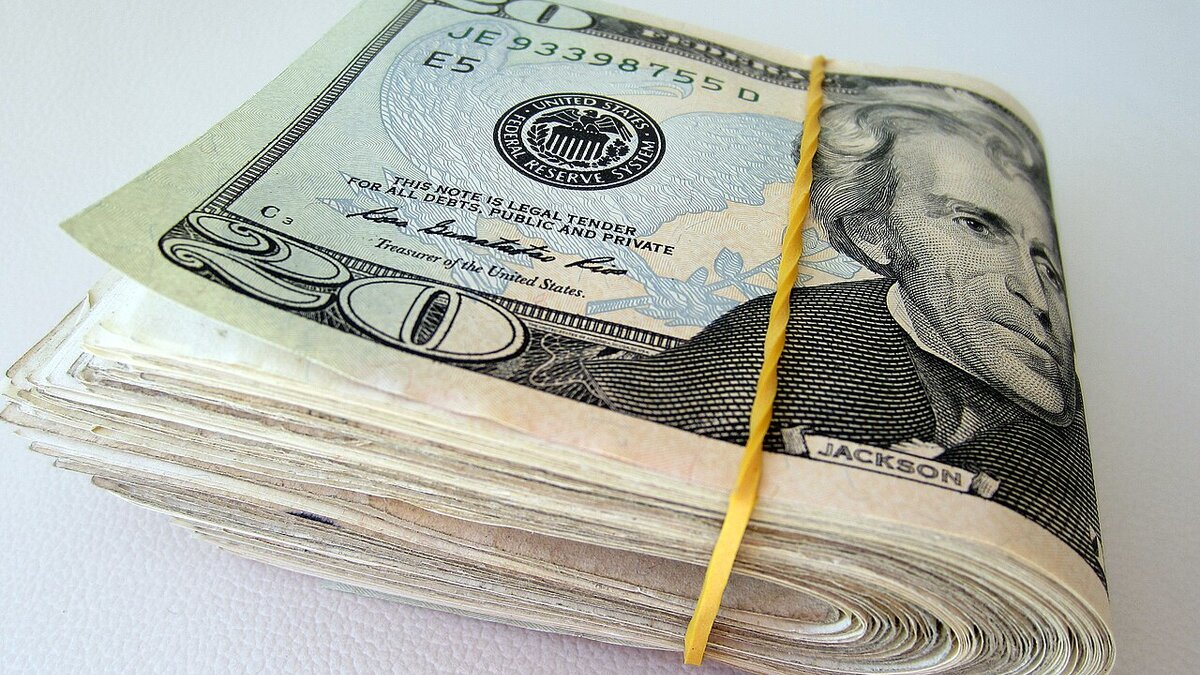
There is no legal limit on how much cash you can fly with inside the US, and no cap on international flights either — but cross a US border with more than $10,000 and you must declare it. Here are the real rules, the thresholds in the EU, UK, Canada, Australia and India, and what happens when travellers get it wrong.
Cover image: A rubber-banded stack of US $20 bills — photo by 401(K) 2012, CC BY-SA 2.0, via Wikimedia Commons.
Ask how much cash can you fly with and the short answer is simpler than most currency-exchange websites make it sound: there is no legal limit on the amount of cash you can carry on a US domestic flight, and no declaration is required at any dollar figure. Internationally, there is still no cap — but if you enter or leave the United States carrying more than $10,000 in currency and monetary instruments combined, you must declare it to US Customs and Border Protection (CBP) on FinCEN Form 105, according to USAGov's official guidance. The threshold applies to the total carried by a family or group travelling together, not just to each individual. The critical point travellers miss: the offence is failing to declare, not carrying the money. Declare $50,000 correctly and you walk through with a receipt. Fail to declare $10,500 and CBP can seize every dollar of it. The same declare-don't-cap model applies at most major borders, with the EU, UK, Canada and Australia all setting thresholds around the 10,000 mark in local currency.
How much cash can you take on a domestic flight?
As much as you like. No US federal law limits cash on flights within the country, and there is no form to file. The Transportation Security Administration screens for threats to aviation, not for money, and its own guidance confirms cash is permitted in carry-on and checked bags in any amount.
The practical risk is different: large sums spotted at screening are sometimes referred to law enforcement, an issue covered below. Carry cash in your hand luggage, never checked baggage, and be ready to explain its origin — a withdrawal receipt or bill of sale defuses most questions.
Do you have to declare cash at the airport?
Only when crossing an international border. For the US, anyone transporting more than $10,000 into or out of the country must file FinCEN Form 105, online up to 72 hours before travel or on paper with a CBP officer. Per USAGov, the reporting requirement — codified at 31 U.S.C. 5316 — covers more than banknotes:
What counts toward the $10,000: US and foreign paper currency and coins, traveller's cheques, money orders, cashier's cheques, promissory notes, and negotiable instruments in bearer form or endorsed without restriction. What does not count: ordinary credit and debit cards, and personal cheques made out to a named payee.
The family aggregation rule catches many travellers: members of a family or group travelling together must combine their holdings. A couple carrying $6,000 each is over the threshold and must declare — splitting cash among companions to stay under $10,000 is a separate offence called structuring.
What happens if you don't declare cash?
CBP's first tool is civil asset forfeiture: officers can seize the entire undeclared amount, not just the portion above $10,000. Under 31 U.S.C. 5317, undeclared currency is subject to seizure and forfeiture, and USAGov warns that criminal penalties for reporting offences can reach fines of up to $500,000 and up to 10 years in prison in aggravated cases. Deliberately concealing cash to evade the report is bulk cash smuggling under 31 U.S.C. 5332, itself carrying up to five years' imprisonment plus forfeiture.
Travellers whose money is seized are not without recourse. CBP issues a notice of seizure, and the owner can file a petition for remission with the agency's Fines, Penalties and Forfeitures office — typically within 30 days — or elect judicial forfeiture proceedings. Honest-mistake cases with documented legitimate funds are often resolved with partial or full return, but the process can take months and many claimants hire counsel.
Can TSA take your cash?
TSA has no authority to seize money — but screeners have historically alerted law-enforcement agencies when they spot large sums. The Drug Enforcement Administration built a controversial airport interdiction programme on such referrals, seizing cash from domestic travellers without charges. The Institute for Justice, which brought a class action against the TSA and DEA, documented cases including a retired railroad engineer whose $82,373 life savings was seized at Pittsburgh airport and returned only after publicity. In November 2024, following a critical Justice Department Inspector General review, the DOJ ordered the DEA to suspend its 'consensual' airport searches; Reason magazine reported in December 2025 that DHS agencies had nonetheless continued some airport cash seizures. The lesson stands: flying domestically with $20,000 is legal, but documentation of where it came from is your best protection.
Cash declaration thresholds by country
| Jurisdiction | Declaration threshold | Notes |
|---|---|---|
| United States | More than $10,000 | FinCEN Form 105; family/group totals combined |
| European Union | €10,000 or more | Covers cash, cheques and traveller's cheques; declared to the entry/exit member state |
| United Kingdom | £10,000 or more | Online declaration from 72 hours before travel; up to £5,000 penalty to release seized cash |
| Canada | CAN$10,000 or more | CBSA report; failure risks forfeiture or penalties |
| Australia | AUD 10,000 or more | No limit, but movement must be reported to AUSTRAC |
| India | Currency notes over US$5,000, or US$10,000 aggregate | Currency Declaration Form on arrival, per RBI/customs rules |
When does carrying cash make sense?
Rarely, above four figures. A wire transfer or a multi-currency card moves money with a paper trail, no seizure risk and usually a better exchange rate — see our beginner's guide to travel credit cards and points for plastic-first strategies. Cash still wins for markets and destinations with weak card acceptance, and it pairs naturally with duty-free shopping, where declaration rules for goods run in parallel. If you do declare at a busy hub, build in time: new automated border systems are already lengthening queues at European airports in 2026, and a currency declaration is one more stop before the gate.
Frequently asked questions
Is the $10,000 US threshold per person or per family?
It is combined for a family or group travelling together. Two relatives carrying $6,000 each must declare the $12,000 total. Deliberately splitting money between companions to duck the threshold is structuring, a separate federal offence.
Can you get seized cash back from CBP?
Often, yes — by filing a petition for remission with CBP's Fines, Penalties and Forfeitures office, usually within 30 days of the seizure notice, with evidence the funds are legitimate. Expect months of process; many petitioners retain a forfeiture attorney.
Is it illegal to fly with $20,000 in cash domestically?
No. There is no limit and no declaration duty on US domestic flights. But sums that size have attracted law-enforcement referrals and DEA seizures, so carry proof of origin such as a bank withdrawal slip or sale contract.
What about flying with cash from a car sale?
Perfectly legal domestically, and legal internationally if declared above the threshold. Keep the bill of sale, the buyer's details and any bank records with the cash — provenance documents are what turn a suspicious bundle into an explained one.
Do credit cards count toward the $10,000?
No. Ordinary credit and debit cards are not monetary instruments for US reporting. The count covers currency, coins, traveller's cheques, money orders and bearer-form or blank-endorsed instruments. The EU's rules similarly capture cheques and traveller's cheques alongside banknotes.
Sources
- USAGov — How much money can you bring into and out of the U.S.?
- Your Europe (europa.eu) — Rules for taking cash in and out of the EU
- GOV.UK — Take cash in and out of the UK
- Canada Border Services Agency — Travelling with CAN$10,000 or more? Declare it
- AUSTRAC — Moving money overseas
- Institute for Justice — DEA and TSA Airport Forfeitures



Post a comment