

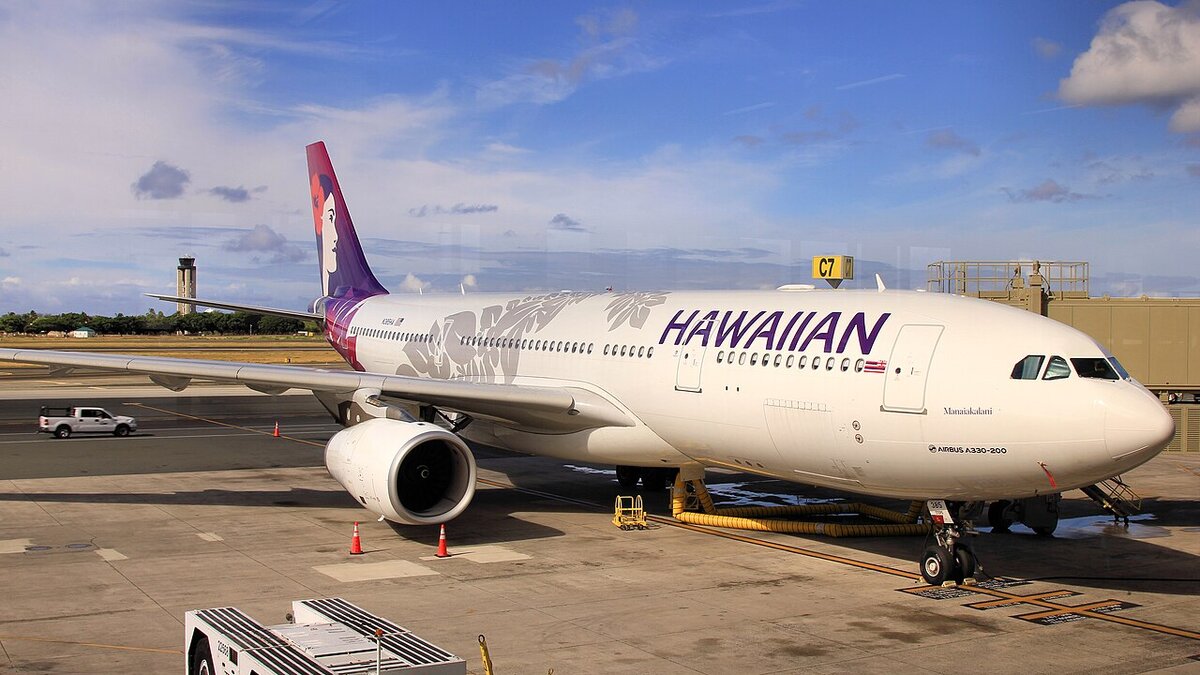
Tropical Storm Moke is forecast to pass south of Hawaii this weekend, bringing up to 15 inches of rain to a Big Island still recovering from Hurricane Lala. Here is what travellers need to know.
Cover image: Hawaiian Airlines Airbus A330 parked at Honolulu airport — photo by Larry D. Moore, CC BY 4.0, via Wikimedia Commons.
Hawaii is preparing for its second tropical cyclone in eight days. Tropical Storm Moke, which was upgraded from Tropical Depression Two-C on Friday, is forecast to pass south of the Big Island late Saturday into Sunday, 22–23 August, dumping 5 to 10 inches of rain — locally up to 15 inches — on ground already saturated by Hurricane Lala. For anyone weighing Tropical Storm Moke Hawaii travel plans this weekend, the immediate risks are flash flooding and mudslides on the Big Island, heavy rain spreading west across Maui and the other islands Sunday into Monday, and the possibility of fresh flight disruption at Hilo and Kona airports, both of which closed for Lala a week ago.
As of the Central Pacific Hurricane Center's 11 p.m. HST Friday advisory, Moke was centred about 545 miles southeast of Hilo with maximum sustained winds of 45 mph, moving west-northwest at 8 mph. Crucially, this is a rain event more than a wind event: forecasters do not expect Moke to reach hurricane strength, and its centre should stay offshore. But a flood watch is already in effect for the Big Island, Hawaii Volcanoes National Park has closed again, and airlines that scrubbed 143 flights for Lala are watching the track closely.
Where is Tropical Storm Moke heading?
The CPHC forecast takes Moke's centre south of the Big Island this weekend, then south of the smaller main Hawaiian islands early next week — a track expected to keep the core roughly 150–200 miles offshore, further out than Lala tracked, according to weather.com. No coastal watches or warnings were in effect as of the Friday-night advisory, though forecasters urged residents and visitors to monitor updates through the weekend.
The headline hazard is water, not wind. Per the CPHC and the Honolulu Star-Advertiser:
- Big Island: 5–10 inches of rain, with isolated maximums of 15 inches, beginning late Saturday — enough to trigger life-threatening flash flooding and mudslides, especially in areas Lala already soaked.
- East Maui: 1–2 inches, locally 4 inches, as the rain shield spreads west Sunday into Monday.
- Coasts: building swells capable of dangerous surf and rip currents, plus gusty winds on windward and southeast-facing slopes.
Peak intensity is forecast around 50–60 mph — a mid-strength tropical storm, not a repeat of Lala's Category 1 landfall-adjacent pass.
Which flights and airlines are affected?
At time of writing — early Saturday morning Hawaii time — no airline had published a Moke-specific travel waiver, and no mass cancellations had been announced. Alaska Airlines' newsroom page covering the Lala disruption was formally closed out without mention of the new storm. That is likely to change quickly if the rainfall forecast holds: carriers typically post weather waivers 24–48 hours before impact.
If you fly to, from or within Hawaii between Saturday 22 and Monday 24 August, check these pages before heading to the airport:
- Alaska/Hawaiian: news.alaskaair.com/on-the-record and hawaiianairlines.com → Travel Advisories (the combined group now posts flexible-travel policies for both brands).
- Delta, United, Southwest, American: each carrier's travel-alerts or advisories page; all issued Hawaii waivers for Lala and are expected to do so again if Moke's forecast verifies.
- Hawaii DOT airports: for Hilo (ITO) and Kona (KOA) operational status — both closed during Lala and reopened the following day.
Interisland flying is the most exposed segment: of the 143 Hawaiian and Alaska cancellations during Lala, 112 were neighbour-island flights, against 31 transpacific services.
What did Hurricane Lala already do to Hawaii travel?
Lala passed south of the Big Island as a Category 1 hurricane on Saturday 15 August before weakening to a tropical storm. The state closed Hilo International Airport on Saturday morning and Kona International on Saturday afternoon, suspending all commercial flights until Sunday, Hawaii News Now reported. Across the three-day event, Hawaiian and Alaska cancelled 112 neighbour-island and 31 transpacific flights, per the airlines' joint update, with waivers extended through the Monday. Delta, Southwest, United and Air Canada issued their own Hawaii waivers, TravelPulse reported.
The aftermath is still visible on the ground — and it matters for anyone with a Hilo booking this weekend. Hawaii News Now reports the 12-storey Grand Naniloa Hotel in Hilo lost air conditioning and all three elevators in the storm; one lift was restored on Tuesday, but the general manager estimates at least a month to repair the other two. Around 600 guests are in the hotel, roughly a third of them displaced Big Island residents. State officials say tourism infrastructure overall escaped major damage, but east Hawaii Island is operating well below normal — and Moke's rain is aimed squarely at it.
Hawaii Volcanoes National Park is closed — again
Hawaii Volcanoes National Park, the Big Island's biggest visitor attraction, closed entirely (including Kahuku) at 5 p.m. Friday ahead of Moke. The park had only partially reopened after Lala and remains without power, internet or phone lines, the National Park Service said. There is a volcanic wrinkle too: the US Geological Survey says Kīlauea's summit eruption is paused but the next lava-fountaining episode is likely between 22 and 26 August — meaning it could resume mid-storm, with no public viewing possible. Travellers should not plan any park visit before an official reopening notice.
What should you do if you fly to Hawaii this weekend?
- Wait for the waiver before paying to change. Once a carrier posts a weather waiver, changes within the window are free; rebooking pre-emptively at your own cost rarely makes sense for a rain-dominant storm on this track.
- Know your refund rights. Under US DOT rules, if the airline cancels or significantly changes your flight and you choose not to travel, you are owed a cash refund, automatically — weather is no exemption. Vouchers are optional, not mandatory. Our guide to your rights when a flight is cancelled explains the process.
- Insurance is now closed for Moke. Policies bought after a storm is named will not cover claims arising from it, and Moke was named on Friday 21 August. See what travel insurance actually covers before assuming a payout.
- Big Island itineraries need slack. Build buffer days around Hilo-side plans, avoid driving in heavy rain (mudslides closed roads during Lala), and confirm your hotel has power and working lifts before arrival.
- Perspective for planners: back-to-back cyclones are consistent with the active Pacific pattern forecasters flagged this season — our analysis of the 2026 hurricane season outlook and booking through hurricane season covers how to book resiliently.
Frequently asked questions
Will my flight to Hawaii be cancelled this weekend?
Not necessarily. As of early Saturday, no cancellations had been announced for Moke, and the storm's centre is forecast to stay 150–200 miles south of the islands. Interisland flights to Hilo and Kona late Saturday through Sunday face the highest risk, since both airports closed during Hurricane Lala a week earlier. Check your airline's app and the carrier's travel-advisories page the morning of departure.
Do airlines charge change fees during hurricane waivers?
No. When an airline issues a weather waiver, passengers booked in the affected window can change dates — and usually routing — without change fees, and typically without fare difference if rebooked within the stated window. During Lala, Hawaiian and Alaska let customers booked through the Monday change or cancel free; Delta, Southwest, United and Air Canada offered similar terms. Expect Moke waivers to follow the same pattern if impacts materialise.
Am I owed a refund if my Hawaii flight is cancelled?
Yes. Under US Department of Transportation rules, if your airline cancels or significantly changes a flight to, from or within the US and you decline the alternative offered, you are entitled to an automatic cash refund of the unused ticket — even for weather cancellations, and even on non-refundable fares. Airlines may offer vouchers, but you can insist on money back.
Does travel insurance cover Tropical Storm Moke?
Only if you bought your policy before the storm existed. Moke was named on Friday 21 August 2026; travel insurance purchased after a storm is named treats it as a foreseeable event and will not pay storm-related claims. Policies bought earlier can cover trip cancellation, interruption and delay per their terms. If you are only buying cover now, it will still protect future, unrelated events — just not Moke.
Sources
- Central Pacific Hurricane Center — Tropical Storm Moke public advisory
- Honolulu Star-Advertiser — Tropical Storm Moke to bring heavy rain, gusty winds to Hawaii this weekend
- Alaska Airlines newsroom — Updates on Tropical Storm Lala
- Hawaii News Now — Hawaii Island airports closed, flights canceled as Hurricane Lala passes south
- Hawaii News Now — Hawaii Volcanoes National Park to close ahead of approaching tropical storm
- Hawaii News Now — Hurricane Lala knocks out air conditioning, elevators at Hilo hotel

Post a comment