

Tipping in Italy is not expected: staff earn contracted wages and locals simply round up for good service. Here is what the coperto and servizio lines on your bill actually mean, and what to leave in every situation.
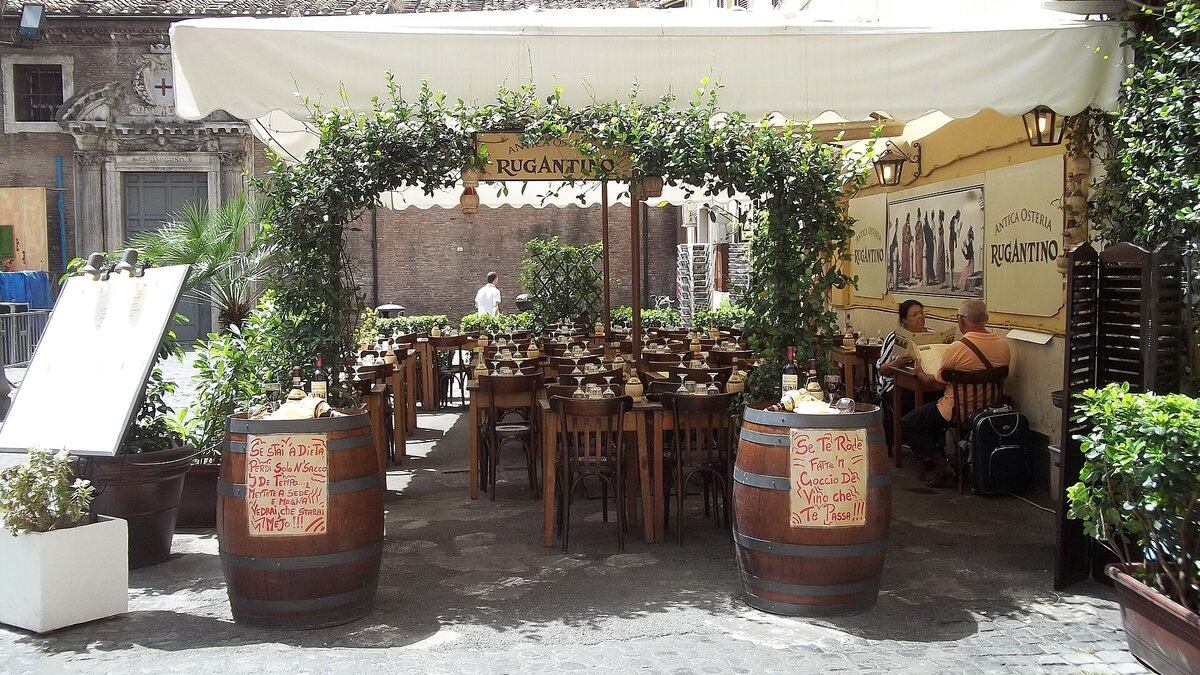
Cover image: Outdoor terrace of a traditional Roman osteria in Trastevere with wooden tables — photo by altotemi, CC BY-SA 2.0, via Wikimedia Commons.
No, you do not need to tip in Italy. Tipping is neither expected nor obligatory: waiters, bartenders and taxi drivers earn contracted wages under national labour agreements, and a gratuity is a genuine bonus rather than part of anyone's pay. The local habit is modest — round the bill up, or leave a euro or two in coins when service was genuinely good. Nobody will chase you down the street if you leave nothing.
What confuses visitors is not tipping itself but two printed line items on Italian restaurant bills that look like tips and are not: the coperto (a per-person cover charge) and the servizio (a percentage service charge). Both must appear on the menu, both are legal, and neither obliges you to add anything further. If a servizio is charged, you never tip on top of it.
This is a very different code from Japan, where a tip is politely refused outright — see our Japan tipping guide for the contrast — and from the United States, whose 20% norms have no equivalent anywhere in Italy.
What is the coperto charge?
The coperto is a fixed cover charge, typically EUR 1–3 per person — sometimes EUR 4–5 at smarter addresses, and higher still at premium spots in Venice or Milan. It covers the table setting, linen and bread, it goes to the restaurant rather than the waiter, and it is not a tip. There is no national cap, but the amount must be printed on the menu, so you can check before you sit down.
One regional quirk: Lazio, the region around Rome, banned the coperto line item by regional law in 2006. In practice many Roman menus simply relabel it — a EUR 1–3 charge for pane (bread) is common and legally defensible provided bread is actually served and the charge is disclosed. If you do not want the bread basket, say so when it arrives.
What is servizio — and do you tip on top of it?
Servizio is a service charge of roughly 10–15%, most common in tourist-heavy areas, at upmarket restaurants and for larger groups. Like the coperto, it must be shown on the menu. Crucially, if servizio appears on your bill, service has been paid — do not add a tip. Consumer groups note some venues blur the labels, so scan the menu's small print: a bill can legitimately carry a coperto or a servizio, but a hefty helping of both deserves a raised eyebrow.
How much do you tip at restaurants in Italy?
Where no servizio is charged and you want to recognise good service, follow what Italians do: leave coins or round up. At a trattoria or pizzeria that means EUR 1–5 on the table, not a percentage. Only in fine dining does 5–10% register as generous. At a bar, an espresso drunk standing at the counter needs nothing — at most, drop the small change into the tray by the till, as regulars do.
| Situation | Local norm | If service was excellent |
|---|---|---|
| Trattoria / pizzeria | Nothing, or round up | EUR 1–5 on the table |
| Fine dining | Round up | 5–10% (if no servizio) |
| Bar counter espresso | Nothing | Coins in the tray |
| Taxi | Round to the euro | Round up EUR 1–2 |
| Hotel porter | EUR 1–2 per bag | EUR 2–3 per bag |
| Housekeeping | Optional | EUR 1–2 per day |
| Private tour guide | Optional | EUR 5–10 pp half-day, ~10% private |
| Venice gondola / water taxi | No tip expected | Round up if you wish |
Do you tip taxis, hotels and tour guides in Italy?
Taxis: round up to the nearest euro and no more — fares are metered or fixed by route. Hotel porters customarily get EUR 1–2 per bag; housekeeping EUR 1–2 a day is a kind, entirely optional gesture, left in cash in the room. Guides are the one trade where tips are genuinely customary: around EUR 5–10 per person for a half-day group tour, more for a full day, or roughly 10% for a private guide. Venice's gondoliers charge city-regulated fixed rates, and a tip is not expected.
Should you tip in cash or by card in Italy?
Tip in cash. Most Italian card terminals have no tip line at all, and where a prompt does appear — increasingly in tourist-area restaurants in Rome, Florence and Venice — there is no guarantee the money reaches your server. A note handed directly, or coins left on the table, does. Be equally sceptical of tip jars, "service not included" nudges and pre-set gratuity screens aimed at American visitors; travellers on forums report card machines in Florence with no zero-tip option. Pressure to tip is usually the surest sign you are in a tourist trap, and you remain free to decline.
Carrying a little cash solves most of this — sensible anyway, as our guide to how much cash you can fly with explains. For the wider rulebook on visiting Europe this year, see our round-up of Europe's tourist rules, fees and bans, and before you order that bottle of acqua minerale, our sister guide answers whether you can drink tap water in Italy.
Frequently asked questions
Do you tip in Italy restaurants?
No — tipping is optional and never expected. Italian waiters earn contracted salaries, so locals simply round up the bill or leave EUR 1–5 in coins for genuinely good service. Check your bill first: if a servizio (service charge of 10–15%) is included, service has already been paid and you should not add anything. Only in fine dining is a 5–10% tip considered a generous gesture.
Is the coperto a tip?
No. The coperto is a per-person cover charge, usually EUR 1–3, that pays for the table setting, linen and bread. It goes to the restaurant, not the waiter, and it must be printed on the menu. In Lazio (Rome) a 2006 regional law banned the coperto line, so many Roman menus charge for pane — bread — instead. It creates no obligation to tip on top.
Do you tip taxi drivers in Italy?
Not really. The standard practice is simply to round the metered fare up to the nearest euro — EUR 18.50 becomes EUR 19 or 20 — or to tell the driver to keep small change. No percentage tip is expected anywhere in Italy, including on fixed-rate airport runs. Drivers in big tourist cities are used to receiving tips from foreigners but will not expect one.
Should you tip in cash or by card in Italy?
Always in cash. Most Italian card terminals do not offer a tip line, and where tourist-area restaurants have added prompts there is no guarantee a card gratuity reaches the staff who served you. Handing a few euros directly to your waiter, or leaving coins on the table, is the local way and ensures the money goes to the right person. Keep small notes and coins handy for this.
Sources
- The Local Italy — Should you really get mad about Italy's table charge?
- Wanted in Rome — Restaurant cover charges banned
- Walks of Italy — Tipping in Italy: A Guide to the Do's and Don'ts
- CIU Travel — Deciphering Your Restaurant Bill in Italy: Coperto, Servizio, and Tipping
- Frommer's — Tipping in Italy: A Gratuities Guide for Hotels, Restaurants and Tours



Post a comment