

US in-cabin pet fees now run roughly $95-150 each way, and the true first-flight cost with crate, health certificate and paperwork lands between $300 and $800. Here is the verified airline-by-airline breakdown for 2026.
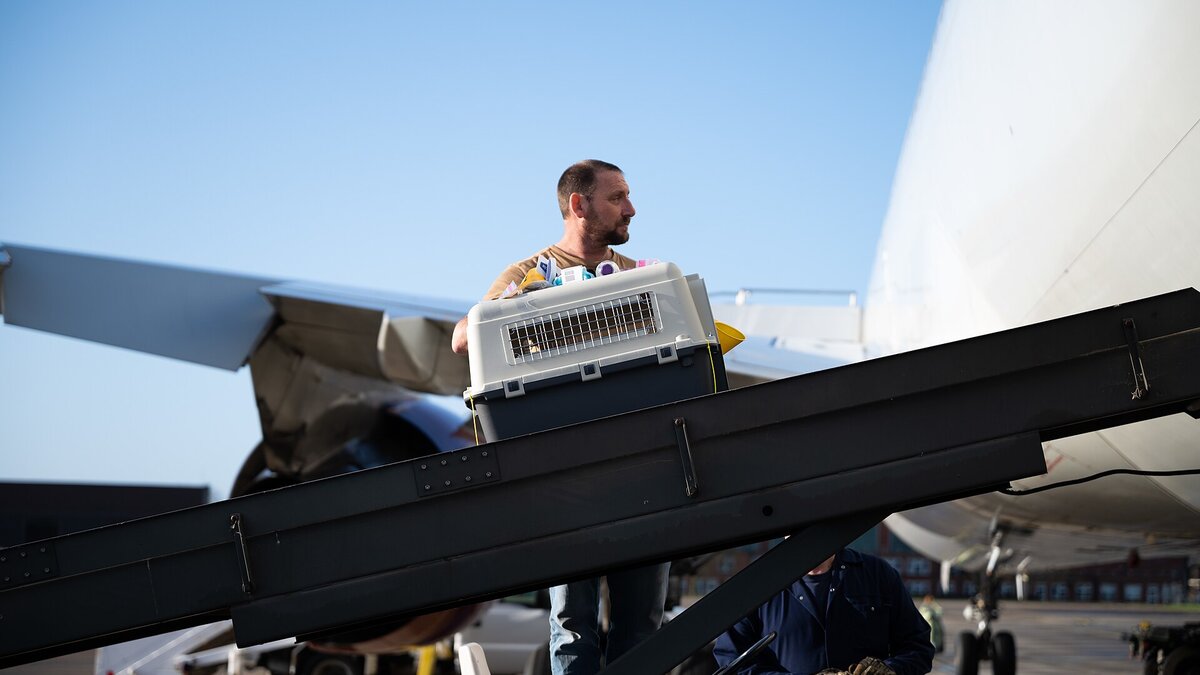
Cover image: A dog in an airline-approved travel crate being carried up the airstairs for loading onto a passenger aircraft. — photo by U.S. Air Force photo by Airman 1st Class Viviam Chiu, Public domain, via Wikimedia Commons.
How much does it cost to fly with a dog? For most US travellers in 2026 the direct answer is a flat in-cabin pet fee of roughly $95 to $150 each way, charged per flight segment on top of your own ticket. Allegiant is the outlier at $50 per segment, while American, Delta and United all sit at the top of the market at $150 one way — $300 for a domestic round trip, per NerdWallet's March 2026 fee survey. Cargo and checked-baggage programmes, where they still exist, cost more: Alaska Airlines charges $200 each way for its climate-controlled hold service. But the airline fee is only part of the bill. Once you add an airline-compliant carrier ($50-$500), a veterinary health certificate ($50-$300) and any destination paperwork, a first flight with a dog typically costs $300 to $800 all-in, and considerably more for international moves. Below is the verified fee table and the rules that decide what you actually pay.
How much does it cost to fly a dog in the cabin?
Every major US carrier charges the pet fee per segment, per direction — a round trip with one connection can trigger four charges on some itineraries. United also adds a $125 service charge for stopovers longer than four hours. Fees below were checked in August 2026 against airline pages and current fee surveys.
| Airline | In-cabin fee (each way) | As of / notes |
|---|---|---|
| Allegiant | $50 per segment | June 2026; cheapest US option, cabin only |
| Frontier | $99 | March 2026; no cargo option at all |
| Alaska Airlines | $100 | March 2026; also offers $200 cargo service up to 150 lb |
| Hawaiian Airlines | $100 ($35 within Hawaii) | March 2026; cut from $125; still accepts checked pets |
| Southwest | $125 (refundable) | January 2026; domestic only, cabin only |
| JetBlue | $125 | 2026; pet plus carrier capped at 20 lb |
| Spirit | $125 | 2026; soft carriers only, 40 lb combined limit |
| American Airlines | $150 | March 2026; $300 domestic round trip |
| Delta Air Lines | $150 domestic, $200 international | Raised 58% from $95 in early 2026 |
| United Airlines | $150 | March 2026; +$125 per 4-hour-plus stopover |
| Air Canada | CA$50-118 | 2026; varies domestic vs international |
| Lufthansa | €55-110 | 2026; varies by route length |
Allegiant at $50 per segment is now the cheapest US airline to fly with a dog, followed by Frontier at $99 and Alaska and Hawaiian at $100. The gap matters: a family flying Delta round trip with a connection each way could pay $600 in pet fees alone.
What are the carrier and size rules?
In-cabin travel is limited to small dogs (and cats) in a carrier that fits fully under the seat in front — in practice about 15-20 lb of pet and bag combined, though most airlines regulate by carrier dimensions rather than weight. Southwest's maximum soft carrier is 18.5 x 13.5 x 8.5 inches; JetBlue caps pet plus carrier at 20 lb.
Budget for the bag itself too: on Southwest, Alaska and most rivals the pet carrier counts as your carry-on or personal item, so a checked bag fee often sneaks into the trip total. Our airline baggage allowance guide explains how those allowances stack.
Can large dogs still fly in the hold?
Mostly not on the US majors. American, Delta, United, Southwest, JetBlue, Spirit, Frontier and Allegiant no longer sell hold transport to ordinary passengers — cabin only, with military and government exceptions at some carriers, and Delta routing commercial shipments through its separate Delta Cargo arm. Alaska ($200 each way, dogs up to 150 lb) and Hawaiian are the notable US survivors with true cargo or checked-pet programmes; otherwise big-dog owners need IPATA pet shippers, where cross-country moves start around $1,000 and international relocations can exceed $3,000-6,000.
How much does it cost to fly a dog internationally?
International trips add paperwork on both ends. Flying into the US, CDC rules in force since 1 August 2024 — and still current in August 2026 — require every dog to be at least six months old, microchipped, and covered by a free CDC Dog Import Form receipt. Dogs that have been in a high-risk rabies country in the previous six months also need certified rabies vaccination; foreign-vaccinated dogs without an approved blood-titer result face a 28-day quarantine at the owner's expense.
Add an accredited-vet health certificate with USDA endorsement (often $150-300 for international travel), destination requirements such as the EU animal health certificate, and higher fees like Delta's $200 international charge, and a transatlantic trip with a small dog realistically costs $500-1,000 before any shipper is involved. Note that standard travel insurance rarely covers pet costs, and pets are not covered by cash compensation schemes if things go wrong — see our flight delay compensation guide for what you can claim for yourself.
Do service dogs and emotional support animals pay pet fees?
Trained service dogs fly free in the cabin under the US Department of Transportation's Air Carrier Access Act rules, regardless of size or breed, with a one-page DOT attestation form. Emotional support animals lost that status under the DOT rule that took effect in January 2021: airlines may — and all US majors do — treat ESAs as ordinary pets, meaning the same fees, carriers and size limits listed above.
Frequently asked questions
What is the cheapest airline to fly with a dog in 2026?
Allegiant, at $50 per segment as of June 2026. Among full-network carriers, Frontier ($99), Alaska ($100) and Hawaiian ($100) undercut Southwest, JetBlue and Spirit ($125) and the big three at $150 each way.
Why is my total so much higher than the pet fee?
Fees are charged per segment and per direction, the carrier may use up your carry-on allowance, and you still need an airline-compliant carrier ($50-500) and often a vet health certificate ($50-300). That is how a "$125 fee" becomes a $300-800 first trip.
Can my dog fly in cargo on Delta, United or American?
Not as an ordinary passenger in 2026 — the big three are cabin-only for the public, with limited military and government exceptions and Delta referring shippers to Delta Cargo. Alaska and Hawaiian still offer hold transport; otherwise use an IPATA-member pet shipper.
What documents does my dog need to enter the United States?
Since August 2024: a microchip, proof the dog is at least six months old, and a CDC Dog Import Form receipt. Dogs arriving from high-risk rabies countries also need certified rabies vaccination and, if foreign-vaccinated, an approved titer test or a 28-day quarantine.
Do emotional support animals still fly free?
No. Since the DOT rule change effective January 2021, US airlines treat emotional support animals as pets, with standard pet fees and carrier rules. Only trained service dogs, documented on the DOT attestation form, travel free in the cabin.
Sources
- NerdWallet — The Best Airlines for Flying With Pets in 2026
- Upgraded Points — Southwest Airlines Pet Policy (2026)
- Sniffspot — Which Airlines Allow Dogs in Cabin? 2026 Guide
- Travel Ready Pets — Airline Pet Travel Costs 2026
- CDC — Dog Import Form and Instructions
- US Department of Transportation — Service Animals





Post a comment