

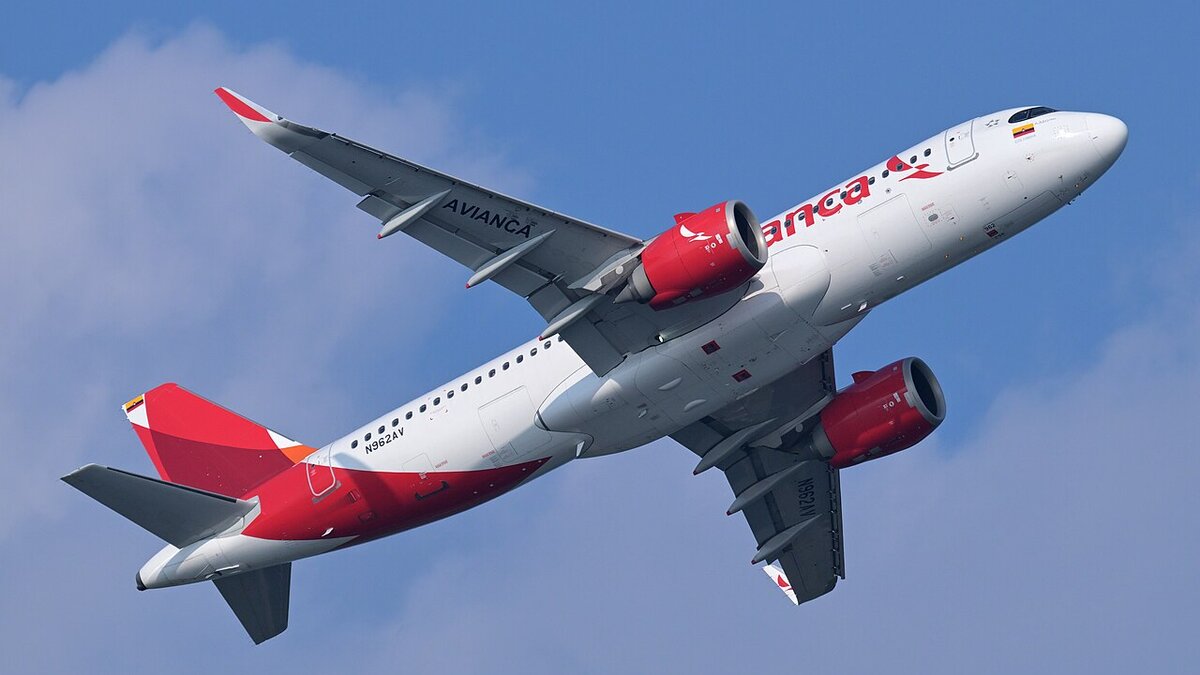
Avianca and Gol parent Abra Group grew Q2 2026 revenue 17.7% to US$2.59 billion and carried 17.6 million passengers, but an 80% jump in fuel costs widened losses and forced capacity cuts.
Cover image: Avianca Airbus A320neo climbing after takeoff against a blue sky — photo by 4300streetcar, CC BY 4.0, via Wikimedia Commons.
Abra Group, the UK-incorporated holding company that owns Colombia's Avianca and Brazil's Gol, reported operating revenue of US$2.59 billion for the second quarter of 2026, up 17.7% year-on-year on a pro forma basis, as its airlines carried 17.6 million passengers — 4.3% more than a year earlier. But the top-line growth was swamped by fuel: the group's aircraft fuel bill surged 80.2% to US$984 million, from US$546 million in the same period last year, and losses widened sharply. Air Data News, citing the group's financial statements, put the net loss at US$766 million, against a US$178 million loss a year earlier.
In response, Abra cut planned flying, recovered about 49% of the higher fuel costs, and delivered US$70 million in cost savings plus US$75 million in additional synergies between its carriers. FlightGlobal reports the group now aims to recapture the rest of the fuel shock through higher fares — a signal that air travel across Latin America is about to get more expensive.
What do Abra Group's Q2 2026 numbers show?
Demand held up well. Passenger revenue rose 18.3% to US$2.15 billion, cargo and other revenue climbed 14.8% to US$448 million, and capacity grew 6.5% to 30.7 billion available seat kilometres (ASKs) with a broadly flat load factor of 79.7%. The group operated roughly 74,000 flights across more than 370 routes in 27 countries.
Profitability told the opposite story. Adjusted EBITDAR fell 61.7% to US$195 million, compressing the margin from 23.1% to just 7.5%. The quarter lands in the middle of a bruising global airline Q2 2026 earnings season in which fuel has been the dominant swing factor for carriers on every continent.
| Metric (Q2 2026) | Result | Change YoY |
|---|---|---|
| Operating revenue | US$2.59bn | +17.7% (pro forma) |
| Passengers carried | 17.6 million | +4.3% |
| Aircraft fuel expense | US$984m | +80.2% |
| Adjusted EBITDAR | US$195m (7.5% margin) | -61.7% |
| Net loss (per Air Data News) | US$766m | vs US$178m loss |
| Load factor | 79.7% | Broadly flat |
Why did Abra Group's losses widen?
Fuel, almost entirely. The US$984 million kerosene bill included roughly US$445 million in additional costs versus the prior year, according to Air Data News — an increase no Latin American carrier could fully offset in a single quarter through fares or productivity. The mechanics of how jet-fuel costs feed through into airfares mean pricing typically lags a fuel spike by several months.
Abra's countermeasures recovered about half the hit:
- 49% of the incremental fuel cost recouped in the quarter, per the group's release;
- US$70 million of cost savings delivered;
- US$75 million of additional synergies between Avianca and Gol;
- Planned capacity trimmed — Air Data News reports reductions of about 1% at Avianca and 6% at Gol.
The balance sheet still carries weight: liquidity stood at about US$2.06 billion, including US$1.4 billion in cash and short-term investments, while Air Data News put net debt at US$9.4 billion, or 3.7 times adjusted EBITDAR.
How are Avianca and Gol performing individually?
Avianca carried 9.1 million passengers (up 3.7%) on 18.5 billion ASKs, with a 78.8% load factor and passenger yields up 9.1%. Gol carried 8.5 million passengers (up 5%) on 12.2 billion ASKs at an 81% load factor, with yields up 12% — evidence both brands are already pushing price. Gol, which emerged from US Chapter 11 bankruptcy protection in 2025 before folding into Abra's combined structure, is leaning hardest on capacity discipline with its 6% cut.
The group's fleet stood at 310 operating aircraft out of 328 contracted, and Abra has up to 45 Embraer E195-E2s on order alongside 100 CFM LEAP-1A engines. Its LifeMiles and Smiles loyalty programmes count roughly 48 million combined members — a cash-generative asset in downturns, as anyone who understands how airline miles programmes make money will recognise.
Will airfares in Latin America rise?
That is the explicit plan. FlightGlobal reports Abra intends to keep pushing fares up to recapture fuel costs while preserving liquidity through what management called a challenging environment. With Avianca and Gol together commanding leading positions in Colombia and Brazil, and rivals LATAM Airlines Group, Panama's Copa Airlines and Dominican low-cost entrant Arajet facing the same fuel curve, the whole region has an incentive to price up rather than chase share.
For travellers, that points to firmer fares on intra-Latin America trunk routes into 2027, with capacity cuts tightening seat supply just as demand keeps growing. Consolidation pressure across the Americas, from Abra's dual-brand model to the unwinding of the Delta–Aeromexico joint venture, only reinforces the pricing power airlines are trying to rebuild.
"We continue to deploy our vision of strengthening connectivity across Latin America and creating new travel opportunities," Abra chief executive Adrian Neuhauser said in the results release.
Frequently asked questions
What were Abra Group's Q2 2026 results?
Abra Group reported operating revenue of US$2.59 billion for the quarter ended 30 June 2026, up 17.7% year-on-year on a pro forma basis, with 17.6 million passengers carried, up 4.3%. However, an 80.2% surge in fuel costs to US$984 million cut adjusted EBITDAR by 61.7% to US$195 million, and Air Data News reports the net loss widened to US$766 million.
Why did Abra Group lose money despite record revenue?
Fuel was the culprit. The group's aircraft fuel bill rose 80.2% year-on-year, adding roughly US$445 million in costs that revenue growth could not absorb within the quarter. Abra recovered about 49% of the increase through fares, US$70 million in cost savings and US$75 million in synergies, but the remainder flowed straight through to a wider loss.
Will Avianca and Gol fares go up?
Almost certainly. FlightGlobal reports Abra plans to recapture its higher fuel costs through increased fares while trimming capacity — about 1% at Avianca and 6% at Gol, per Air Data News. Yields were already rising 9–12% in the quarter, and fewer seats plus growing demand across Latin America typically translate into firmer ticket prices into 2027.
Who owns Abra Group?
Abra Group is a UK-incorporated holding company created by the principal shareholders of Avianca and Gol. It controls Colombia's Avianca and Brazil's Gol as separately branded airlines, alongside the LifeMiles and Smiles loyalty programmes, which count around 48 million combined members. The group operates more than 370 routes serving 145 destinations in 27 countries.
Sources
- PR Newswire — Abra reports 2Q 2026 results supported by revenue growth and expanding connectivity
- Air Data News — Abra Group revenue rises 18% but fuel costs weigh on second-quarter results
- FlightGlobal — Abra Group looks to recapture fuel costs through increased fares after 'challenging' quarter
- Aeroflap — Abra, owner of Gol and Avianca, reports strong growth in revenue and margin


Post a comment