The US State Department made its visa bond program permanent on 3 August 2026. B-1/B-2 applicants from 50 designated countries can now be required to post refundable bonds of $10,000, $15,000 or $20,000 — here is how the scheme works and who it affects.
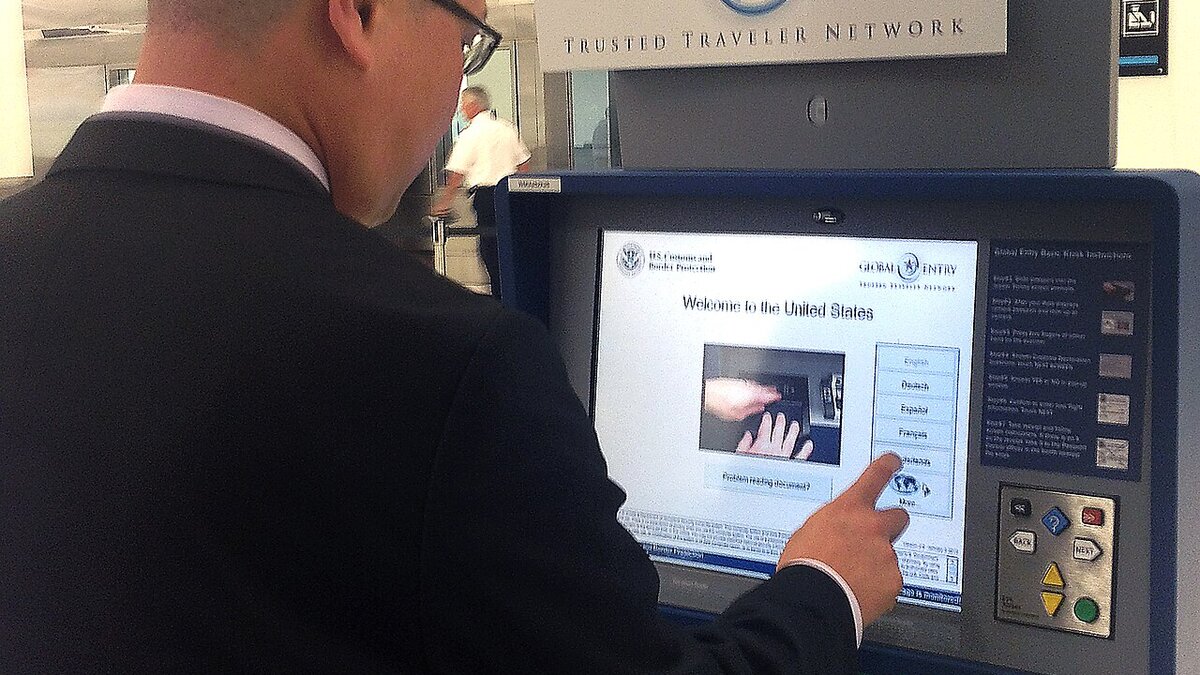
Cover image: Traveller completes entry screening at a US Customs and Border Protection Global Entry kiosk — photo by U.S. Customs and Border Protection, Public domain, via Wikimedia Commons.
The United States has made its visa bond requirement permanent. A final rule from the US Department of State, published in the Federal Register and effective 3 August 2026, lets consular officers require applicants for B-1 business and B-2 tourist visas from 50 designated countries to post a refundable bond of $10,000, $15,000 or $20,000 before a visa is issued. Officers are expected to set the bond at $15,000 in most cases, with discretion to adjust either way, according to immigration law firm Fragomen. Travellers who comply with their visa terms and leave on time get the full amount back, without interest.
The permanent scheme replaces — and raises the stakes of — a 12-month pilot that began on 20 August 2025 with just two countries, Malawi and Zambia. The pilot allowed bonds of $5,000, $10,000 or $15,000; the final rule scraps the $5,000 tier and lifts the ceiling to $20,000, with inflation adjustments to the maximum from 1 October 2027, per Erickson Immigration Group.
How does the US visa bond actually work?
The bond is posted after a consular officer approves the application but before the visa is issued. Payment is made online using Form I-352 through the US Treasury's pay.gov portal, and a third party — a relative or sponsor, for example — may post the bond on the applicant's behalf, according to Fragomen.
Bonded visas carry tighter conditions than a standard B-1/B-2. Holders receive single- or multiple-entry visas valid for three to twelve months, depending on reciprocity, and must enter and leave the United States through a commercial airport, including US Customs and Border Protection (CBP) preclearance locations. During the pilot, arrivals were limited to a designated list that reached nine airports by January 2026 — including New York JFK, Atlanta, Chicago O'Hare, Los Angeles and preclearance at Toronto and Montréal — with more added on a rolling basis, according to law firm Ogletree Deakins. Land borders, seaports, charter and private aviation are off-limits.
If the traveller departs on time without breaching their status, the bond is generally cancelled automatically and refunded to the original payer through the Treasury system.
| Feature | Pilot (Aug 2025 – Aug 2026) | Permanent (from 3 Aug 2026) |
|---|---|---|
| Bond tiers | $5,000 / $10,000 / $15,000 | $10,000 / $15,000 / $20,000 |
| Standard amount | Case-by-case, up to $15,000 | $15,000 |
| Countries covered | 2 at launch, 50 by April 2026 | 50 (rolling list) |
| Inflation indexation | None | Periodic, from 1 Oct 2027 |
Which countries are on the visa bond list?
The list — maintained on travel.state.gov — reached 50 countries on 2 April 2026; 30 of the 50 are African states. Key stages, per Ogletree Deakins:
- 20 August 2025: Malawi, Zambia
- October 2025: The Gambia (11th); Mauritania, São Tomé and Príncipe, Tanzania (23rd)
- 1 January 2026: Bhutan, Botswana, Central African Republic, Guinea, Guinea-Bissau, Namibia, Turkmenistan
- 21 January 2026: 25 more, including Algeria, Bangladesh, Cuba, Nepal, Nigeria, Senegal, Uganda, Venezuela and Zimbabwe
- 2 April 2026: Cambodia, Ethiopia, Georgia, Grenada, Lesotho, Mauritius, Mongolia, Mozambique, Nicaragua, Papua New Guinea, Seychelles, Tunisia
The roster is deliberately fluid: countries can be added with at least 15 days' notice on travel.state.gov, while removals take effect immediately, according to Fragomen.
Why were these countries chosen?
The State Department targets countries with high B-1/B-2 overstay rates in the Department of Homeland Security's annual Entry/Exit Overstay Report, or with weak screening, identity-verification and document-security practices. The FY2023 DHS report found the highest B-visa overstay rates concentrated in African countries plus Haiti, Laos, Myanmar and Yemen, according to PolitiFact.
Critics note the absolute numbers are small: the Center for Global Development calculated that Malawi and Zambia, the first two designees, together accounted for about 625 B-visa overstayers in 2023 — just 0.2% of the global total. The State Department counters that nationals of the 50 listed countries recorded more than 45,000 overstays in FY2024, per Erickson Immigration Group.
What did the 2025–26 pilot show?
Demand far exceeded forecasts: the department estimated around 2,000 applicants would be affected, but roughly 20,000 applied under the pilot, and about half posted bonds, according to Fragomen's analysis of the final rule. Fewer than 50 overstays were recorded among bonded travellers in the pilot's first ten months, per Erickson Immigration Group.
The deterrent effect was stark: B-visa issuance to nationals of pilot countries fell 83% year on year, according to Fragomen. For travel sellers that is the operative number: a five-figure deposit prices many legitimate visitors out of US trips entirely.
What happens if a traveller overstays?
The bond is forfeited to the US government for substantial breaches. Triggers include overstaying, unauthorised employment, filing a late extension or change-of-status request, failing to leave within 10 days of a denial — and, notably, filing an asylum application (Form I-589) or other humanitarian request, according to Fragomen. DHS makes the breach determination, and forfeited funds go to the Treasury. Travellers who properly file a timely extension or change of status keep their refund rights.
How does the bond fit into wider US entry tightening in 2026?
The bond is one strand of a broader hardening of US entry rules. Since 6 September 2025 — with guidance reaffirmed in December 2025 — the State Department directs nonimmigrant applicants to interview at a US embassy or consulate in their country of nationality or residence, warning third-country applicants of longer waits and tougher odds, according to NAFSA. A separate $250 "visa integrity fee", enacted in July 2025 under the One Big Beautiful Bill Act, is being layered on top of the $185 application fee, with uneven rollout across consulates. Fee inflation is a global trend — see our breakdown of Japan's visa fee increases from July 2026.
None of this touches the 40-plus Visa Waiver Program nationalities, who continue to enter the US under ESTA and the visa waiver entry rules without bonds or interviews. Europe's own pre-travel screening layer, ETIAS, will cost €20; a conventional Schengen visa costs €90. For inbound US tourism, already under pressure in 2026, the 83% issuance drop is the number to watch as the list evolves.
Frequently asked questions
Do travellers get the visa bond money back?
Yes, in full, provided they comply with their visa conditions and depart on time through a commercial airport — or properly file a timely extension or change of status. The bond is generally cancelled automatically and refunded to the original payer, without interest.
Does the visa bond apply to ESTA or Visa Waiver Program travellers?
No. The bond applies only to B-1/B-2 visitor-visa applicants from the 50 designated countries. Visa Waiver Program nationals travelling under ESTA, and other visa categories such as students or workers, are outside the scheme.
Who can pay the bond, and how is it posted?
The bond is posted online via Form I-352 on the Treasury's pay.gov portal, after visa approval but before issuance. A third party, such as a relative or sponsor, may pay on the applicant's behalf.
Can countries be added to or removed from the bond list?
Yes. Additions require at least 15 days' public notice on travel.state.gov; removals take effect immediately. Check the current list before booking a consular interview.
Sources
- Federal Register — Visas: Visa Bond Program (final rule)
- Fragomen — B-1/B-2 visa bond program made permanent, bond amounts increased
- Ogletree Deakins — Visa bond program: 32 new countries and 6 new airports
- Ogletree Deakins — Visa bond program: 12 new countries added
- Erickson Immigration Group — DOS finalizes permanent visa bond program
- PolitiFact — What is a visa bond? Who is affected?
- Center for Global Development — Do US visa restrictions target overstays, or poor countries?
- NAFSA — DOS guidance on visa interview location for NIV applicants