

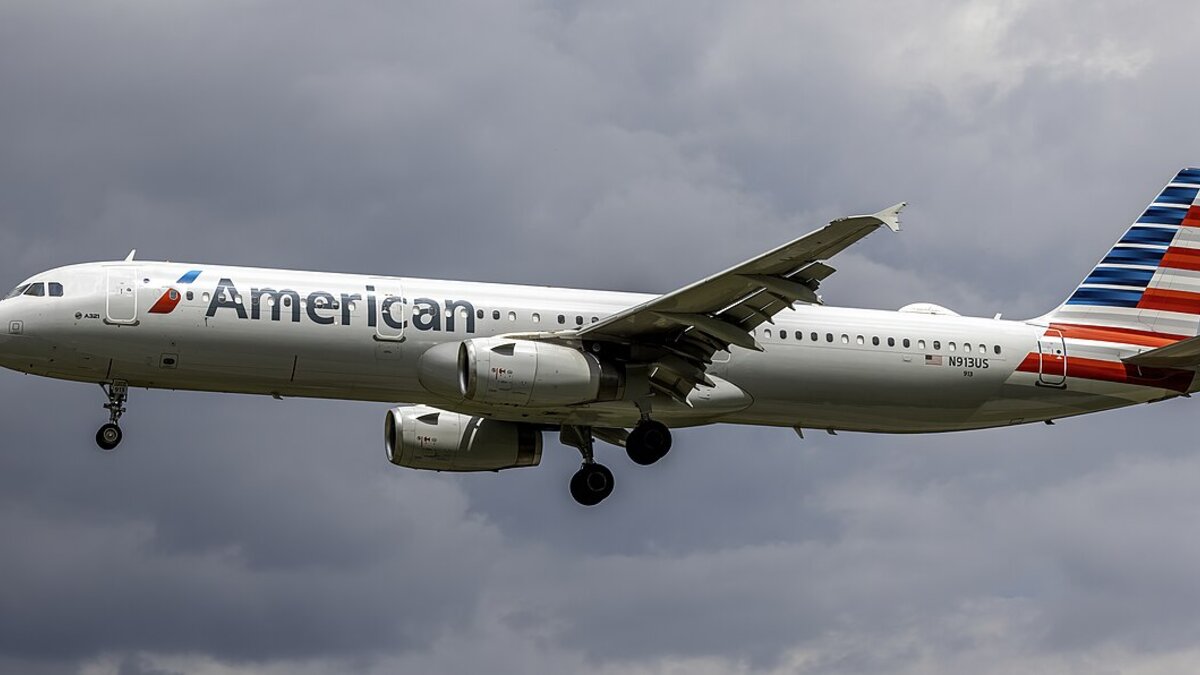
A passenger's laptop caught fire aboard American Airlines Flight 2398 from Atlanta to Dallas–Fort Worth on 21 August, leaving several passengers with minor burns before crew contained the device in a thermal bag.
Cover image: American Airlines Airbus A321 in flight against blue sky — photo by Acroterion, CC BY-SA 4.0, via Wikimedia Commons.
A laptop fire on American Airlines Flight 2398 forced cabin crew into emergency mode on Friday 21 August 2026, when a passenger's computer began smoking and then ignited roughly 30 minutes before landing. The Airbus A321, flying from Atlanta to Dallas–Fort Worth with 133 people aboard, landed safely at DFW at around 6:55 p.m. local time, CBS News reported. The pilot told controllers that four to five passengers had suffered burns to their hands — several while trying to help smother the device — and one person was treated by medics on the ground and released. Flight attendants sealed the burning laptop inside a thermal containment bag within about five minutes, and the aircraft taxied to the terminal under its own power. "We thank our crew for their professionalism and swift response to quickly contain the device," American Airlines said in a statement. The incident is the latest in a steady rise of lithium-battery fires on US passenger aircraft — events the FAA says now occur nearly twice a week.
What happened on American Airlines Flight 2398?
According to air traffic control audio cited by CBS News, the pilot reported a "cabin fire in the back of the airplane" and said flight attendants were working to put it out as the jet descended towards Dallas–Fort Worth. Smoke spread through the cabin as the laptop entered thermal runaway — the uncontrolled, self-accelerating overheating that lithium-ion cells can suffer after damage, overcharging, overheating or exposure to liquids.
Crew followed the standard playbook: isolate the device, cool it, and lock it inside a fire-resistant containment bag, which most large US carriers now stock on board. Simple Flying reported the aircraft was met by emergency vehicles at DFW but taxied to Terminal C normally. The injuries — burned hands among passengers seated nearby, some of whom tried to assist — were minor, with one passenger treated and released.
The outcome mirrors other recent cabin incidents where quick crew intervention prevented escalation, in contrast to events such as the Air India turbulence injuries on the Phuket–Delhi route, where passengers had far less warning.
How often do lithium batteries catch fire on planes?
More often every year. FAA data cited by CBS News shows at least 56 lithium-battery incidents involving smoke, fire or extreme heat on flights in 2026 so far. That follows 93 verified incidents in 2025 — about 4.5% up on the year before, with roughly 80 of them on passenger aircraft rather than freighters, according to FAA figures compiled by hazmat trainer Lion Technology.
The longer trend is starker: lithium-battery events on US flights have risen 388% since 2015, per FAA data reported by CBS News. Portable power banks are the most common culprit, followed by e-cigarettes and phones; laptops accounted for only 8 of the 93 incidents logged in 2025. The growth tracks the sheer number of devices now carried — a typical passenger boards with three or more lithium-powered items.
What are the rules for laptops and power banks on flights?
Rules have tightened sharply since an Air Busan A321 was destroyed by a power-bank fire on the ground in January 2025. The essentials:
- Never put laptops, power banks or spare batteries in checked bags. Spare lithium batteries are banned from the hold worldwide; a fire in the cargo compartment cannot be fought by crew.
- Southwest Airlines became the first US carrier to require power banks to stay in plain sight while in use, and from 20 April limits passengers to a single portable charger, which must stay out of overhead bins.
- Asian carriers have gone further: Korean Air, Asiana, EVA Air, Singapore Airlines, Scoot and Thai Airways ban using power banks to charge devices in-flight altogether, and prohibit recharging them from in-seat USB ports, CNN reported.
- American, Delta and United have also introduced portable-charger restrictions, per Simple Flying.
Our full airline-by-airline breakdown is in the guide to power bank rules on planes, including watt-hour limits by airline, and vapers should note the parallel restrictions covered in the rules for bringing a vape on a plane — e-cigarettes are the second-most-common source of onboard battery fires.
What should passengers do if a device catches fire mid-flight?
Tell the crew immediately — do not try to be a hero. Several of the burned hands on Flight 2398 belonged to passengers who intervened. Flight attendants are trained for thermal-runaway events and have fire gloves, extinguishers and containment bags.
Prevention matters just as much:
- Don't crush devices in seat mechanisms. A phone or laptop that slips into a reclining seat can be pinched and punctured — a classic thermal-runaway trigger. Ask crew to retrieve it rather than moving the seat.
- Keep devices where you can see them, not buried in an overhead bin where smoke goes unnoticed. Pressure on bin space — which will only grow as carriers such as Jetstar move to charge for overhead bin access from 2027 — makes under-seat storage the safer habit anyway.
- Stop using any device that feels hot, swells or smells odd, and hand it to crew.
- Buy certified batteries and avoid cheap, unbranded power banks, a disproportionate source of incidents.
Flight 2398 ended as a footnote rather than a disaster because the system worked: an alert cabin, a trained crew and a containment bag used within minutes. With US battery incidents already past the mid-fifties for 2026, it will not be the last test.
Frequently asked questions
What caused the fire on American Airlines Flight 2398?
A passenger's laptop entered thermal runaway — uncontrolled overheating of its lithium-ion battery — and ignited in the cabin about 30 minutes before landing. Flight attendants contained the burning device in a thermal containment bag within roughly five minutes, and the Airbus A321 landed safely at Dallas–Fort Worth at about 6:55 p.m. on 21 August 2026.
Was anyone hurt in the American Airlines laptop fire?
The pilot reported four to five passengers with burns to their hands, several of them injured while trying to help smother the device. Injuries were minor: one passenger was treated by medical personnel on the ground at DFW and released. All 133 people aboard deplaned normally after the aircraft taxied to the terminal under its own power.
How common are lithium battery fires on planes?
FAA data cited by CBS News records at least 56 incidents of lithium batteries smoking, catching fire or overheating on US flights in 2026 so far, after 93 in 2025. Events now occur nearly twice a week on average and have risen 388% since 2015. Power banks are the leading cause, followed by e-cigarettes and phones.
Can I put my laptop in checked luggage?
Avoid it. Spare lithium batteries and power banks are banned from checked bags outright, and regulators strongly advise keeping laptops in the cabin, where a fire can be detected and fought within seconds. If a laptop must be checked, it should be switched fully off — not asleep — and protected from being crushed.
What should I do if my phone or laptop starts smoking on a flight?
Alert the cabin crew immediately and move away from the device. Do not attempt to grab or smother it yourself — that is how passengers on Flight 2398 burned their hands. Crew are trained to cool the device and seal it in a fire-containment bag. Also tell crew if a device slips into your seat mechanism, before moving the seat.
Sources
- CBS News — Laptop catches fire on American Airlines flight from Atlanta to Dallas
- Simple Flying — Passengers burned after laptop fire on American Airlines Airbus A321
- Lion Technology — FAA: 93 lithium battery air incidents in 2025
- CBS News — Lithium battery fires on U.S. flights now occur nearly twice a week, FAA data shows
- CNN — Why are a growing number of airlines banning power banks on flights?
- Gizmodo — Southwest is about to limit power banks on flights




Post a comment