

Japan's record tourism boom has brought a wave of new and higher visitor charges in 2026: a tripled ¥3,000 departure tax, Kyoto's ¥200–¥10,000 hotel tax, a ¥4,000 Mount Fuji fee and new lodging taxes across the country. Here is what a typical trip now pays.
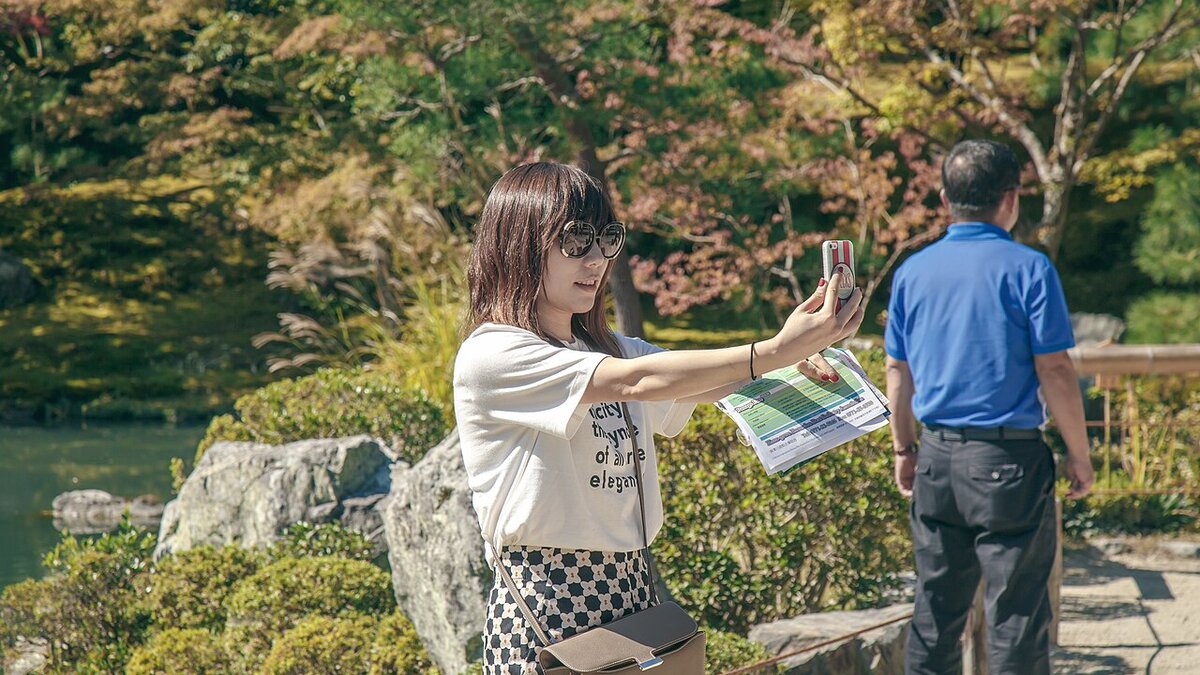
Cover image: Tourist taking a smartphone photo in a Kyoto temple garden — photo by John Gillespie from New York, USA, CC BY-SA 2.0, via Wikimedia Commons.
The Japan tourist tax bill for 2026 is now clear, and it is roughly double what visitors paid a year ago. A couple spending a week in Japan — four mid-range nights in Tokyo and three in Kyoto — now pays about ¥10,000 (roughly US$65) in tourist taxes and fees, against about ¥4,800 for the same itinerary in 2025. The two drivers: Japan's International Tourist Tax, the departure levy collected through airline tickets, tripled from ¥1,000 to ¥3,000 per person on 1 July 2026; and Kyoto's accommodation tax, restructured on 1 March 2026 into five tiers running from ¥200 to ¥10,000 per person, per night — a tenfold increase at the top end and now Japan's highest lodging tax. Add a Mount Fuji climb and each hiker pays a further ¥4,000 trail fee on any of the four main routes. None of these charges is going away: they are the policy response to Japan's record inbound year, which saw 42.7 million foreign visitors in 2025, and to 2026 arrivals that are tracking ahead of even that pace.
How much is Japan's departure tax in 2026?
The International Tourist Tax — commonly called the departure tax or sayonara tax — rose from ¥1,000 to ¥3,000 per departure on 1 July 2026, after the ruling parties wrote the increase into the FY2026 tax reform outline. It applies to everyone leaving Japan by air or sea, Japanese citizens included, and is collected automatically as a surcharge on the airline or ferry ticket, so there is nothing to pay at the airport. Tickets issued on or before 30 June 2026 remained at the old ¥1,000 rate under transition rules.
The government has earmarked the extra revenue for overtourism countermeasures and for spreading visitor demand beyond the crowded golden-route cities. For a family of four, the levy now adds ¥12,000 to the cost of flying home. Separately, Japan also raised its visa fees from July 2026, a change that mainly affects nationalities that cannot travel visa-free.
How does Kyoto's hotel tax work?
Kyoto replaced its old three-band accommodation tax (¥200–¥1,000) with a five-tier structure on 1 March 2026, charged per person, per night and set by the nightly accommodation charge per guest:
- Under ¥6,000: ¥200
- ¥6,000–19,999: ¥400
- ¥20,000–49,999: ¥1,000
- ¥50,000–99,999: ¥4,000
- ¥100,000 and over: ¥10,000
The top rate is a tenfold increase and the steepest lodging tax in Japan. Crucially for booking behaviour, the tax is usually not included in online booking prices — it is collected by the hotel or ryokan at check-in or check-out, in addition to the 10% consumption tax. A couple in a luxury property at ¥100,000-plus per person now pays ¥20,000 per night in city tax alone; a mid-range couple pays ¥800 a night. Student groups on school excursions remain exempt.
Do I have to pay to climb Mount Fuji in 2026?
Yes. For the 2026 summer season, all four main routes — Yoshida, Subashiri, Gotemba and Fujinomiya — charge a ¥4,000 entry fee per climber, and advance online registration is mandatory before reaching the trailhead. Yamanashi's popular Yoshida trail also operates a daily cap of 4,000 climbers; the three Shizuoka-side trails have no numerical cap but require registration through the prefecture's app, including a short e-learning module. Same-day entry on the Yoshida route is only possible if the cap has not been reached, so trade partners selling Fuji products should book slots when itineraries are confirmed.
Which other Japanese cities and prefectures charge lodging taxes?
Kyoto is the headline, but 2026 is the year accommodation taxes went national. Hokkaido introduced Japan's first prefecture-wide lodging tax on 1 April 2026, at ¥100–¥500 per person, per night depending on room rate — and Sapporo levies its own ¥200–¥500 on top, so guests in the city pay both. Tokyo continues its long-standing tax of ¥100–¥200 per person per night (stays under ¥10,000 are exempt), while Osaka charges up to ¥500 per person per night following a recent revision, with stays under ¥5,000 exempt. Hiroshima Prefecture (¥200 on stays of ¥6,000-plus), Gifu City, Toba and Yugawara have all joined the list, and Okinawa and Miyazaki are preparing schemes. In every case the pattern is the same: per person, per night, payable at the property rather than through the booking platform.
| Charge | Amount | Who pays / when | In effect since |
|---|---|---|---|
| International Tourist Tax (departure tax) | ¥3,000 per person (was ¥1,000) | All departing travellers; collected in the air/sea ticket price | 1 July 2026 |
| Kyoto accommodation tax | ¥200–¥10,000 per person, per night (5 tiers) | Guests, at check-in/out; usually not in online booking price | 1 March 2026 |
| Hokkaido prefectural lodging tax | ¥100–¥500 pp/night (+¥200–¥500 Sapporo city tax) | Guests, at the property | 1 April 2026 |
| Tokyo accommodation tax | ¥100–¥200 pp/night (under ¥10,000 exempt) | Guests, at the property | 2002 |
| Osaka accommodation tax | Up to ¥500 pp/night (under ¥5,000 exempt) | Guests, at the property | 2017 (rates revised 2025) |
| Mount Fuji climbing fee | ¥4,000 per climber, all four main trails | Climbers; advance online registration, Yoshida capped at 4,000/day | 2026 summer season |
Why is Japan raising tourist taxes now?
The maths of the boom explain the policy. Japan welcomed a record 42.7 million international visitors in 2025 — up 15.8% on 2024 and the first time past 40 million — who spent a record ¥9.45 trillion. The government is targeting 60 million visitors and ¥15 trillion in spending by 2030, and has chosen to fund crowd management, transport and dispersal measures through visitor levies rather than throttle demand. It is the same playbook now visible from Barcelona to Venice, where tourist taxes are also climbing. For the trade, the practical takeaway is disclosure: lodging taxes are typically excluded from OTA prices and collected at the desk, so quoting them up front avoids the check-in dispute that damages the client relationship, not the destination.
Frequently asked questions
How much is the Japan tourist tax in 2026?
Japan's International Tourist Tax is ¥3,000 per person for departures from 1 July 2026, tripled from ¥1,000. It is collected automatically in the price of your air or sea ticket, so there is nothing to pay separately at the airport. On top of that, many cities charge per-night accommodation taxes at the hotel, and Mount Fuji climbers pay a ¥4,000 trail fee.
Is Kyoto's hotel tax included in my booking price?
Usually not. Kyoto's accommodation tax — ¥200 to ¥10,000 per person, per night from 1 March 2026, depending on your nightly rate — is generally excluded from online booking totals and collected by the hotel or ryokan at check-in or check-out, on top of Japan's 10% consumption tax. Budget for it in cash or card when you arrive, and check your booking confirmation's fine print.
Do I have to pay to climb Mount Fuji in 2026?
Yes. All four main summit trails — Yoshida, Subashiri, Gotemba and Fujinomiya — charge ¥4,000 per climber for the 2026 season, and advance online registration is mandatory. The Yoshida trail on the Yamanashi side is capped at 4,000 climbers per day, so reserve early for peak July and August dates; Shizuoka's trails require registration and a short e-learning course but have no daily cap.
Do children pay Japan's tourist taxes?
Children under two are exempt from the ¥3,000 departure tax, as are passengers transiting Japan within 24 hours. Accommodation taxes are charged per person regardless of age in most cities, although exemptions vary by municipality — Kyoto, for example, exempts student groups on school excursions. Check the specific city's rules, as thresholds and exemptions differ across Japan.
How much will a week in Japan cost in tourist taxes for two people?
For a couple on a typical seven-night trip — four mid-range nights in Tokyo and three in Kyoto — expect around ¥10,000 in taxes: ¥6,000 in departure tax, about ¥1,600 in Tokyo lodging tax and ¥2,400 in Kyoto. The same trip cost roughly ¥4,800 in 2025. Add ¥8,000 if you both climb Mount Fuji, and far more for luxury Kyoto stays, which carry up to ¥10,000 per person, per night.
Sources
- Japan Tourism Agency (MLIT) — International Tourist Tax: JPY 3,000 per departure from 1 July 2026 (PDF)
- Travel Voice — Ruling parties specify a rise in departure tax to 3,000 yen in the Tax Reform Outline for FY2026
- Japan Travel — Kyoto lodging taxes to increase from March 2026
- Time Out — What do you need to know about Japan's new lodging tax?
- The Japan Times — Foreign visitors to Japan topped 40 million in 2025
- LIVE JAPAN — Hokkaido accommodation tax 2026: what it is, who pays
- Time Out Tokyo — Japanese govt plans to raise visa fees and departure tax in 2026


Post a comment