

On an 8-hour flight, business class is worth it if you're paying 2-3x economy and flying overnight — you land rested and save a day. At 4-5x the economy fare on a daytime flight, premium economy usually wins.
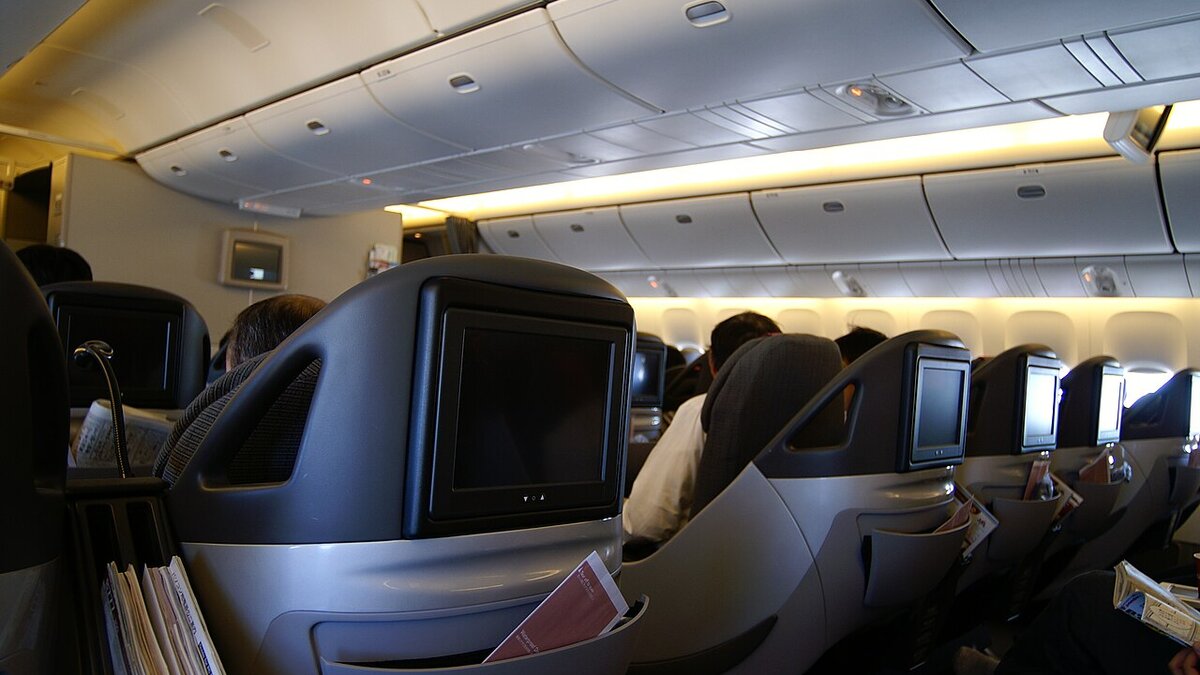
Cover image: the premium cabin of a widebody aircraft with lie-flat style seats and seatback screens — photo by Hideyuki KAMON from Takarazuka / ???, Hyogo / ???, Japan / ??, CC BY-SA 2.0, via Wikimedia Commons.
Business class is usually worth it for an 8-hour flight only when three things line up: the fare is around 2–3× economy, the flight is overnight, and sleeping on the plane saves your next day. That's when a lie-flat seat converts directly into usable vacation or working hours. When the fare gap stretches to 4–5× economy — common on daytime transatlantic peak dates — most leisure travelers get better value from premium economy and a good night's sleep on arrival.
Eight hours is exactly the sector where this decision gets expensive and emotional: it's the New York–London, London–New York, Dubai–London, Los Angeles–Paris band of routes where business cabins are at their best and their priciest. Here's how to run the numbers honestly.
What an 8-hour business class ticket actually buys you
- A seat that becomes a bed. On widebody long-haul routes, business means direct aisle access and a lie-flat bed (roughly 6'1"–6'6" of flat surface on modern products) versus a 31–32" pitch economy recliner. This is the entire product case: on an overnight sector it is the difference between landing wrecked and landing functional.
- The airport experience. Lounge access before the flight (showers, food, quiet), priority check-in/security/boarding, and priority baggage. If you land at 7 a.m. with a 9 a.m. meeting, this is worth real money; if you're starting a beach holiday, much less.
- Food, drink and Wi-Fi. Multi-course dining on china, free alcohol, and on most network carriers included connectivity.
- Flexibility. Business fares typically carry lower change fees and better rebooking options when things go wrong — worth something on winter routes.
The price gap, with real numbers
Fare-analysis site Winghoppers' pricing breakdown illustrates the typical spread on the classic 8-hour routes: off-peak New York–London round trips run roughly $450–700 in economy versus $2,200–3,200 in business — about a 4–5× multiple — while New York–Tokyo shows economy at $900–1,400 against business at $2,800–3,800, closer to 3×. Their broader observation matches what fare watchers see generally: the multiple shrinks as the base fare rises, and on competitive or leisure-heavy routes business can dip below 2× economy in off-peak windows. That 2–3× zone is exactly where the "worth it" math starts working for an overnight flight.
The demand side confirms this isn't a niche indulgence: IATA's World Air Transport Statistics found international premium-cabin travel grew 11.8% in 2024, outpacing the 11.5% growth in economy, with 116.9 million premium passengers — 6% of all international travelers. Europe is the largest premium market (39.3 million premium passengers), and the Middle East has the highest premium share of any region at 14.7% — the Gulf carriers' 8-hour business cabins are their most profitable real estate.
| Economy | Premium economy | Business (8-hr) | |
|---|---|---|---|
| Seat | 31–32" pitch, reclines a few inches | ~38" pitch, wider, bigger rest | Lie-flat bed, direct aisle access |
| Typical fare vs economy | 1× | ~1.5–2× | ~2–5× (route and season dependent) |
| Sleep on an overnight 8-hr | Poor | Mediocre | Genuinely restorative |
| Lounge / priority | No | Rarely | Yes (network carriers) |
| Best for | Day flights, short trips, budget trips | Daytime long-haul, value hunters | Overnight sectors, work travel, occasions |
When business class IS worth it on an 8-hour flight
- Overnight westbound or eastbound sectors where you must perform the next day. Sleep from takeoff to landing and you've bought a functional day one. This is the strongest case, and it's why corporate travel policies allow it on 8-hour-plus night flights.
- When the multiple compresses to 2–3×. Off-peak dates, fare wars on competitive routes, or error-adjacent sales. Watch business-class sales specifically rather than assuming the gap is fixed.
- Awards and upgrades. Redeeming miles or buying a bid/offer upgrade converts the same product into a much lower effective cost — our piece on Flying Blue's award-chart overhaul shows how sharply redemption pricing can move.
- Trips where the ground experience matters: tight connections, winter-weather contingency, or landing straight into work.
When it is NOT worth it
- Daytime flights at a 4–5× gap. You'll stay awake anyway; you're paying thousands for lunch and a wider chair.
- When premium economy exists on the route. At roughly 1.5–2× economy you get a materially better seat without the cliff-edge price.
- On low-cost "business" fares. Some carriers sell a business-branded fare with no lounge, no fast track and a standard recliner — read what's bundled before paying.
- If the flight is the start of a holiday you'll sleep through anyway. A 9 a.m. arrival wrecked but excited beats a $2,500 nap for many travelers.
One structural point: the alternative at the top is disappearing. First class has retreated to a handful of flag carriers — American Airlines, as Simple Flying has documented, now flies true first only on its A321T transcon and 777-300ER fleets, and its new Flagship Suites on the A321XLR and 787-9 are business-class products. On most 8-hour routes, business is the top cabin you can actually buy, which is precisely why airlines price it with confidence. Even the ultra-luxury outliers — see our report on Air France's La Première first class — sit far above the 8-hour business decision.
The verdict
For an 8-hour flight, run one calculation: (fare gap) versus (the value of arriving rested + the hours of lounge/priority time you'll actually use). Overnight sector, gap under ~3×, a day that matters tomorrow — book the lie-flat. Daytime flight, gap over 4×, holiday starting slow — premium economy and a hotel early check-in will leave you better rested and several hundred dollars ahead. And if you do buy business, arrive early enough to use what you paid for: our guide to how early to reach the airport covers the lounge math.
Frequently asked questions
How much more does business class cost than economy on an 8-hour flight?
Typically 3 to 5 times the economy fare. Fare-analysis site Winghoppers puts off-peak New York–London round trips at roughly $450–700 in economy versus $2,200–3,200 in business, and New York–Tokyo at $900–1,400 versus $2,800–3,800 — the multiple shrinks as the base fare rises.
Is business class worth it on a daytime flight?
Much less often. The core value of an 8-hour business seat is sleep — on a daytime flight you'd stay awake anyway, so you're paying mostly for lounge access, better food and space. If the day-fare gap is 4x or more, premium economy is usually the rational buy.
What's the cheapest way to fly business class?
Four routes: fare sales on competitive routes (the price multiple compresses off-peak), airline bid-or-offer upgrades bought after booking, award redemptions through loyalty programs, and last-minute check-in upgrade offers. Buying a full-fare business ticket is the most expensive path by far.
Does an 8-hour business class ticket always include lounge access?
On full-service network carriers, yes — lounge access, priority boarding and extra baggage are bundled with long-haul business fares. They're not included on low-cost carriers' business-style fares, which often only add seat pitch and flexibility.
Sources
- IATA — 2024 World Air Transport Statistics release (premium vs economy growth, premium passenger volumes)
- Winghoppers — Is Business Class Worth It? The Honest Answer (fare-range examples)
- Simple Flying — When Is Business Class Worth It & When Is It Not? (first-class phase-out, Flagship Suites)


Post a comment