

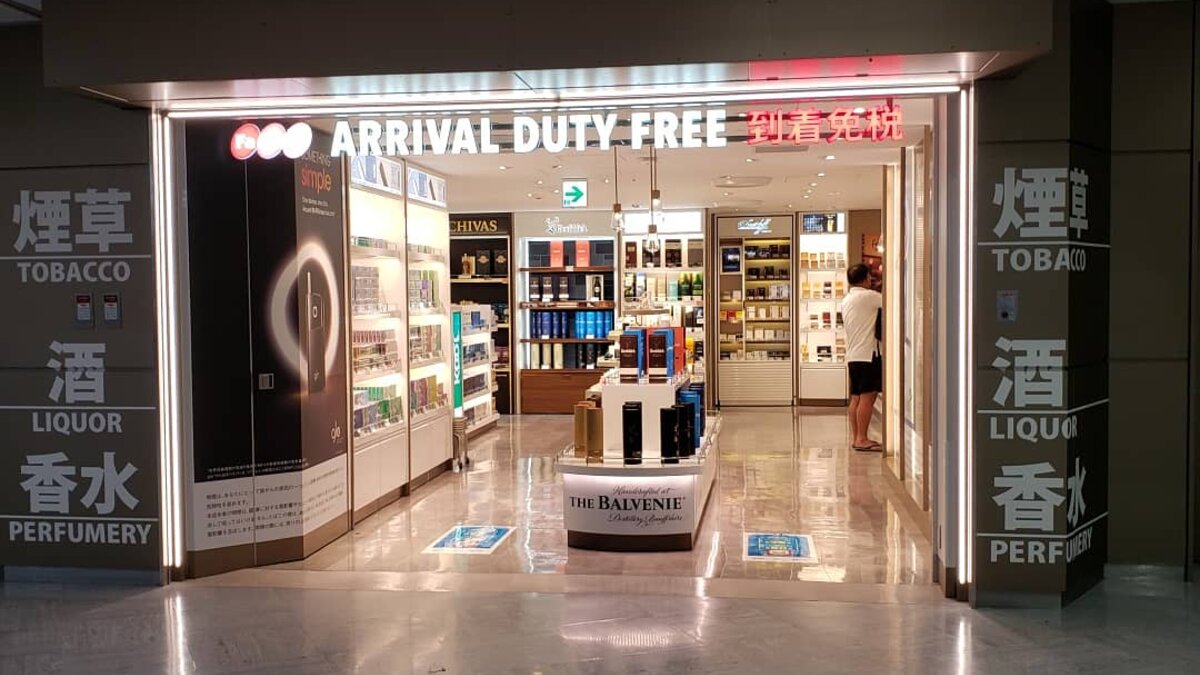
Duty-free shops sell goods free of customs duty, excise tax and VAT because the stock legally sits outside the tax territory. Here is when the price is genuinely a deal, what each country lets you bring in, and how sealed-bag rules work on connections.
Cover image: duty-free shop inside an airport terminal — photo by 特急東海, CC0, via Wikimedia Commons.
Duty-free shopping works on one legal fiction: goods in an airport duty-free shop are held under customs bond, technically outside the country's tax territory, and sold only to travellers who will export them. The buyer skips three layers of tax: customs duty, excise duty (the per-unit tax on alcohol, tobacco and fuel) and VAT or sales tax, which alone runs to 20% in the UK and 17-27% across the EU. Savings are biggest on heavily excised goods, which is why spirits and cigarettes dominate the shelves. But the exemption only applies on the way out; on the way in, the destination sets hard allowance limits. As of mid-2026 those are €430 of goods and 1 litre of spirits for air passengers entering the EU, £390 and up to 4 litres of spirits for Great Britain, US$800 and 1 litre for the United States, and AUD$900 and 2.25 litres for Australia, per the respective customs authorities. Exceed them and you owe tax at the border, sometimes on the whole amount.
What taxes does duty-free actually skip?
A normal retail price bundles up to three charges. Customs duty applies to imported goods; excise duty is a fixed levy per litre of alcohol or per thousand cigarettes; and VAT or sales tax is charged on the final price of almost everything. Duty-free stock never legally enters the market of the country where the shop stands, so none of the three is charged.
That structure explains the product mix. On a bottle of gin in a high-tax market, excise plus VAT can be well over half the shelf price, so removing both produces a visible discount. On a camera or handbag there is little excise to remove, so the saving is mostly the VAT, and often less once airport rent is priced in. Mordor Intelligence, a market research firm, values global duty-free and travel retail at roughly US$102 billion in 2026, riding the demand wave behind the record 1.58 billion international arrivals forecast for 2026.
When is duty-free actually a deal, and when is it not?
Duty-free is reliably cheaper where tax is most of the price and frequently beatable everywhere else; a quick phone price check against a supermarket or online retailer settles it in seconds.
- Usually a genuine saving: spirits, tobacco and travel-retail-exclusive bottle sizes, especially when departing high-excise markets such as the UK, Ireland, Scandinavia, Australia and Singapore.
- Sometimes a saving: fragrance and premium cosmetics, where airport pricing is competitive but online discounting often matches it.
- Rarely a saving: electronics, sunglasses, confectionery and luxury fashion, where there is little excise to strip out and airport operating costs push prices up.
- Watch the currency: paying in your home currency typically means a poor conversion rate; pay in the local currency on a fee-free card.
One more trap: a bargain that busts your inbound allowance is no bargain. The Australian Border Force warns that if you exceed a category limit, duty is charged on everything in that category, not just the excess.
Arrival duty-free vs departure duty-free: which is better?
Dozens of countries, including the UAE, Norway, Australia, New Zealand and much of Southeast Asia, Latin America and the Caribbean, operate arrivals duty-free shops in the baggage-reclaim area. The EU, the UK and the US do not; there, duty-free is departure-only.
Where arrivals shopping exists, it is usually the smarter buy. You avoid carrying bottles through the journey and sidestep liquid-security rules on connections through hub airports. The purchase still counts against the destination's inbound allowance either way; only the logistics change. Departure duty-free makes sense mainly when the destination has no arrivals shop or when the departure airport's pricing on a specific item is demonstrably better.
What are the duty-free allowance limits by country?
Allowances apply per adult and cover everything you bring in, whether bought duty-free or on the high street abroad. Figures below are the standard air-traveller limits published by each authority, current as of July 2026.
| Arriving into | Alcohol | Tobacco | Other goods |
|---|---|---|---|
| Great Britain (GOV.UK) | 42L beer + 18L still wine + 4L spirits or 9L sparkling/fortified wine | 200 cigarettes or 50 cigars or 250g tobacco | £390 |
| EU, from outside the EU (Your Europe) | 4L still wine + 16L beer + 1L spirits or 2L fortified/sparkling wine | 200 cigarettes or 50 cigars or 250g (some states apply a 40-cigarette lower tier) | €430 by air or sea |
| United States (CBP) | 1 litre (age 21+) | 200 cigarettes and 100 cigars | US$800 exemption |
| Australia (ABF) | 2.25 litres (age 18+) | Up to 25 cigarettes or 25g tobacco unopened, plus one open packet | AUD$900 |
Intra-EU travellers pay tax at the till and face no meaningful personal-use limits; the figures above apply to arrivals from outside. CBP notes that alcohol beyond 1 litre is dutiable even under the US$800 value cap, and families arriving in Australia may pool their concessions.
How do sealed-bag rules work on connecting flights?
The 100ml carry-on liquid limit is the reason duty-free bottles can be confiscated mid-journey. The workaround is the security tamper-evident bag, or STEB, a standard set by ICAO, the UN aviation agency: the retailer seals the bottle in a transparent tamper-proof bag with the receipt visible inside, and security at the connecting airport accepts it as screened.
The system has strict conditions. The US Transportation Security Administration accepts oversized duty-free liquids on connections only if the bag is unopened, shows no sign of tampering and the receipt proves purchase within the preceding 48 hours. Do not open the bag before your final destination, and check your connecting airport's transit rules before buying, because acceptance is not universal. When in doubt, buy at the last airport before your destination, use an arrivals shop, or move bottles into checked baggage within your airline's allowance during a layover with baggage recheck.
Frequently asked questions
Why do duty-free staff scan my boarding pass?
The scan proves the sale qualifies for tax exemption and records your destination, since the goods must leave the country. On intra-EU routes it also tells the till to charge normal tax, since duty-free pricing applies only to passengers leaving the EU's tax area.
Is airport duty-free always cheaper than the high street?
No. It is consistently cheaper for spirits and tobacco departing high-tax countries, because excise and VAT are stripped out. For electronics, sunglasses and confectionery, supermarkets and online retailers frequently beat airport prices.
Can I open my sealed duty-free bag during a layover?
Not if another security screening lies ahead. An opened STEB seal invalidates the bag, and any bottle over 100ml can be confiscated at the next checkpoint. Keep it sealed, receipt inside, until you exit your final airport.
What happens if I go over my duty-free allowance?
Declare the goods and pay the applicable duty and tax at the border. In some jurisdictions, including Australia, exceeding the limit triggers tax on the entire category, and failing to declare risks seizure and penalties.




Post a comment