

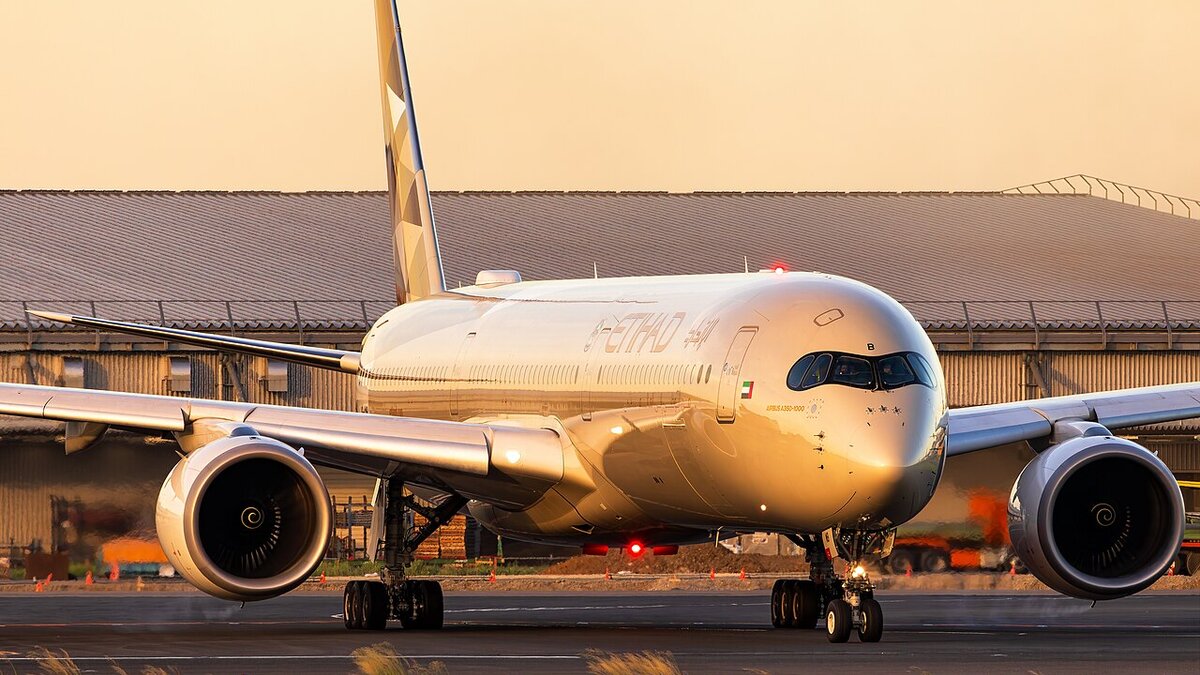
Etihad is flying more than 300 daily flights at the summer peak and launching 27 new routes — from Kraków to Zanzibar — as the Abu Dhabi carrier lifts capacity around 10% year on year.
Cover image: an Etihad Airways Airbus A350 widebody — photo by Luca Radulescu, CC BY 4.0, via Wikimedia Commons.
Etihad Airways is having an expansionist summer. The Abu Dhabi flag carrier is operating more than 300 flights a day at the seasonal peak and rolling out 27 new routes, pushing capacity up roughly 10% year on year as it presses an aggressive growth strategy from its Gulf hub.
It is one of the boldest expansion plans among the Gulf carriers in 2026, and a clear signal that Etihad — historically the more measured of the big three Gulf airlines — is now competing hard for both connecting traffic and point-to-point leisure demand.
A network reaching in every direction
The 27 new routes spread Etihad's map across Europe, the Middle East and Africa, mixing business-friendly city links with sun-and-sand leisure destinations. Among the additions are connections to:
- Kraków — tapping central Europe's fast-growing travel market.
- Palma de Mallorca — a marquee Mediterranean leisure destination.
- Damascus — restoring a link to the Syrian capital.
- Zanzibar — extending Etihad's reach into East African leisure travel.
The breadth is deliberate. By layering leisure-heavy routes on top of its traditional business network, Etihad is diversifying its demand base and feeding more connecting traffic through Abu Dhabi's hub.
Growth built on a refreshed hub and fleet
The expansion leans on Abu Dhabi's modern terminal capacity and Etihad's investment in new aircraft and upgraded cabins. Operating 300-plus daily flights at the peak requires not just aircraft but slots, ground infrastructure and crew — and Etihad has spent recent years positioning Abu Dhabi to handle exactly this kind of step-change in volume.
The double-digit capacity increase also reflects confidence in demand. Etihad is betting that summer 2026 travel appetite — across leisure, business and connecting markets — is strong enough to absorb a meaningfully larger schedule without crushing fares.
The Gulf context
Etihad's push does not happen in isolation. It comes as Qatar Airways expands to around 160 destinations, Emirates deepens its own network, and Riyadh Air enters the market as a brand-new competitor. The Gulf's carriers are collectively adding capacity at pace, turning the region into one of the most dynamic — and competitive — aviation markets in the world heading into the second half of 2026.
What it means for travellers
For passengers, more routes and more frequencies mean more choice and more one-stop options through Abu Dhabi, particularly to secondary leisure cities that previously required multiple connections. The competitive intensity among Gulf carriers also tends to keep premium-cabin product improving and selective fares sharp.
The bottom line
With 27 new routes and 300-plus daily flights, Etihad is making its most assertive growth statement in years. The summer of 2026 will test whether the demand is there to match the ambition — but for now, Abu Dhabi's carrier is unmistakably on the front foot.


Post a comment