

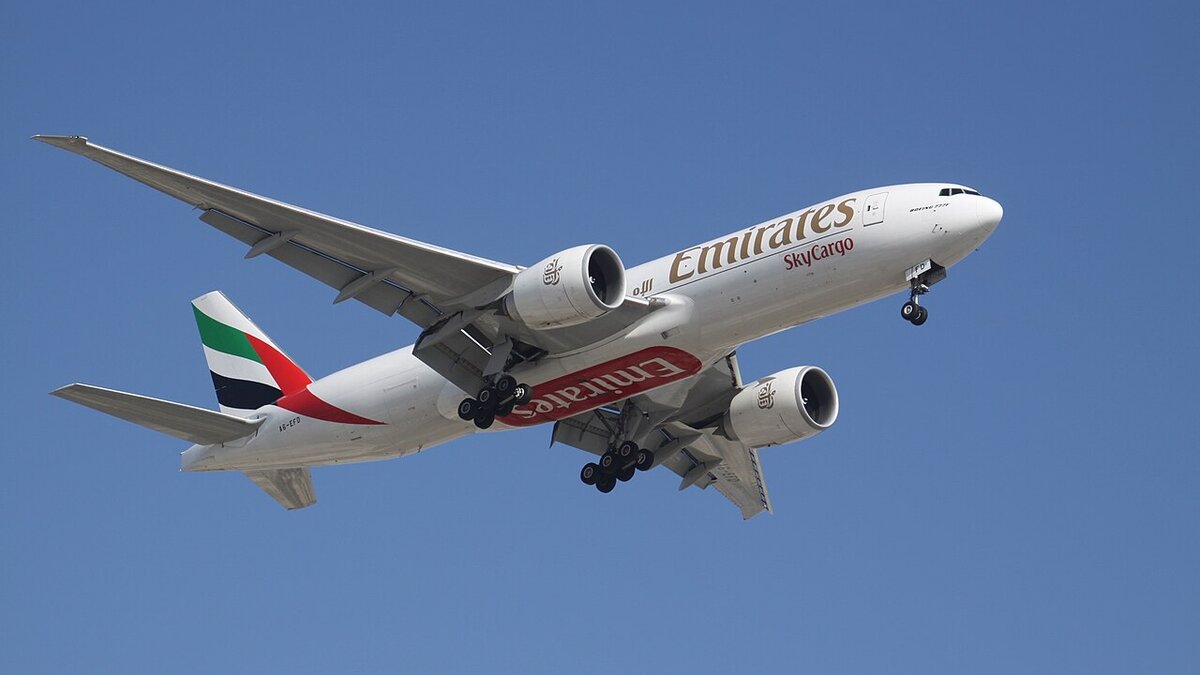
Emirates SkyCargo has taken four new Boeing 777 Freighters since March and expects six more before year-end, expanding capacity as global air-freight demand stays resilient.
Cover image: an Emirates SkyCargo Boeing 777 Freighter — photo by Aeroprints.com, CC BY-SA 3.0, via Wikimedia Commons.
While passenger aviation grabs the headlines, the freight side of the business is quietly expanding. Emirates SkyCargo, the cargo division of the Dubai carrier, has taken delivery of four new Boeing 777 Freighters since March 2026, with six more scheduled before the end of the year — a meaningful lift in main-deck capacity for one of the world's largest air-cargo operators.
The fleet growth is a bet on durable demand. Even as supply-chain constraints squeeze the wider aircraft market, air freight has remained resilient, buoyed by e-commerce, time-sensitive shipments and the role of Dubai as a global logistics crossroads.
Why the 777 Freighter
The Boeing 777F is the workhorse of the modern long-haul cargo fleet — a twin-engine freighter prized for combining long range with a large main-deck payload and competitive operating economics. For an operator like Emirates SkyCargo, whose model is built on flying high-value goods between continents through Dubai, the 777F is the natural tool for adding capacity without sacrificing efficiency.
Each new freighter expands the network's ability to move everything from pharmaceuticals and perishables to electronics and e-commerce parcels across Emirates' global map.
Air cargo's quiet resilience
The expansion reflects a broader truth about 2026: air-freight demand has held up better than many expected. Several structural forces are at work.
- E-commerce continues to push time-definite, cross-border shipments that favour air over sea.
- Supply-chain caution has companies willing to pay for speed and reliability after years of disruption.
- Dubai's hub position places Emirates SkyCargo at the intersection of trade lanes linking Asia, Europe, Africa and the Americas.
Capacity as a competitive edge
In air cargo, available capacity is strategy. By adding ten freighters across 2026, Emirates SkyCargo is positioning itself to capture demand that competitors with tighter fleets may have to turn away — and to offer shippers the reliability that comes from scale. The timing also matters: building freighter capacity while the passenger fleet faces its own delivery constraints gives the cargo division room to grow on its own terms.
The bottom line
Emirates SkyCargo's freighter expansion is a reminder that aviation's growth story runs on two tracks. As passengers fill cabins this summer, the belly-and-freighter business is scaling up to meet a demand that, for now, shows no sign of slowing. Ten new 777Fs in a single year is a confident statement about where air cargo is headed.




Post a comment