

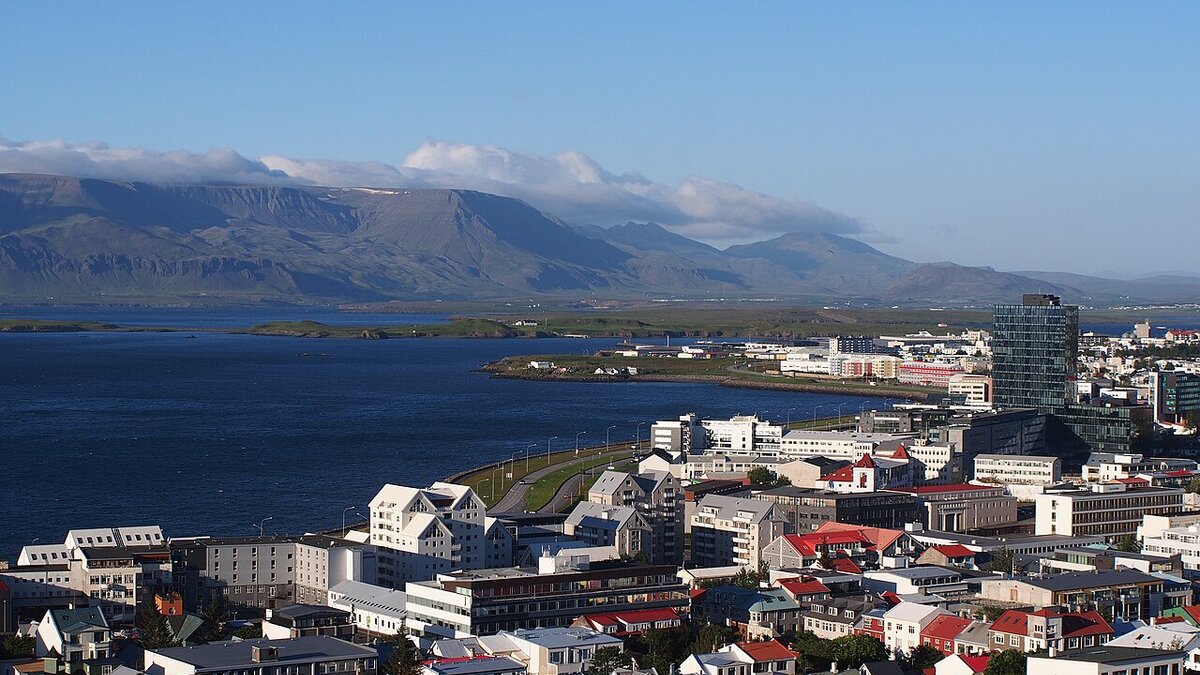
Amadeus data shows eclipse-week hotel occupancy up 16% and ADR up 36% across Spain and Iceland, with Reykjavik rooms averaging $1,012 a night. How a two-minute celestial event on 12 August 2026 is repricing an entire region's inventory.
Cover image: Reykjavik rooftops and harbour, a gateway city selling out for the 2026 eclipse — photo by rheins, CC BY 3.0, via Wikimedia Commons.
Hotels along the path of the 12 August 2026 total solar eclipse are riding one of the sharpest compression events European hospitality has seen. Across Spain and Iceland, eclipse-week occupancy is running 16% ahead of 2025 and average daily rates (ADR) are up 36% year-on-year, according to Amadeus data for the week of 9–16 August, measured from bookings on the books as of May 2026. Flight bookings to airports along the totality path are up 25% for arrivals between 7 and 12 August, peaking at +39% on 10 August, Amadeus reports.
The city-level numbers are more dramatic still. Hotel booking growth versus 2025 has reached +366% in Bilbao, +292% in Asturias and +137% in Valencia, according to Amadeus. In Reykjavik — the only capital city inside the band of totality — benchmarking firm Lighthouse puts eclipse-week hotel rates at an average of $1,012 per night, roughly double 2025 levels and 212% above the city's 2026 average. For hoteliers, a celestial event lasting barely two minutes has repriced an entire region's August inventory; for travellers still hunting a bed, the window is closing fast.
How much have hotel prices risen for the 2026 eclipse?
Pricing power tracks proximity to the centreline plus supply scarcity. Iceland, with a small hotel stock and 60.6% of its short-term rental listings inside the path of totality according to AirDNA, commands the steepest rates. Spain, where AirDNA counts 86,300 in-path rental listings — more than ten times Iceland's entire rental market — shows strong but less extreme increases.
| Market | Eclipse-week signal | Source |
|---|---|---|
| Reykjavik | Hotel ADR $1,012 (+212% vs 2026 average); rentals $1,172 (+178% YoY) | Lighthouse |
| A Coruña | 81% of rooms already booked; rates up 85% in four weeks | Lighthouse |
| Asturias | Bookings +76% YoY; ADR +85% YoY | SiteMinder |
| Bilbao | Hotel ADR $315 (+35% YoY); rentals $1,088 (+206% YoY) | Lighthouse |
| Valencia | Bookings +75% YoY; ADR +6% YoY | SiteMinder |
| Santiago de Compostela | Hotel ADR $193 (+13% YoY) — the value play in the path | Lighthouse |
Demand data confirms the pattern is genuinely eclipse-driven rather than a general summer effect. AirDNA figures reported by Euronews show Spanish rental demand inside the path pacing 7.4% ahead of last year for 11–12 August while demand outside the path is down 5.4%. In Iceland, in-path demand is pacing 56.9% ahead. Zaragoza (+123%), Logroño (+109%) and Burgos (+65%) lead Spain's in-path cities, per AirDNA.
Which cities are selling out first in Spain and Iceland?
Reykjavik was 66% booked by late July with daily demand for 12 August up 166% year-on-year, according to Lighthouse — and Hotels.com data cited by Euronews puts search demand for the Icelandic capital up 250%. Serious eclipse chasers locked in rooms long ago, and hoteliers are merchandising the moment: Reykjavik's Center Hotels chain runs a dedicated solar-eclipse landing page with packaged eclipse stays, while astro-tour operators such as TravelQuest sell multi-day Iceland eclipse itineraries from $12,750 per person.
In Spain, booking lead times tell the compression story: SiteMinder data shows Asturias lead times stretching from 121 to 215 days — a 77% jump — while average length of stay fell 36% as guests book precisely around eclipse night. Amadeus likewise records a 57% rise in short one-to-five-day stays. The demand surge itself is covered in more depth in our companion piece on the 2026 eclipse travel surge across Spain and Iceland.
What did the April 2024 US eclipse teach hoteliers?
The precedent is well documented. Ahead of the 8 April 2024 eclipse, Forbes reported a 492% spike in hotel rates in Buffalo, New York — rooms at $420 a night against 2023 prices — months before the event. CBS News found a Best Western in Saranac Lake, New York listing eclipse-night rooms at $650 against a usual $99, while the nearby Saranac Waterfront Lodge charged $2,400 for a room that fell to $131 the following night.
The lesson revenue managers absorbed: properties that sold out early, at normal rates, left extraordinary sums on the table. Totality demand is close to perfectly inelastic — one date, one narrow band, no reschedule — so the inventory holder, not the shopper, sets the clearing price.
How does a two-minute event reprice a region's hotels?
Eclipse compression is a pure demonstration of the mechanics we unpack in our explainer on how hotel room pricing actually works: when demand for a fixed date overwhelms fixed supply, dynamic pricing engines push rates until booking pace normalises. Attica21 Hotels operations director Bruno García Monteagudo told SiteMinder the group is seeing bookings made much earlier, at average prices more than 50% higher, with a stronger mix of US and UK guests.
The playbook emerging from Spain and Iceland has three parts:
- Hold inventory back. Selling out 300 days early at last year's ADR is the classic error; staggered rate releases capture the late, price-insensitive wave.
- Apply length-of-stay controls. Minimum-stay rules and multi-night packages stop one-night eclipse guests from blocking a high-season week — countering the short-stay pattern in the Amadeus and SiteMinder data.
- Watch the post-event cliff. Demand outside the path is already negative in Spain, per AirDNA; 13 August pricing needs to revert quickly or rooms sit empty.
Where can travellers still find rooms for the 2026 eclipse?
Late shoppers are not entirely out of options. Lighthouse data identifies Santiago de Compostela at $193 a night — up only 13% — as the standout value inside the Spanish path, and Euronews notes that free-cancellation deadlines expiring in the final weeks typically release a wave of rooms back onto the market.
- Stay outside the path and drive. Madrid and Santander sit within a morning's drive of totality; our guide to the 2026 path of totality and best viewing spots maps the band in detail.
- Check direct channels. Smaller independents often hold back inventory from OTAs at peak events — trade-offs covered in our comparison of booking direct versus using an OTA.
- Book refundable, then keep shopping. Lock in a cancellable rate as insurance and rebook if prices soften.
- Consider campsites, rural guesthouses and cruises — the alternatives Euronews reports are absorbing overflow demand.
Frequently asked questions
Why are hotel prices so high for the August 2026 eclipse?
The 12 August 2026 event is the first total solar eclipse visible from mainland Spain since 1905 and the first in Iceland since 1954, so demand is funnelling into one date and a narrow geographic band. With occupancy up 16% and no way to add supply, Amadeus data shows rates have risen 36% year-on-year.
Are Reykjavik hotels completely sold out for the eclipse?
Not entirely — Lighthouse measured the city at roughly 66% booked in late July — but remaining rooms average $1,012 a night, about double normal rates. Availability is thinnest around 11–12 August itself; rural south-west Iceland retains more inventory.
What is the cheapest place to stay in the 2026 eclipse path?
Within Spain's path, Santiago de Compostela is the clear value option at around $193 a night, only 13% above 2025 levels according to Lighthouse. Staying just outside the totality band and driving in on eclipse morning remains the biggest money-saver in both countries.
Will prices drop closer to 12 August 2026?
Lighthouse analysts believe rates in Bilbao and Reykjavik have likely peaked, and rooms often reappear when free-cancellation deadlines pass in the final month. But the April 2024 US eclipse precedent suggests last-minute inventory in prime path cities gets scarcer and pricier, not cheaper.
Sources
- Amadeus — 2026 Solar Eclipse Drives Surge in Travel to Spain and Iceland
- Lighthouse — Solar Eclipse 2026: Hotel Prices in Iceland & Spain
- SiteMinder — Solar eclipse drives up to 76% growth in bookings for Spain's hotels
- Euronews — Solar eclipse accommodation demand surges in Spain and Iceland. Is it too late to book?
- Forbes — America's Total Eclipse Of The Sun Causes A 492% Spike In Hotel Rates
- CBS News — Hotel prices in the eclipse path of totality
Related coverage
 Hilton Lifts 2026 RevPAR Outlook After 3.9% Q2 Gain as World Cup Fills North American Hotels
28 Jul 2026
Hilton Lifts 2026 RevPAR Outlook After 3.9% Q2 Gain as World Cup Fills North American Hotels
28 Jul 2026
 Global Hotel Pipeline Hits Record Highs in 2026 — But New Rooms Stay Scarce, and Rates Are Holding Firm
06 Jul 2026
Global Hotel Pipeline Hits Record Highs in 2026 — But New Rooms Stay Scarce, and Rates Are Holding Firm
06 Jul 2026
 Booking Direct vs OTAs: The Real Economics Behind Where You Book Your Hotel Room
05 Jul 2026
Booking Direct vs OTAs: The Real Economics Behind Where You Book Your Hotel Room
05 Jul 2026


Post a comment