

Most Western passports now enter Türkiye visa-free for 90 days in any 180 — and China joined the exemption list in January 2026. Here is who still needs an e-visa, what it costs on the only official portal, and the passport-validity rule that catches travellers out.
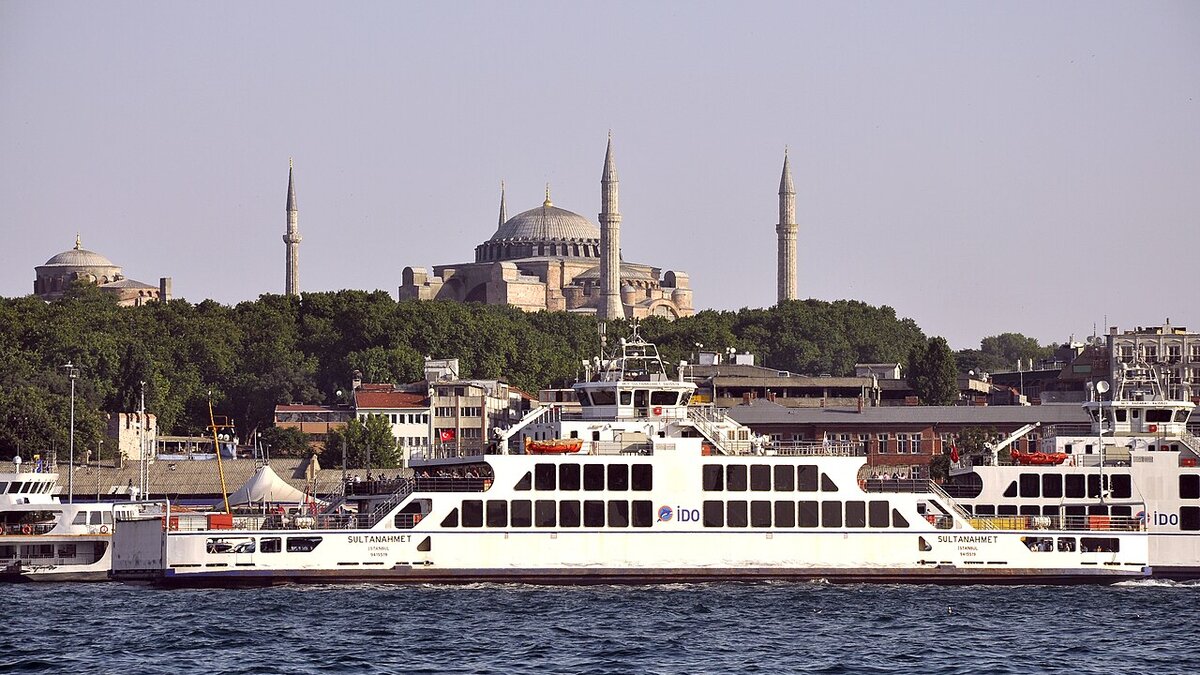
Cover image: Hagia Sophia above the Bosphorus with an Istanbul ferry in the foreground — photo by Moonik, CC BY-SA 3.0, via Wikimedia Commons.
If you are asking "do I need a visa for Turkey?", the answer for most Western travellers is now a straightforward no. As of August 2026, ordinary passport holders from the United States, United Kingdom, all EU member states, Canada, Australia and New Zealand enter Türkiye visa-free for tourism for up to 90 days in any 180-day period, according to the Turkish Ministry of Foreign Affairs (MFA). Türkiye scrapped its e-visa requirement for US and Canadian citizens on 23 December 2023, later extended the exemption to Australians, and on 2 January 2026 added Chinese ordinary-passport holders to the visa-free list. Travellers from India and South Africa, by contrast, still need a visa — an e-visa from the only official portal, evisa.gov.tr, or a sticker visa from a Turkish consulate. Below is the full breakdown by passport, verified against the MFA's country-by-country list.
Do US, UK and EU citizens need a visa for Turkey?
No. The MFA's visa information page states that US ordinary passport holders are "exempted from visa up to 90 days in any 180-day period", with identical wording for Canada. UK visitors travelling "for touristic purposes are exempt from visas for up to 90 days in any 180 day period". German and French passport holders — like other EU nationals — are exempt for up to 90 days, and Australians are exempt "for touristic visits and transit travel" on the same 90/180 basis.
Two caveats. First, the exemption covers tourism and short business visits only — work, study and journalism assignments still require the appropriate visa in advance. Second, official and diplomatic passport holders follow different rules for several nationalities, so check the MFA list if you travel on a service passport.
Who still needs a Turkey e-visa — and how much does it cost?
Dozens of nationalities still apply online at evisa.gov.tr, the only official portal, run by the Turkish MFA. Fees vary by nationality and are payable in US dollars at the point of application.
Indian citizens sit in the conditional e-visa scheme: the MFA states they "may get their single entry e-Visas valid for one month" only if they hold a valid Schengen, US, UK or Ireland visa or residence permit — and that supporting document must still be valid on the day they enter Türkiye. The widely quoted fee is US$43 as of August 2026. Indians without a qualifying visa must apply for a sticker visa at a Turkish mission.
South African citizens can obtain a one-month single-entry e-visa via evisa.gov.tr — issued at no visa fee on the official portal as of August 2026 — or a three-month multiple-entry sticker visa from a Turkish consulate, per the MFA.
Beware lookalike sites. A cottage industry of visa-mill websites mimics the official portal and charges three to ten times the government fee — US$60–150 for documents that cost US$43 or nothing at source. Any domain other than evisa.gov.tr is a commercial intermediary at best. The same warning applies across Asia; see our guides on whether you need a visa for Japan or a visa for Vietnam.
How long can I stay in Turkey without a visa?
The exemption works like the Schengen short-stay rule: 90 days of total presence in any rolling 180-day window, counted across all entries. Border-hopping to a Greek island and returning does not reset the clock.
Overstaying is taken seriously. Exit officers levy a fine calculated on the length of the overstay, and travellers who overstay or refuse to pay can face an entry ban ranging from several months to five years. Airlines and Turkish border police check the 90/180 arithmetic on exit, so keep your own count.
Turkey entry requirements by passport (August 2026)
| Passport | Requirement (tourism) | Cost | Max stay |
|---|---|---|---|
| United States | Visa-free | Free | 90 days / 180 |
| United Kingdom | Visa-free | Free | 90 days / 180 |
| EU member states | Visa-free | Free | 90 days / 180 |
| Canada | Visa-free | Free | 90 days / 180 |
| Australia | Visa-free | Free | 90 days / 180 |
| New Zealand | Visa-free | Free | 90 days / 180 |
| China | Visa-free (since 2 Jan 2026) | Free | 90 days / 180 |
| India | Conditional e-visa (valid Schengen/US/UK/Ireland visa required) or sticker visa | US$43 (e-visa) | 30 days, single entry |
| South Africa | E-visa or consular sticker visa | Free (official e-visa portal) | 30 days e-visa; 90 days sticker |
Passport validity, blank pages, transit — and the Schengen confusion
Whatever your nationality, the paperwork rules still bite. UK government travel advice specifies a passport with an expiry date at least 150 days after the date you arrive in Türkiye, plus at least one blank page — the 150 days reflecting Turkish law's requirement that passports outlast the permitted 90-day stay by 60 days. The US authorities cite a six-month validity rule of thumb; carrying more margin than you need costs nothing.
Transiting Istanbul Airport airside requires no visa for any nationality: if you stay in the international transit zone, you never cross Turkish immigration. You only need entry permission — visa-free or e-visa — if you clear passport control for a layover tour or an overnight hotel.
Finally, the perennial confusion: Türkiye is not in the Schengen area or the EU. A Schengen visa does not admit you to Turkey (except as a supporting document for conditional e-visa nationalities), and days spent in Turkey do not consume your Schengen 90/180 allowance — a useful fact for long-trip planners, as we explain in our Schengen visa guide. Note that the UK runs its own separate system too; see our UK ETA explainer.
What if I want to stay longer than 90 days?
Remote workers and long-stay visitors must apply for a short-term residence permit through Türkiye's Presidency of Migration Management before their 90 days expire — the application is lodged online and completed at an in-country appointment. Tourist permits are typically granted for up to one or two years, but approval is discretionary and evidence of accommodation, means and health insurance is required. Leaving and re-entering to reset the clock does not work under the 90/180 rule.
Frequently asked questions
Does a Schengen visa let me enter Turkey?
No. Türkiye is outside the Schengen area, so a Schengen visa is not an entry document for Turkey — although for conditional e-visa nationalities such as India, holding a valid Schengen, US, UK or Ireland visa is what unlocks eligibility to buy a Turkish e-visa online.
Is evisa.gov.tr really the only official Turkey visa site?
Yes. evisa.gov.tr is operated by the Turkish Ministry of Foreign Affairs and is the only official portal; every other "Turkey e-visa" website is a commercial intermediary, many charging several times the government fee.
Do Australians still need a Turkey e-visa?
No. The MFA now lists Australian ordinary passport holders as exempt from visa requirements for tourist visits and transit for 90 days in any 180-day period — the old US$60 e-visa is no longer required as of August 2026.
What happens if I overstay in Turkey?
You will be fined on exit, with the amount scaling with the length of the overstay, and you risk an entry ban that can run from a few months to five years depending on the violation. Track your 90/180 days carefully across all entries.
Sources
- Republic of Türkiye Ministry of Foreign Affairs — Visa Information For Foreigners
- GOV.UK — Turkey travel advice: entry requirements
- evisa.gov.tr — Official Republic of Türkiye Electronic Visa Application System
- Xinhua — Türkiye grants visa-free entry to Chinese tourists
- The Mobile Workforce — Türkiye enables visa-free travel for USA, Canada and other nationals







Post a comment