

The Court of Appeal has rejected campaigners' final challenge to London Gatwick's £2.2bn Northern Runway Project, clearing the way for dual-runway operations, around 100,000 extra flights a year and, ultimately, up to 80 million passengers annually.
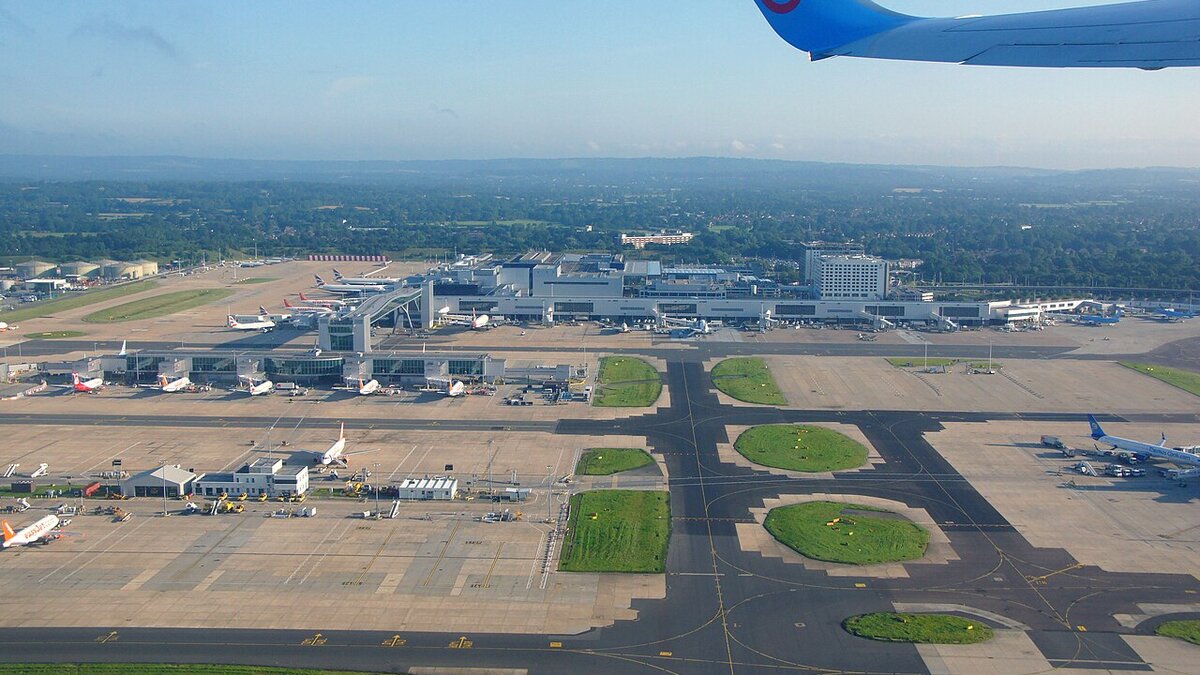
Cover image: Aerial view of London Gatwick Airport terminals, taxiways and parked aircraft — photo by Chris Sampson, CC BY 2.0, via Wikimedia Commons.
London Gatwick's second runway has cleared its final legal hurdle. On 4 August 2026 the Court of Appeal in London rejected a challenge brought by two campaign groups — the Gatwick Area Conservation Campaign (GACC) and Communities Against Gatwick Noise Emissions (CAGNE) — against the government's approval of the airport's £2.2 billion Northern Runway Project, according to reports from AeroTime and Simple Flying.
The ruling upholds the High Court's 23 June 2026 judgment, which itself confirmed the Development Consent Order (DCO) granted by the Secretary of State for Transport on 21 September 2025. With the appeal dismissed, Gatwick says the privately financed project is effectively shovel-ready: the airport's existing northern standby runway will be brought into routine use for departures, with its centreline moved 12 metres north to meet international safety-separation standards.
The prize is substantial. Gatwick handled 43.2 million passengers and 265,358 aircraft movements in 2024, per published traffic data. The airport's project pages put eventual dual-runway capacity at up to 80 million passengers a year, while AeroTime cites around 13 million additional passengers and about 100,000 extra flights annually from the added runway.
What exactly did the Court of Appeal rule on Gatwick's second runway?
The judges dismissed the campaigners' appeal against the planning consent. GACC, led by chair Peter Barclay, and CAGNE had argued that the environmental assessment underpinning the approval was incomplete — contending, per Simple Flying's report, that it "only considered carbon dioxide, but not other aviation-related emissions".
It is the second time the courts have sided with the government and the airport. The High Court threw out the initial challenge in June, and the Court of Appeal has now declined to overturn that finding. Gatwick chief executive Pierre-Hugues Schmit said the decision "confirms, yet again, that the September 2025 decision by the Secretary of State for Transport to approve the Northern Runway Project was taken properly and lawfully".
CAGNE said it was disappointed and signalled the fight is not entirely over: its focus now moves to "the proposed new terminal, declining air quality and airspace changes" that fell outside the scope of this application.
How will Gatwick's northern runway actually work?
Gatwick will not build a new strip of tarmac from scratch. The plan repositions the existing 2,565-metre northern runway, currently used as a taxiway and emergency standby because it sits only about 200 metres from the main runway — too close for simultaneous operations under international rules.
- Northern runway (2,565m): handles departures by smaller, mainly short-haul aircraft.
- Main southern runway (3,316m): keeps all arrivals plus departures by larger, long-haul aircraft.
- Financing: the £2.2 billion cost is privately financed, according to the airport.
Gatwick projects the expansion will create around 14,000 jobs in the South East and inject roughly £1 billion a year into the region's economy. The mechanics of squeezing more departures out of a constrained single-runway site are a case study in the capacity economics we unpack in our guide to how airline hub airports actually work.
| Metric | Today (2024 data) | With northern runway |
|---|---|---|
| Passengers per year | 43.2 million | Up to 80 million |
| Aircraft movements | 265,358 | ~100,000 more flights a year |
| Runways in routine use | 1 (3,316m) | 2 (3,316m + 2,565m) |
| Cost | — | £2.2bn, privately financed |
| Target for first operations | — | By the turn of the decade (~2030) |
When will Gatwick's second runway open, and what happens for local residents?
Gatwick says construction could be completed and the runway ready for operational use "by the turn of the decade" — around 2030 — now that the legal path is clear. The airport describes the scheme as shovel-ready, though full construction will take several years.
Alongside the consent, the airport has committed to mitigation measures set out on its future-plans pages: a new Noise Insulation Scheme opening for applications shortly after construction works begin, Home Relocation Assistance for properties inside the 66dB Leq 16-hour noise contour (covering reasonable moving and legal costs, stamp duty and a 1 per cent estate-agent fee), and a route for homeowners who believe the project has hit their property's value to apply to Gatwick for compensation after 12 months.
What does Gatwick's expansion mean for airlines and airfares?
Gatwick is slot-constrained in peak hours, and the biggest beneficiary is likely to be easyJet, its largest operator, holding 43.3 per cent of slots as of April 2018, per published airport data. More departure capacity should ease the scramble for the early-morning wave slots low-cost carriers depend on.
More seats generally exert downward pressure on fares on competitive routes, though ticket prices in 2026 are being pushed the other way by input costs — see our analysis of how jet fuel costs are feeding into 2026 airfares. Network planners will also be watching: carriers were already loading fresh capacity into the UK market this summer, as our round-up of July 2026's new airline routes showed, and a bigger Gatwick widens the option set for both short-haul and long-haul entrants from the late 2020s.
How does the ruling compare with Heathrow's third runway?
The contrast with Heathrow is stark. While Gatwick now has a consented, financed and litigation-tested scheme, Heathrow's third runway remains at the policy stage: the government's draft Heathrow Expansion National Policy Statement was still out for consultation in June 2026, when Heathrow published its formal response on 18 June, per the airport's media centre.
That sequencing means Gatwick is set to deliver the UK's first meaningful new runway capacity in decades, years before any Heathrow scheme could clear its own DCO process.
Frequently asked questions
Is Gatwick's second runway definitely going ahead now?
The Court of Appeal's 4 August 2026 ruling removed the last major legal obstacle, following the High Court's dismissal of the challenge on 23 June 2026. Gatwick says the £2.2 billion project is shovel-ready, though campaigners say they will continue to contest related issues such as terminal expansion and airspace changes.
When will the second runway handle its first flights?
Gatwick has said construction could be complete and the runway operational "by the turn of the decade" — around 2030. The airport has not yet published a firm opening date, and large infrastructure schemes routinely slip, so treat 2030 as a target rather than a guarantee.
Will the new runway handle all types of flights?
No. The repositioned 2,565-metre northern runway will be used for departures by smaller, mainly short-haul aircraft. All arrivals and departures by larger long-haul aircraft will continue to use the 3,316-metre main runway.
Who opposed the Gatwick expansion and why?
The Gatwick Area Conservation Campaign and CAGNE brought the legal challenges, arguing the environmental assessment was incomplete because it considered carbon dioxide but not other aviation-related emissions. Both the High Court and the Court of Appeal rejected those arguments.
Sources
- AeroTime — Gatwick to press ahead with second runway after judges rule against appeal
- Simple Flying — London Gatwick Airport To Proceed With 2nd Runway Project After Legal Challenge Rejected
- London Gatwick — Northern Runway project pages
- London Gatwick — Our future plans (High Court ruling, noise and compensation schemes)
- Wikipedia — Gatwick Airport (traffic statistics and runway data)
- Heathrow Media Centre — response to draft Heathrow Expansion National Policy Statement




Post a comment