

September is the cheapest month to visit Koh Samui at roughly 30% below peak, but November is the wettest. Month-by-month rain and price table, plus the Surat Thani ferry money-saver.
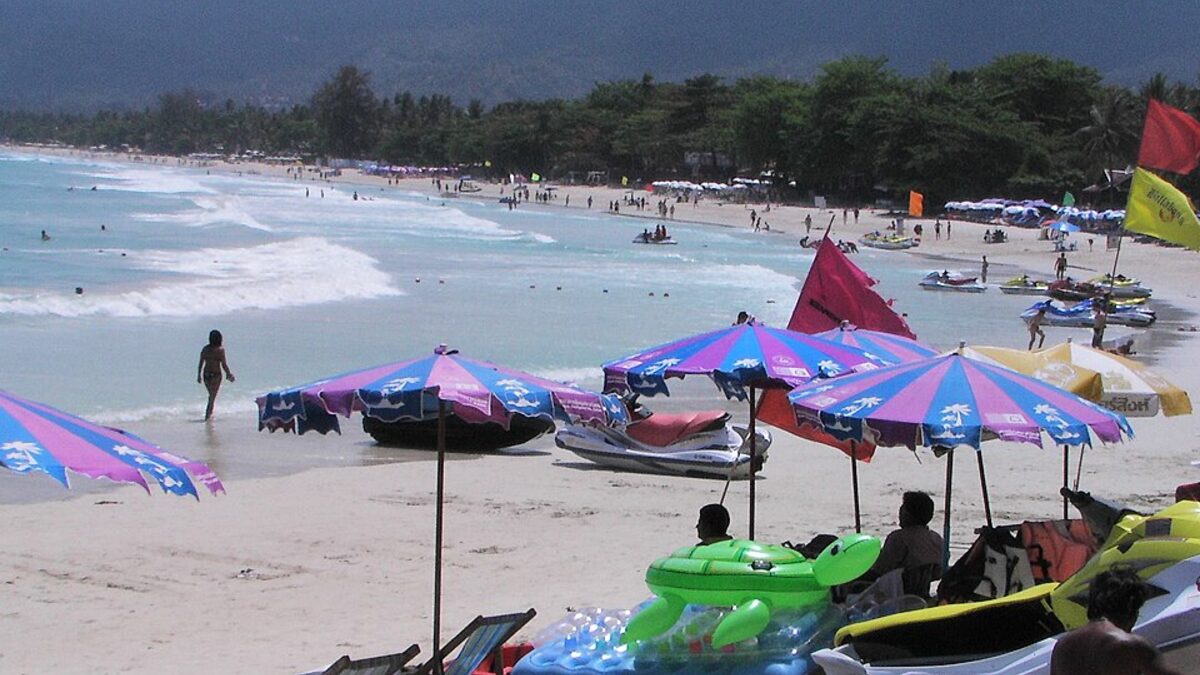
Cover image: Chaweng Beach on Ko Samui, Thailand, with beach umbrellas and jet skis — photo by User: (WT-shared) Wipkinger at wts wikivoyage, Public domain, via Wikimedia Commons.
September is the cheapest month to visit Koh Samui — local guides put island hotel rates roughly 30% below peak — with October and November also discounted. The catch is the northeast monsoon: November is statistically the island's wettest month, averaging about 445 mm of rain. If you want low prices and dry weather, the value sweet spot is March to April, when rates sit at standard levels after the peak-season crowds thin but rainfall is among the lowest of the year.
Koh Samui pricing works differently from Phuket's, and understanding why is the key to paying less.
Koh Samui's seasons work backwards from Phuket
Samui sits in the Gulf of Thailand, on the country's east coast, so its monsoon arrives months after the Andaman coast's. The island has a tropical monsoon climate, and with roughly 1,994 mm of rain a year it is noticeably drier than Phuket, which collects about 2,220 mm. Phuket's cheapest, wettest months are the summer monsoon; Samui's are the autumn and early winter, when the northeast monsoon peaks.
Koh Samui weather and prices by month
The rainfall figures below are 1991–2020 climate normals for Ko Samui; the price bands reflect the seasonal pattern described by Samui-focused travel guides (peak ≈ +35–40% versus standard, low season ≈ −20 to −30%).
| Month | Rain (mm) | Rain days | Prices | Verdict |
|---|---|---|---|---|
| January | 127 | 8.5 | Peak | High season; tail of monsoon, book early |
| February | 64 | 4.3 | Peak | Driest month — best weather, top prices |
| March | 116 | 4.7 | Standard | Value pick — hot, mostly dry, crowds gone |
| April | 83 | 6.1 | Standard | Value pick — low rain, Songkran mid-month |
| May | 132 | 11.0 | Low (−20%) | Hottest month; showers returning |
| June | 134 | 10.3 | Low (−20%) | Mixed sun and showers |
| July | 117 | 10.7 | Medium (+10%) | European summer holidays lift demand |
| August | 102 | 10.5 | Medium (+15%) | Family-travel peak; decent beach weather |
| September | 118 | 10.6 | Lowest (−30%) | Cheapest month — rain risk rising |
| October | 295 | 15.8 | Low (−25%) | Monsoon building; very wet |
| November | 445 | 16.5 | Low | Wettest month — deep discounts, flooded days |
| December | 263 | 11.6 | Peak | Drying out; Christmas/New Year premiums |
When do hotel prices actually drop?
Koh Samui draws more than two million visitors a year, and December through February accounts for nearly 40% of annual arrivals, according to figures cited by Samui-focused guides from the Tourism Authority of Thailand. That concentration is why mid-December to January rates jump 35–40% over standard pricing, with a second bump in February despite — or because of — it being the island's driest month. Prices slide from May, bottom out in September, and recover only when the monsoon retreats in late December.
The practical consequence: the same beachfront villa can swing by a third of its price depending on the week you book. If your dates are fixed to school holidays, late August beats Christmas on price by a wide margin; if they are flexible, the first two weeks of September are the year's floor.
Why Samui flights stay expensive — and the ferry workaround
Accommodation is only half the budget. Samui's airport is privately owned and operated by Bangkok Airways, which gives the carrier a near-monopoly on flights into USM — Thai Airways flew the Bangkok route only between 2008 and 2018, and competition arrived in earnest when Scoot launched Singapore–Samui in May 2024. The result is that direct fares rarely match what you would pay to fly into Phuket or Krabi.
The classic money-saver is to fly to Surat Thani on the mainland and continue by ferry. Lomprayah and Raja Ferry run catamaran and car-ferry services from the Surat Thani area piers to the island, and the combined bus-plus-ferry tickets cost a fraction of a direct flight — at the cost of several extra hours and a luggage transfer. Families with small children or short trips will find the direct flight worth the premium; backpackers and long-stayers rarely do.
What things cost on the island once you are there
Thailand remains one of the better-value beach destinations in Asia. At the European Central Bank reference rate of 24 August 2026, one euro bought 38.1 Thai baht, which puts a US dollar at about 32.7 baht and a pound sterling at about 44.6 baht. Street food and local eateries still trade at a few dozen baht a dish, mid-range resort dinners run to a few hundred per person, and the island's temple and beach activities are mostly free or cheap. Budget travelers can plausibly manage on $40–60 a day outside peak season; luxury villas are the one category where Samui competes with the Maldives on price. If you are combining the island with Bangkok, our guide to tourist taxes in Japan covers the neighboring country's entry fees for a two-country trip — and Thailand's own entry rules are summarized in our piece on visa-free stays of up to 30 days.
Before you book the cheap month, check health prep: our Thailand vaccination guide lists what the CDC recommends, and monsoon-season travel brings mosquito-borne illness risk the dry season does not. For a contrast in shoulder-season strategy, see how the same logic plays out in Morocco, where autumn is the value window instead of the wet one.
So when should you book?
Three answers, depending on what you are optimizing:
- Lowest possible price: September, accepting rising rain risk; October–November only if a resort's deep discount makes an indoor-heavy trip worth it.
- Best weather per baht: March and April — standard rates, minimal rain, hot but manageable beach weather.
- Guaranteed sun at any price: February, the driest month, booked months ahead; or Christmas–New Year if the trip is date-fixed and premium pricing is the cost of doing business.
Frequently asked questions
What is the cheapest month to fly to Koh Samui?
September typically has the year's lowest hotel rates (around 30% below peak), and flight prices soften with demand — but because Bangkok Airways dominates the island's airport, airfare savings are smaller than hotel savings. Flying to Surat Thani and taking the ferry is the bigger transport saving.
What is the rainy season in Koh Samui?
The northeast monsoon peaks from October to December. October averages about 295 mm of rain, November about 445 mm — the wettest of the year — and December about 263 mm before conditions dry out in January.
Is Koh Samui expensive compared to Phuket?
They are broadly similar on the ground, but Samui's flight access is pricier because one airline owns the airport. Samui is also slightly drier year-round (about 1,994 mm of rain versus Phuket's 2,220 mm), and their wet seasons fall at different times of year.
When is the best weather on Koh Samui?
February — the driest month, averaging just 64 mm of rain over about four rain days. March and April are nearly as dry and noticeably cheaper.
How much spending money do I need for a week in Koh Samui?
At August 2026 exchange rates (about 32.7 baht per US dollar), a comfortable mid-range week runs roughly $400–700 per person for food, transport and activities, on top of your hotel — less in September, more at Christmas.
Sources
- Wikipedia — Ko Samui (climate data, 1991–2020 normals)
- Inside Samui — Best Time to Visit Koh Samui 2026, month-by-month guide
- Wikipedia — Samui International Airport (ownership and airline history)
- European Central Bank — daily reference rates, 24 August 2026
- Lomprayah — ferry routes and tickets to Koh Samui



Post a comment