

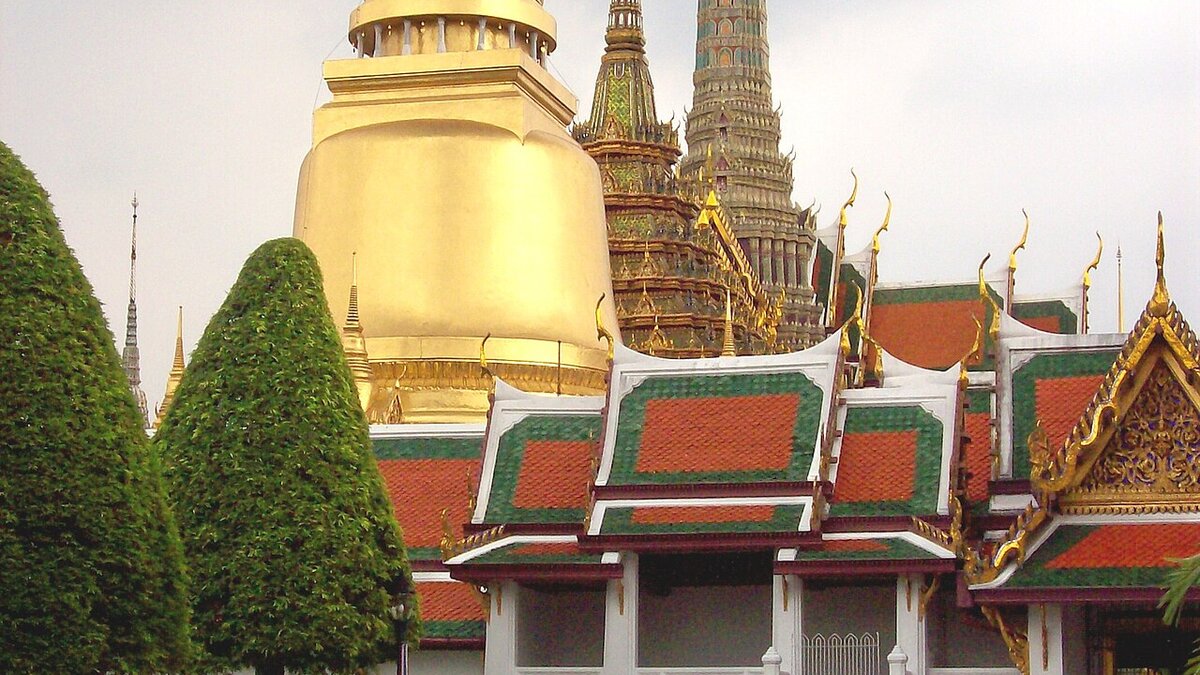
Thailand is safe for most tourists in 2026 with normal precautions; advisories are Level 1 except the far south and the Cambodia border zone.
Cover image: the Grand Palace complex in Bangkok with golden roofs — photo by Philip Nalangan, CC BY 4.0, via Wikimedia Commons.
Yes, Thailand is generally safe to visit in 2026 for tourists who take normal precautions. The US State Department rates most of Thailand at Level 1 Exercise Normal Precautions and the UK FCDO advises against travel only to the four southernmost provinces near Malaysia and within 20 km of the Cambodia border where land crossings remain closed. Bangkok, Chiang Mai, Phuket, Krabi, Koh Samui, Pattaya and Hua Hin are not under an advisory. The dominant risks are not terrorism but road crashes, bag snatching, drink spiking around nightlife, strong currents and rip tides, and scams that separate you from your passport or cash.
Millions visit without incident. Petty crime is the pattern that actually shows up in consular reports, not violent crime against tourists. In 2026 Thailand welcomed more than 35 million foreign visitors in 2019 levels and is on track to beat that, with tourist police boxes now common in major resorts. Treat Thailand like a busy southern European destination: secure valuables, use licensed transport, respect local laws and swim only where lifeguarded.
What do official advisories say right now?
The US travel advisory for Thailand is Level 1 for most of the country, rising to Level 2 for the southern provinces of Yala, Pattani, Narathiwat and parts of Songkhla where insurgent attacks and martial law powers persist. The UK FCDO uses the same geography: advise against all but essential travel to those four provinces and against travel within 20 km of the Thailand-Cambodia border, where temples such as Preah Vihear remain closed and landmines are present after the July and December 2024 clashes. For the rest of the country the FCDO notes there is a high threat of terrorism globally and that attacks could occur anywhere including tourist sites, but this is a standard global statement, not a Thailand-specific warning.
Australia's Smartraveller also rates Thailand Exercise Normal Precautions overall. None of the three advisories warns against Bangkok, the islands or the north. All three highlight the same practical cautions that have not changed in 2026: avoid protests, carry a copy of your passport data page, and expect police checks. If you are planning an overland Bangkok to Siem Reap trip, you must fly. The land border remains shut and the Thailand-Cambodia Border Warning 2026 explains the 20 km buffer and closed crossings.
What are the real risks for tourists?
Road safety is the biggest risk. Thailand has one of the highest road death rates in the world, driven by motorcycles. The FCDO notes frequent crashes, particularly involving scooters. You need a 1968 International Driving Permit plus your home licence to ride, helmets are mandatory and many rental bikes are unregistered which can void travel insurance. If you have never ridden a scooter at home, do not start on Phuket or Koh Samui. Use Grab, licensed taxis or hotel transfers instead.
Petty crime and scams: bag snatching by motorbike in Bangkok and Pattaya, pickpocketing in markets and on night buses, and jet-ski and tuk-tuk scams that inflate damage bills or fares. Never hand over your passport as a deposit for a bike or jet-ski. Use your hotel safe, carry a photocopy and keep cash in a front pocket or money belt. Card skimming at ATMs is reported, so use machines inside bank branches.
Nightlife risks: the FCDO and US State Department both warn that drink spiking and sexual assault occur in areas with intense nightlife, including around full-moon events. Do not leave drinks unattended, pre-arrange transport and avoid unlicensed party boats. Alcohol measures are larger than many visitors expect and methanol contamination has caused deaths in poorly regulated venues. Vaping devices are illegal in Thailand and will be confiscated, with fines and detention possible.
Water safety: rip currents on Phuket's west coast during the May to October monsoon, flash floods at waterfalls and caves, and occasional jellyfish from May to October. The FCDO advises swimming only where lifeguarded and obeying red flags. Boats can be overloaded and maintenance varies, with sinking and collision incidents reported in monsoon seas.
| Situation | Risk level | What to do |
|---|---|---|
| Bangkok, Chiang Mai, Phuket, Koh Samui, Krabi, Pattaya | Low with normal precautions | Secure bags, use Grab or BTS/MRT, avoid political protests |
| Islands party zones and full-moon events | Moderate | Watch drinks, stay with friends, pre-book return boat |
| Scooter and motorbike rental | High | IDP required, helmet, insured hire only, or avoid |
| Sea swimming May to October west coast | Moderate | Lifeguarded beaches only, respect flags |
| Four southern provinces and Cambodia border 20 km | Avoid | Follow FCDO advise-against, fly instead of drive |
Is Thailand safe for solo female travellers and families?
Solo female travellers report Thailand as one of the more comfortable destinations in Southeast Asia when they stay in well-reviewed accommodation, use ride-hailing apps at night and avoid isolated beaches after dark. The FCDO noted violent sexual assaults can occur in tourist areas, most frequently linked to nightlife and alcohol. Practical steps: book accommodation with 24-hour reception, share your live location with a contact, and avoid accepting drinks from strangers. In daytime markets, temples and malls the environment is relaxed and harassment is less common than in many dense cities.
Families should note that health care in private hospitals in Bangkok, Chiang Mai and Phuket is excellent but requires travel insurance. Heat and humidity demand water and sunscreen. Tap water is not drinkable anywhere in Thailand, including Bangkok, so use bottled water for drinking and brushing teeth with small children. Check Do I Need Vaccinations for Thailand before you go. Hepatitis A and typhoid are recommended for most visitors, and mosquito protection matters for dengue, which has no vaccine for most travellers. For cultural costs, see Do You Tip in Thailand, where a 20 to 50 THB tip is the quiet norm when there is no 10 percent service charge.
How does Thailand compare to Bali for safety?
Thailand and Bali sit at the same advisory level for most of their territory, Level 1 Exercise Normal Precautions, but the hazard mix differs. Bali's leading risks in Is Bali Safe are road crashes, bag snatching and rip currents at Kuta and Seminyak, plus drink spiking and a strict stance on drugs that mirrors Thailand's. Thailand adds the specific southern insurgency geography and the temporary Cambodia border restriction. Both destinations are tolerant and welcoming for tourists, both ban vaping in practice, and both require caution on scooters. If you are comfortable navigating a southern European city with the same bag and road discipline, you will be comfortable in either.
Frequently asked questions
Is Bangkok safe to visit right now?
Yes. Bangkok is Level 1 with no advise-against. Day-to-day risks are petty theft in crowded areas, taxi and tuk-tuk overcharging, and road traffic. Use the BTS and MRT metro, Grab for cars on the street, and keep valuables in a front pocket in markets. Avoid any protest areas you come across.
Which parts of Thailand should tourists avoid?
The four provinces at the southern tip near Malaysia, Yala, Pattani, Narathiwat and parts of Songkhla, and the 20 km strip along the Cambodia border. The FCDO advises against all but essential travel there and land crossings to Cambodia remain closed. Everywhere else, including all major islands and cities, is not under an avoid warning.
Is tap water safe in Thailand?
No. Do not drink tap water anywhere in Thailand. Use bottled water, avoid ice from unknown sources outside tourist restaurants which usually use factory ice, and use bottled water for brushing teeth with young children. Ice in hotels and malls is generally made from purified water and is considered safe.
Should solo women avoid Thailand?
No, but nightlife needs the same caution as anywhere. Stay in reputable areas, keep drinks in sight, pre-arrange transport and avoid walking alone on isolated beaches at night. Daytime sightseeing, shopping and temple visits are comfortable for solo women across the country.

Post a comment