

Flight bookings to airports along the 12 August 2026 eclipse path are up 25% year-on-year and hotel rates in Spain and Iceland have jumped 36%, according to Amadeus, as Europe's first total solar eclipse since 1999 fuels a fast-growing eclipse-chaser economy.
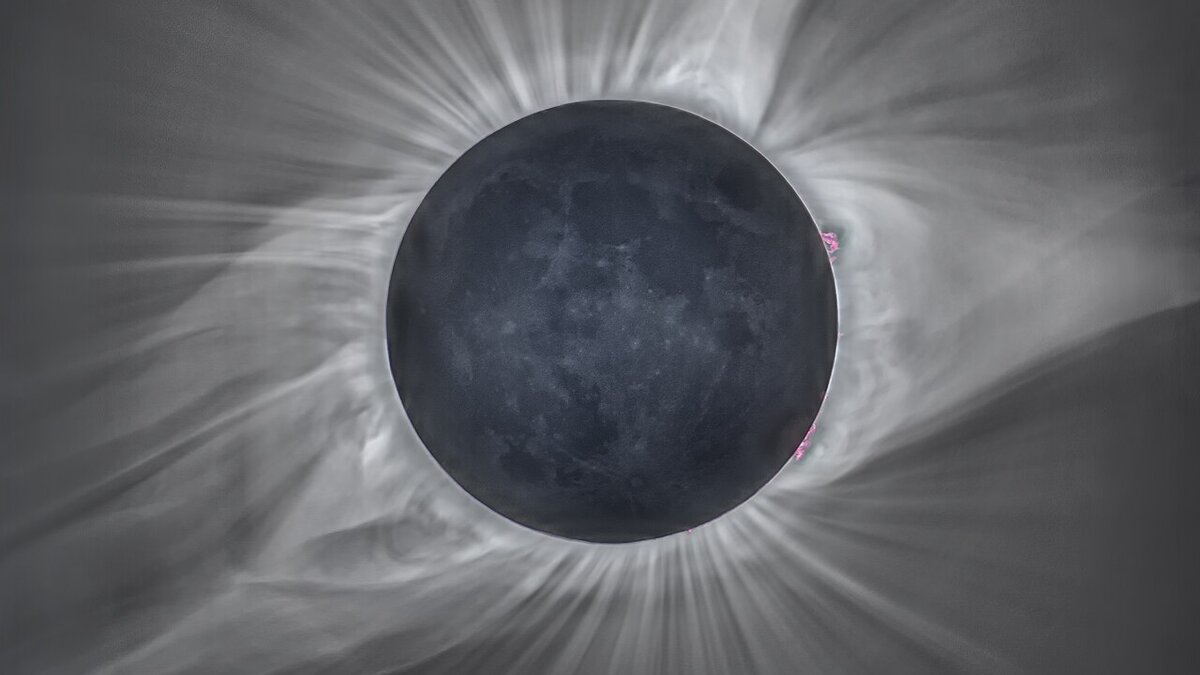
Cover image: The sun's corona blazing around the moon during a total solar eclipse — photo by Michael S Adler, CC BY-SA 4.0, via Wikimedia Commons.
The total solar eclipse of 12 August 2026 — the first visible from mainland Europe since August 1999, and Iceland's first since 1954 — is now driving one of the sharpest demand spikes the European travel industry has recorded for a single-day event. Flight bookings to airports along the path of totality are up 25% year-on-year for arrivals between 7 and 12 August, peaking at +39% on 10 August, according to Amadeus data published in June. Combined hotel occupancy across Spain and Iceland for 9–16 August is up 16%, while average daily rates (ADR) have climbed 36%.
The city-level numbers are more dramatic still. Amadeus reports booking growth of +366% in Bilbao, +292% in Asturias and +137% in Valencia compared with the same dates in 2025, with the United States, Japan, Argentina and Canada the leading long-haul origin markets. Nine days out, the trade is watching a live test of how much revenue a two-minute celestial event can generate — and the 2024 United States eclipse, credited with up to $6 billion in economic impact by The Perryman Group, suggests the ceiling is high.
How big is the solar eclipse 2026 travel surge?
Amadeus, which released its eclipse demand analysis on 5 June 2026, frames the event as a case study in experience-driven travel. Beyond the headline 25% rise in flight bookings to path-of-totality airports, the data shows travellers building entire trips around the eclipse rather than bolting it onto existing holidays.
Short stays of one to five days are up 57%, solo travel is up 48%, and pairs now account for around 40% of eclipse-window travellers, an 18% increase on 2025, according to Amadeus. "Travelers increasingly seek experiences that feel unique and memorable, and major natural phenomena can create powerful travel motivations," said Sol Freixa, Vice President Commercial, Destinations at Amadeus, in the release.
Spain's tourism board is leaning in. Miguel Sanz, General Director of Turespaña, points to the country's "Trio of Eclipses" — totality in 2026 and 2027, plus an annular eclipse in 2028 — as a catalyst to bring international visibility to Spain's regions and astronomy-tourism products.
Where does the 12 August 2026 eclipse actually pass?
The path of totality begins over the Russian Arctic, crosses eastern Greenland and western Iceland — including Reykjavík, the Snæfellsnes peninsula and the Westfjords — then sweeps across the North Atlantic to make landfall in northern Spain in the late evening, clipping a corner of Portugal before ending at sunset. Maximum totality is 2 minutes 18 seconds, out over the ocean; NASA notes most viewers in the path will see the sun fully eclipsed for less than two minutes.
Two quirks matter commercially. In Reykjavík, totality arrives at a comfortable 17:48 local time with the sun 24.5 degrees up — though downtown gets only about a minute of darkness. In Spain, the sun will be low on the horizon shortly before sunset, making west-facing coastal and elevated sites the premium inventory. For a full destination-by-destination breakdown, see our city-by-city guide to the 2026 path of totality.
Which destinations are seeing the biggest booking increases?
Northern Spain dominates the growth table, but Iceland is where pricing power is most extreme. Hotel benchmarking firm Lighthouse puts Reykjavík's average nightly hotel rate for eclipse week at $1,012 — roughly double 2025 levels and 212% above the city's 2026 annual average — with short-term rentals averaging $1,172.
| Destination | Eclipse-window indicator | Change vs 2025 |
|---|---|---|
| Bilbao | Bookings (Amadeus) | +366% |
| Asturias | Bookings (Amadeus) | +292% |
| A Coruña | Rental demand, 12 Aug (Lighthouse) | +186% |
| Reykjavík | Daily demand, 12 Aug (Lighthouse) | +166% |
| Valencia | Bookings (Amadeus) | +137% |
Lighthouse data shows Bilbao hotels averaging $315 a night (+35%) while the city's short-term rentals have tripled to around $1,088 — a sign that compressed hotel supply is spilling demand into alternative accommodation. Our companion analysis of eclipse hotel prices across Spain and Iceland digs into where rate ceilings may still move before 12 August.
How are airlines and cruise lines selling the eclipse?
Carriers have been explicit about the opportunity. Alaska Airlines is marketing its seasonal Seattle–Reykjavík nonstop — at 3,622 miles, the longest nonstop 737 route flown by a US carrier — directly at eclipse-chasers, with a 6:35pm departure landing at 9am the next day and service running to 8 September 2026. The route was among the notable transatlantic additions in our July round-up of new airline routes.
At sea, the calculus is different: ships can reposition under the centreline in the North Atlantic, where totality runs longest, and dodge cloud on the day. That flexibility has made eclipse cruises one of the fastest-selling niches of the season, with lines positioning vessels between Iceland and Spain.
What did the 2024 US eclipse teach the industry?
The April 2024 eclipse across North America is the commercial precedent. The Perryman Group estimated almost $1.6 billion in direct visitor spending in the US, rising to $6 billion once multiplier effects were counted, with Texas alone gaining around $1.4 billion.
Europe's 2026 edition trades the US market's scale for scarcity value: totality lands on mature, capacity-constrained destinations in peak season. For hoteliers in Bilbao or Reykjavík, the question is less whether rooms sell than how much rate the market will bear — and whether first-time astrotourists convert into repeat visitors for Spain's 2027 and 2028 eclipses.
Frequently asked questions
When and where is the 2026 total solar eclipse?
On 12 August 2026, totality crosses eastern Greenland, western Iceland (including Reykjavík at 17:48 local time) and northern Spain in the late evening. Maximum totality is 2 minutes 18 seconds; NASA says most viewers in the path will get under two minutes.
Why is this eclipse such a big travel event?
It is the first total solar eclipse visible from mainland Europe since August 1999 and Iceland's first since 1954 — the next there is not due until 2196. That rarity, landing on two established tourism markets in peak season, has concentrated global demand into a five-day window.
How much have hotel prices risen for eclipse week?
Amadeus puts average daily rates across Spain and Iceland up 36% year-on-year. Lighthouse data shows Reykjavík hotels averaging $1,012 a night for eclipse week, roughly double 2025 levels, and Bilbao up 35% to about $315.
Is it too late to book eclipse travel?
Availability is tight but not gone: Lighthouse reported 81% of short-term rentals booked in A Coruña but only 53% in Santiago de Compostela as of July. Inland northern Spain and last-minute cruise cabins remain the most realistic options.
Sources
- Amadeus — 2026 Solar Eclipse Drives Surge in Travel to Spain and Iceland
- Lighthouse — Solar Eclipse 2026: Hotel Prices in Iceland & Spain
- NASA — Total Solar Eclipse on August 12, 2026
- Alaska Airlines — Chase the 2026 solar eclipse with nonstop service to Iceland
- The Perryman Group — The Economic Impact of the Solar Eclipse on the US and Affected States






Post a comment