

Singapore's international arrivals fell about 2% to 8.2 million in the first half of 2026, with June down almost 5%. The STB is holding its 17-18 million forecast even as Changi Terminal 5 and Singapore Airlines' Europe expansion raise the supply-side stakes.
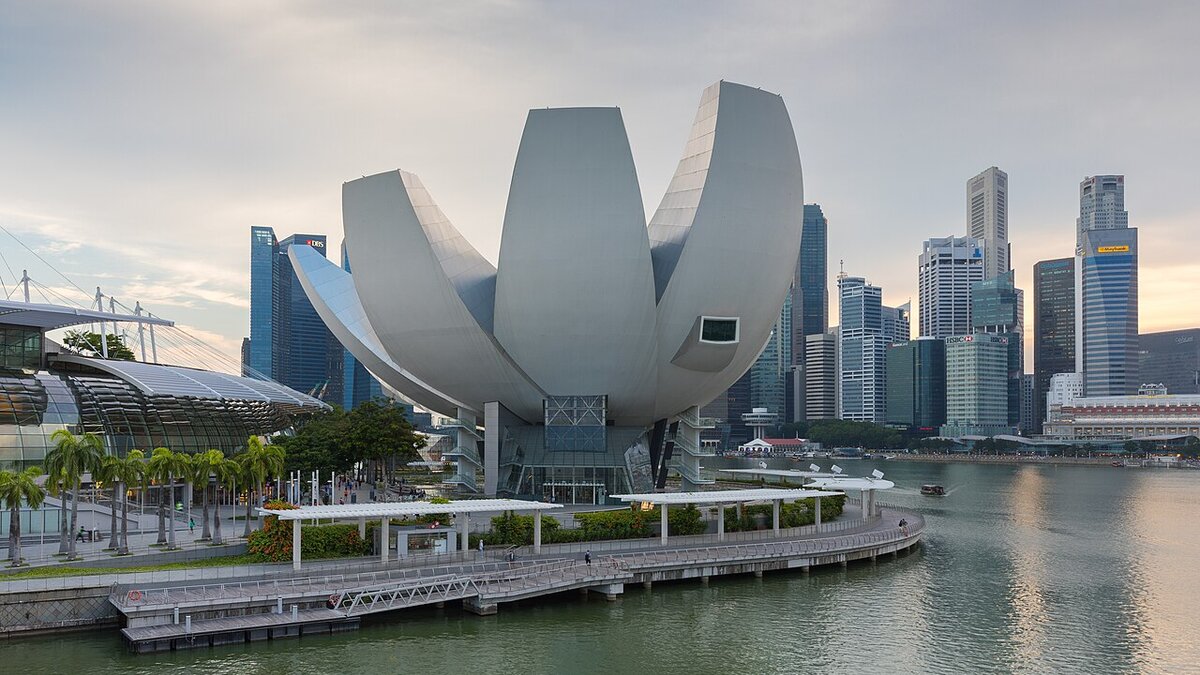
Cover image: The ArtScience Museum and Marina Bay skyline in Singapore, where international visitor arrivals slipped about 2% year-on-year in the first half of 2026. — photo by Basile Morin, CC BY-SA 4.0, via Wikimedia Commons.
Singapore welcomed 1.18 million international visitors in June 2026, down almost 5% year-on-year and the weakest monthly figure of the year so far, according to Singapore Tourism Board (STB) data. That took first-half arrivals to 8.2 million, a decline of about 2% against the same period of 2025 — a wobble for a destination that closed last year with a record 16.9 million visitors and S$32.8 billion in tourism receipts.
The STB is nonetheless holding its full-year forecast of 17 million to 18 million arrivals, while guiding tourism receipts down to S$31 billion to S$32.5 billion — below 2025's record — with chief executive Melissa Ow warning that the board expects "muted demand in the months ahead" and that "global uncertainty will persist", as reported by TTR Weekly. The result is an unusual split screen: softening demand and thinner per-visitor spending on one side, and some of the largest supply-side bets in Asian aviation — Changi Terminal 5 and a record Singapore Airlines (SIA) Europe schedule — on the other.
How bad is Singapore's 2026 tourism slowdown?
Contained, but real. The first quarter actually grew: arrivals rose 3% year-on-year to 4.4 million and tourism receipts climbed 6% to about S$8.6 billion, led by a 23% jump in spending on sightseeing, entertainment and gaming and a 7% rise in shopping, per STB figures. The deterioration came in the second quarter, culminating in June's slide to 1,184,526 arrivals — down from 1.24 million in May and the lowest monthly tally of the year, per official data tracked by Trading Economics.
The board's posture is deliberately cautious rather than alarmed. It set this year's receipts range as a measured call amid economic and geopolitical uncertainty, and has stuck with both the range and the 17–18 million arrivals forecast even as the monthly numbers softened through the second quarter.
| Indicator | Figure | Change / context |
|---|---|---|
| June 2026 arrivals | 1.18 million | -4.9% YoY, lowest month of 2026 |
| H1 2026 arrivals | 8.2 million | About -2% YoY |
| Q1 2026 tourism receipts | ~S$8.6 billion | +6% YoY |
| Mainland China arrivals, H1 | 1.5 million | Largest source market |
| 2026 full-year forecast | 17–18 million | vs 16.9 million in 2025 |
| 2026 receipts forecast | S$31–32.5 billion | vs record S$32.8 billion in 2025 |
Which source markets are holding up — and which are dragging?
Mainland China remained Singapore's largest inbound market with 1.5 million visitors in the first half, followed by Indonesia and Malaysia, per the STB figures. China also leads on spend, topping the first-quarter tourism-receipts table ahead of Indonesia, with long-haul markets such as Australia and the United States punching well above their arrival numbers on yield — exactly the high-value mix Singapore's strategy is built around.
The strain shows elsewhere. A strong Singapore dollar and some of Asia's highest room rates leave the city-state exposed when Japan is running record inbound numbers on a weak yen and Thailand is mounting its own 2026 tourism surge with aggressive visa liberalisation. For regional travellers weighing a short-haul city break, Singapore's premium positioning is a harder sell than it was two years ago.
One bright spot is India. Singapore's fifth-largest source market delivered roughly 247,000 visitors in the first quarter of 2026, according to Markus Tan, the Singapore Tourism Board's regional director for India, Middle East, South Asia and Africa, after tourism receipts from India rose 9 per cent to S$1.62 billion in 2025. Indian travellers spend across retail, accommodation, dining and attractions — and industry reports place them among the biggest spenders on luxury goods in the city-state, bucking a global slowdown in premium retail.
Why is Singapore still betting big on capacity?
Because its planners are pricing a decade, not a quarter. Construction is under way at Changi Terminal 5, designed to handle about 50 million passenger movements a year in its first phase when it opens around the mid-2030s within the 1,080-hectare Changi East development, according to Changi Airport Group. Changi handled record traffic of close to 70 million passengers in 2025.
SIA is expanding into the softness too. By November 2026 the flag carrier will operate a record 134 weekly flights to 15 European airports — 20% more flights and 14% more seats than in June 2024 — including double-daily London Gatwick, a daily Manchester service from July, 10-weekly Munich and a Madrid service returning from October as an extension of the Barcelona route, according to schedule analysis by Mainly Miles. Europe load factors running around 93.5% earlier this year help explain the carrier's confidence.
The near-term economics are unforgiving, though. SIA Group posted a net loss of S$76 million for the quarter ended 30 June 2026 as net fuel costs surged 78.5% and its share of Air India's losses deepened, even on record quarterly revenue of S$5.71 billion, Xinhua reported. That squeeze mirrors the pressure elevated jet fuel costs are putting on airfares across the industry, and helps explain why fare rises have not fully offset fuel — another headwind for price-sensitive inbound demand.
What does Singapore's wobble mean for Southeast Asian tourism?
Singapore is the region's canary. As a hub economy dependent on business travel, stopovers and events, its numbers move early when corporate confidence and long-haul flows weaken — and the state is responding with money rather than markdowns. The STB has committed a fresh S$740 million tranche of the Tourism Development Fund to build new attractions, products and industry capability through the decade.
The strategy is volume-light, yield-heavy: marquee draws such as the Formula 1 Singapore Grand Prix and Disney Cruise Line's Singapore-based Disney Adventure anchor a "Tourism 2040" plan targeting S$47 billion to S$50 billion in annual tourism receipts. For competitors, the lesson cuts both ways: events and premium infrastructure defend spend per visitor, but they do not immunise a high-cost destination against cheaper neighbours in a soft demand year.
Frequently asked questions
How many tourists visited Singapore in the first half of 2026?
Singapore received about 8.2 million international visitors in January–June 2026, down roughly 2% year-on-year, according to Singapore Tourism Board figures. June was the weakest month, with 1.18 million arrivals, a decline of almost 5%.
Will Singapore still hit its 17–18 million arrivals forecast for 2026?
The STB has kept its 17–18 million forecast despite the soft first half, banking on a strong second-half events calendar headlined by the Formula 1 Singapore Grand Prix. Hitting the low end requires roughly 8.8 million second-half arrivals — achievable, since the second half is seasonally stronger, but with little margin for error.
Why are visitors spending less in Singapore in 2026?
The STB projects 2026 tourism receipts of S$31–32.5 billion, below 2025's record S$32.8 billion, citing muted demand and persistent global uncertainty. Competition from cheaper destinations such as Japan and Thailand, a strong Singapore dollar and high room rates are also squeezing discretionary spend.
When will Changi Terminal 5 open?
Changi Airport Group expects Terminal 5 to be operational around the mid-2030s, with capacity for about 50 million passenger movements a year in its first phase. It is being built within the 1,080-hectare Changi East development.
Sources
- TravTalk India — India fifth-largest visitor source market for Singapore: STB
- TTR Weekly — Singapore's resilient tourism faces challenges
- Trading Economics — Singapore tourist arrivals (STB data)
- Xinhua — Singapore Airlines Group posts quarterly loss on higher fuel costs despite record revenue
- Mainly Miles — Singapore Airlines boosts Europe flights
- Changi Airport Group — Terminal 5 project
Related coverage
 World Cup 2026 Tourism Scorecard: Record Crowds, Uneven Hotel Dividend for Host Cities
29 Jul 2026
World Cup 2026 Tourism Scorecard: Record Crowds, Uneven Hotel Dividend for Host Cities
29 Jul 2026
 Europe's Summer of Strikes: French ATC Walkout Grounds 1,500 Flights as Italy and Spain Join In
07 Jul 2026
Europe's Summer of Strikes: French ATC Walkout Grounds 1,500 Flights as Italy and Spain Join In
07 Jul 2026
 World Cup 2026 Knockout Rounds Trigger a Concentrated Travel Surge as the MetLife Final Nears
06 Jul 2026
World Cup 2026 Knockout Rounds Trigger a Concentrated Travel Surge as the MetLife Final Nears
06 Jul 2026


Post a comment